
How Workplace Designer creates alignment, speed, and scale from day one
Most AV projects do not fail because the technology is wrong. They slow down because the process is fragmented. Designs evolve too late, stakeholders are misaligned, approvals drag on, and installers are left reconciling last-minute changes in the field. The result is rework, rising costs, and unnecessary delays.
At BCS Consultants, we see a clear pattern. Projects that begin with a structured design foundation move faster, scale more easily, and deliver consistent results. That is why starting in Workplace Designer from Biamp has become a critical best practice.
Where AV projects lose momentum
In many deployments, design is treated as an afterthought. A concept is sketched, products are selected individually, and documentation is assembled later. Each step introduces interpretation, and each interpretation creates opportunities for misalignment. When IT, facilities, consultants, and integrators all enter the process at different points, even minor changes can trigger major delays.
Without a shared design framework, approvals take longer and revisions multiply.
Design first to eliminate downstream friction
Workplace Designer shifts the starting point of an AV project to where it should be. Instead of disconnected diagrams or spreadsheets, teams begin with a guided, room-specific workflow that aligns layout, technology, and performance requirements from the start.
Designing with intent removes guesswork. What gets approved is what gets deployed, reducing rework and giving all stakeholders confidence in the outcome.
A guided approach that delivers better results
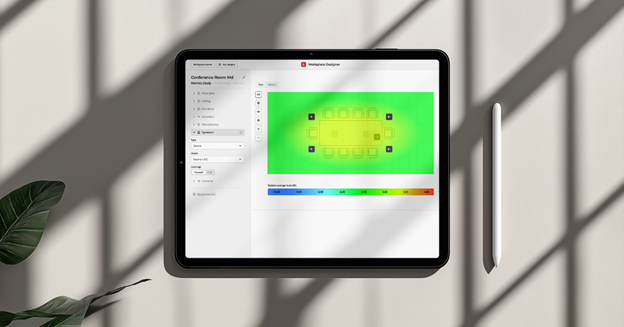
Workplace Designer leads teams through a structured process that supports both technical accuracy and consistency. Users define room size, layout, and use case, apply templates for common space types, receive optimized product recommendations and placements, and visualize system performance and coverage before anything is installed.
This approach ensures designs follow best practices while remaining flexible enough to meet real-world requirements. Teams no longer start from a blank page, and every design decision is documented and repeatable.
Why sound masking must be part of the design conversation
One of the most common gaps in AV planning is acoustic comfort. Even the best collaboration technology underperforms in spaces where speech privacy is compromised and background noise is uncontrolled. Sound masking directly addresses this challenge, but only when it is considered early in the design process.
Incorporating sound masking during the design phase ensures it is properly zoned, evenly distributed, and aligned with room function and occupancy. When sound masking is treated as an afterthought, coverage gaps, inconsistent performance, and occupant dissatisfaction often follow. When it is designed intentionally, it improves focus, protects confidential conversations, and enhances overall workplace comfort without drawing attention to itself.
Workplace Designer allows sound masking to be planned alongside collaboration and paging systems, ensuring acoustic performance supports how the space is actually used. This holistic approach results in environments where technology fades into the background and people can work without distraction.
Built for scale and standardization
For organizations deploying AV across multiple rooms, buildings, or regions, consistency matters as much as performance. Workplace Designer enables standard room types to be created once and reused across sites, eliminating the need to redesign the same space repeatedly.
Standardized templates make it easier to roll out huddle rooms, conference rooms, training spaces, and larger venues with predictable outcomes. Deployment becomes faster, support becomes simpler, and lifecycle management becomes more manageable.
Faster alignment and smoother approvals
Clear design output accelerates decision-making. Workplace Designer makes it easy to share designs with stakeholders, duplicate layouts for similar spaces, and export complete documentation for review.
Visual clarity and standardized deliverables help stakeholders understand the plan quickly, reducing back-and-forth and shortening approval cycles. Projects move forward with fewer bottlenecks and less friction.
From design through the full AV lifecycle
Workplace Designer is not just a planning tool. It connects early design decisions to deployment, management, and long-term optimization. The same logic that defines the room at the beginning supports correct installation, efficient management, and future updates.
This continuity is what turns AV from a one-time install into a scalable, long-term asset.
Start with a stronger foundation
If your goal is fewer revisions, faster approvals, and AV systems that scale without complexity, the answer is not more hardware. It is better design.
At BCS Consultants, we use Workplace Designer to help clients move from concept to deployment with clarity and confidence. The smartest AV projects do not start in the field. They start with a plan.