
For decades, the goal of physical security has been clear: detect, respond, and resolve threats as quickly as possible. But what if the most effective security system didn’t just respond to incidents, but prevented them altogether?
That’s the question driving the latest innovation from Verkada: AI-Powered Deterrence, a new capability that transforms how organizations think about alarms, monitoring, and proactive site protection.
At BCS Consultants, we’re constantly looking for technologies that go beyond the traditional, solutions that don’t just react but anticipate. Verkada’s AI-powered deterrence represents a major leap forward in this direction, combining advanced computer vision, contextual AI, and smart audio communication to deter unwanted activity before an alarm is ever raised.
From Reactive to Proactive: A Shift in Security Mindset
Conventional alarm systems only engage once a perimeter is breached, meaning by the time an alert goes out, damage may already be done. Meanwhile, on-site guards, while effective, come with significant cost and coverage limitations.
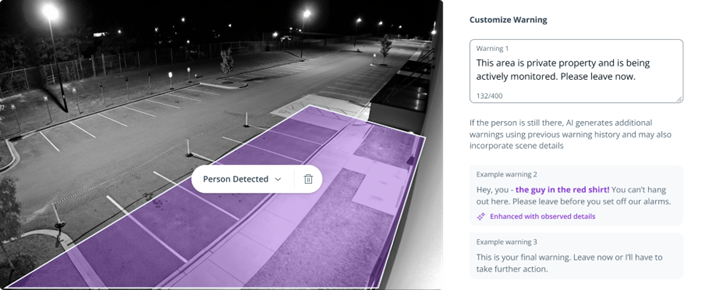
AI-powered deterrence bridges this gap by enabling real-time engagement the moment unusual activity is detected. Using Verkada’s integrated ecosystem of smart cameras and networked talk-down speakers, security systems can now automatically issue escalating, context-aware warnings to potential intruders.
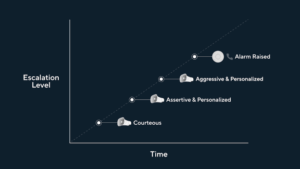
Instead of a single pre-recorded, robotic message, AI-generated deterrence uses dynamic, natural-sounding voice responses that evolve depending on behavior. For instance, if a person lingers after the first warning, the system can deliver increasingly specific messages based on what it “sees”, including clothing descriptions or actions.
This isn’t science fiction, it’s the future of active deterrence made possible through edge AI.
Smarter Deterrence, Fewer False Alarms
One of the biggest challenges in modern monitoring is balancing security sensitivity with operational practicality. Traditional alarms are often triggered by non-threatening movement, a passerby, a delivery driver, or an employee working late. This leads to “alarm fatigue” and unnecessary dispatches.
AI-powered deterrence helps eliminate that inefficiency. By combining visual intelligence and adaptive workflows, the system can first attempt to deter, and only raise an alarm if a person doesn’t respond to repeated warnings.
This layered approach allows businesses to minimize false positives while still maintaining strong coverage. A parking lot, for example, might deter after-hours visitors without generating a flood of alerts every time someone walks by.
It’s smarter, quieter, and more efficient, and it keeps security teams focused on what really matters.
Use Cases That Redefine Site Protection
The versatility of AI-powered deterrence makes it suitable across industries and environments:
- Automotive dealerships can discourage catalytic converter theft or after-hours trespassing without dispatching guards every time a pedestrian passes through.
- Construction sites can secure valuable equipment and materials from theft or vandalism.
- Schools and universities can prevent loitering, graffiti, or other after-hours activity in common areas.
- Corporate campuses can monitor open parking areas or courtyards while reducing false alarms in high-traffic zones.
In each scenario, deterrence workflows can be customized to escalate over time, from an initial warning (“This area is closed. Please leave immediately.”) to more targeted and urgent prompts, eventually triggering alarms, strobe lights, or live talk-downs if needed.
If deterrence fails, the system escalates seamlessly. Monitoring agents can verify live video feeds, confirm the incident, and take appropriate action, whether that’s contacting on-site security, notifying management, or dispatching law enforcement.
Three Powerful Configurations for Real-World Use
AI-powered deterrence is designed with flexibility in mind. Organizations can tailor it to match their site’s layout and risk profile.
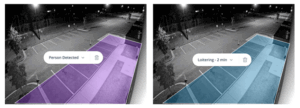
- Prevent Loitering: Trigger deterrence immediately upon detecting a person, and raise an alarm only if loitering continues beyond a set timeframe (e.g., 2 minutes).
- Deter Intrusion: Use deterrence in exterior zones (fences, gates, parking lots) while setting alarm triggers on interior cameras, creating a layered “outer shield.”
- Protect Outdoor Assets: Draw a deterrence region around the perimeter of valuable assets to discourage approach, while an alarm region protects the immediate area.
These setups give security teams granular control over how and when to engage threats, ensuring responses are proportionate, automated, and effective.
Why This Matters for Modern Security Strategies
The evolution of AI deterrence highlights a broader industry trend: the convergence of intelligence, automation, and scalability in physical security systems.
At BCS, we see this as part of a shift toward data-driven site awareness, where cameras, sensors, and network infrastructure all work together to form an adaptive, responsive security fabric.
This type of system not only improves protection but also reduces manual oversight and cost. Every second that a system can act independently, warning an intruder, validating activity, or escalating intelligently, is a second gained for safety and efficiency.
Moreover, AI deterrence isn’t just about preventing intrusions; it’s about building safer, more predictable environments. Businesses gain peace of mind knowing their properties are actively monitored, while communities benefit from reduced incidents and false alarms.
The Next Era of Alarms Begins
As a trusted Verkada partner, BCS Consultants is here to help businesses integrate and optimize these next-generation systems, designing solutions that align with your unique environment, compliance needs, and growth goals.
Whether you’re managing a single facility or a multi-site enterprise, AI-powered deterrence represents a transformative leap toward smarter, safer, and more autonomous security.
Ready to Redefine What Alarms Can Do?
Contact BCS Consultants to learn how AI-driven deterrence and advanced monitoring can elevate your organization’s protection strategy.
You must be logged in to post a comment.