
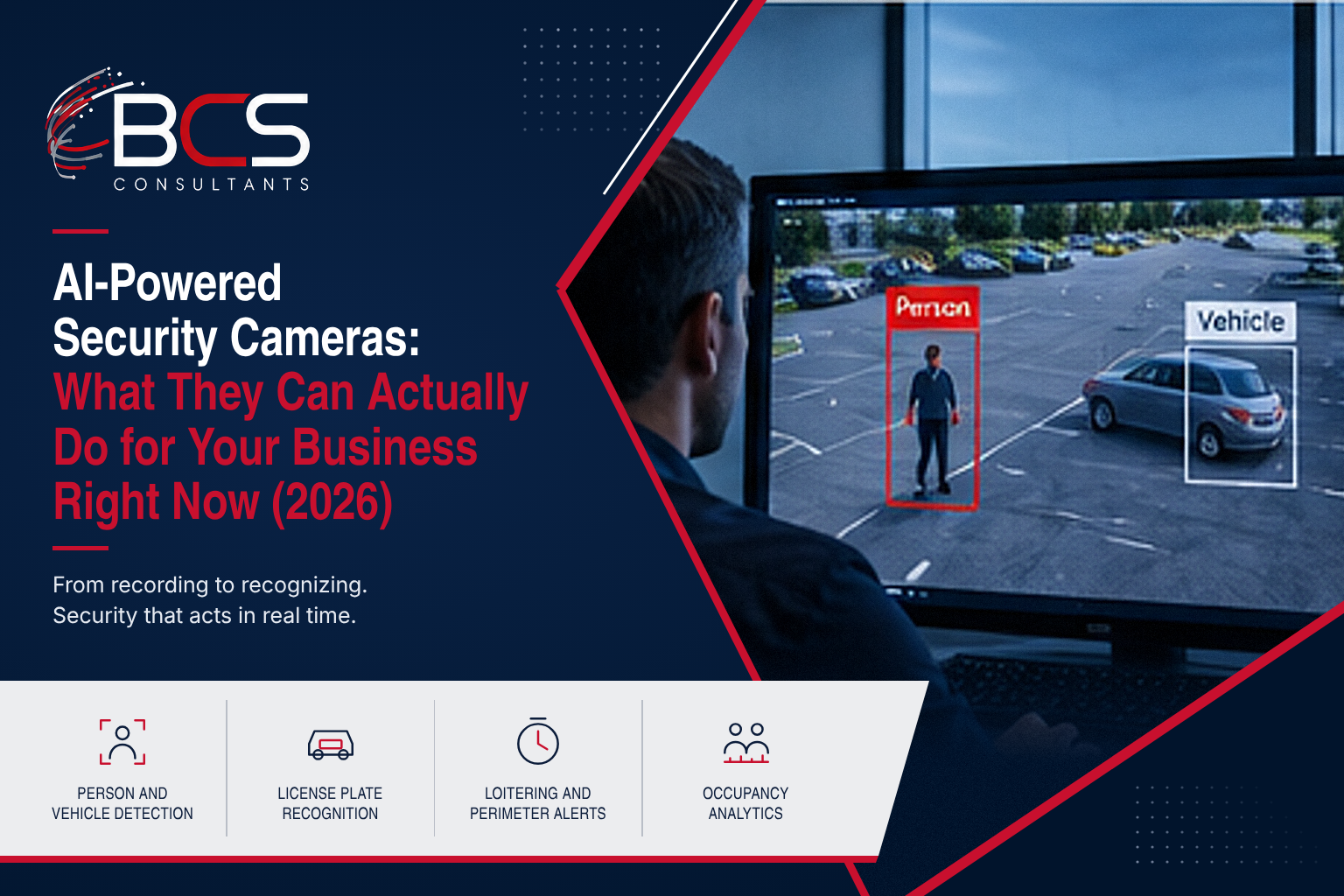
The security camera that simply records what happened is being replaced by the camera that tells you what is happening right now — and alerts you before a situation escalates. AI-powered security cameras are no longer a preview of future technology. They are available in the cameras being installed in commercial buildings today, and the capabilities they offer go far beyond what traditional IP camera systems can provide.
BCS Consultants is a certified Verkada integrator. This guide explains what "AI-powered" actually means for a commercial security camera, the six specific capabilities that AI cameras have today, and how these capabilities change security operations for businesses.
What "AI-Powered" Actually Means for a Commercial Security Camera
Traditional IP cameras capture video and send it to an NVR (network video recorder) or DVR for storage. The camera itself does not analyze the video — it just records. Reviewing footage requires a human to watch recordings, which means security events are discovered after the fact.
AI-powered cameras process video on the camera itself using dedicated AI chips (edge computing). The camera analyzes what it is seeing in real time, classifies objects and behaviors, and generates alerts — without sending the full video to a central server for analysis. This means AI cameras can act on what they see in milliseconds, rather than waiting for a server to process the footage.
6 AI Capabilities Commercial Security Cameras Have Right Now
1. Person Detection
The camera distinguishes people from cars, animals, and other objects, generating alerts only for human presence in defined zones — eliminating the false alarms that make traditional motion detection nearly useless for real security monitoring. False alarm rates for AI person detection are typically 90%+ lower than traditional motion-based detection.
2. Vehicle Detection and License Plate Recognition
The camera identifies and reads license plates — logging entry and exit times, creating searchable vehicle records, and triggering alerts for specific plates (watchlists) or vehicles outside authorized access windows.
3. Dwell Time and Loitering Alerts
The camera detects when a person or vehicle has been stationary in a defined zone for longer than a specified time — enabling proactive response to potential threats rather than reactive review of recorded footage.
4. Perimeter Intrusion Detection
The camera detects when a person crosses a defined virtual line or enters a defined zone during specified hours, triggering alerts before a security event escalates.
5. Occupancy Monitoring and Analytics
The camera counts people in a space over time, generating occupancy data that can be used for space planning, compliance with occupancy limits, and operational analytics.
6. Anomaly and Behavior Detection
Advanced AI cameras detect behaviors that differ from the established pattern for a space — unusual movement patterns, abandoned objects, or crowd formations — that may indicate security concerns.
How AI Changes Security Operations
Traditional security monitoring is reactive: a security event occurs, it is recorded, and it is reviewed — often hours or days later.
AI surveillance is proactive: the system alerts the right people at the moment a defined condition is detected. The security posture shifts from discovering what happened to being informed as it happens.
For organizations that previously relied on recorded footage for post-incident review, AI surveillance provides a meaningful operational improvement without requiring a larger security staff. For organizations with active monitoring, AI surveillance dramatically reduces the volume of false alerts that cause monitoring fatigue.
Privacy and Legal Considerations in California
California's CCPA and California Penal Code §632 establish specific requirements for video surveillance and recording in commercial settings. Organizations deploying AI-enhanced surveillance should ensure: appropriate notices are posted where surveillance is conducted; audio recording (which some AI cameras can capture) is handled in compliance with California's two-party consent law; and facial recognition use (if any) is consistent with applicable regulations. BCS Consultants advises clients on compliant surveillance system design as part of every security system deployment.
Verkada: The AI Surveillance Platform BCS Consultants Deploys
BCS Consultants is a certified Verkada integrator. Verkada cameras include all of the AI capabilities described above — person detection, vehicle detection, license plate recognition, dwell time alerts, and occupancy analytics — as native features of the Verkada platform, with no additional hardware or software licensing required.
How to Evaluate AI Security Camera Vendors: 5 Questions to Ask
Not all AI security camera platforms deliver equal capability. The marketing language surrounding AI in surveillance is expansive — but the actual capabilities, reliability, and integration options vary significantly between vendors. Before investing in an AI-enhanced surveillance deployment, BCS Consultants recommends asking vendors these five questions to cut through the marketing and evaluate real-world performance.
1. Where does the AI processing happen?
There is a critical difference between cameras that process AI on the camera itself (edge processing) and systems that send video to a central server for AI analysis. Edge-processing cameras generate alerts in real time, continue to function during network disruptions, and do not require a dedicated GPU server for AI analysis. Cloud-dependent AI analysis introduces latency — alerts fire seconds after the event, not milliseconds — and creates a single point of failure at the central server. Ask any vendor whether their AI runs on the camera or on a server. The answer determines real-time performance and system reliability under load or network disruption.
2. What is the false positive rate for person detection?
A surveillance system that generates hundreds of false alerts per day trains security staff to ignore alerts — which defeats the purpose of proactive detection. Ask vendors for documented false positive rates for person detection in environments similar to yours. A credible vendor will provide this data. AI person detection from platforms like Verkada achieves false positive rates below 5% in most commercial environments, compared to 30 to 70% false positive rates for traditional motion-based detection systems.
3. How are AI models updated over time?
AI models improve over time as they are trained on more data. On-premise AI systems typically require manual software updates to receive model improvements, creating a maintenance burden and a lag between model improvements and deployment. Cloud-based platforms like Verkada push AI model updates automatically to all cameras in the network — your cameras become more capable over time without any action on your part and without the patching lag that affects on-premise AI systems.
4. What integrations are available with other systems?
The value of AI surveillance increases significantly when it integrates with complementary systems — access control (see the person associated with a door event), visitor management (verify visitor identities against watchlists), and incident management platforms. Ask vendors for documented integration options and whether those integrations require additional licensing or custom development. Verkada platform integrates natively with Verkada access control and offers an open API for third-party integrations, enabling BCS Consultants to build connected security ecosystems rather than isolated point solutions.
Frequently Asked Questions
Are AI security cameras more expensive than regular IP cameras?
AI-capable commercial cameras typically cost 30–80% more than comparable non-AI IP cameras. However, the total system cost savings — from eliminating or reducing the NVR, reducing false alarms, and reducing the labor cost of post-incident review — often offset the hardware premium. BCS Consultants can provide a TCO comparison for your specific installation.
Can AI cameras alert me before something bad happens?
Yes, through proactive alerts. A defined virtual perimeter triggers an alert when crossed. A dwell time alert fires when someone has been stationary in a zone for longer than a specified time. A loitering alert can be configured for parking lots, entry points, or other sensitive areas. These alerts fire before a security incident escalates.
Do AI cameras require a cloud subscription?
Most commercial AI camera platforms, including Verkada, require a cloud subscription for management, remote access, and cloud storage. On-camera storage provides local backup for a defined retention period. The cloud subscription provides unlimited retention, remote access, and ongoing AI model updates.
How is Verkada different from traditional IP camera systems?
Traditional IP cameras require an on-site NVR, manual firmware updates, VPN for remote access, and separate software for video management and analytics. Verkada cameras include on-board storage and AI processing, sync to the cloud automatically, are managed through a browser-based platform from anywhere, and include AI analytics as native features.
Explore AI-Powered Surveillance with BCS Consultants
BCS Consultants installs AI-powered surveillance systems featuring Verkada's cloud platform and advanced analytics for businesses of all sizes across Southern California and nationally.
→ Explore AI-Powered Surveillance Solutions: https://www.bcsconsultants.com/solutions/security/surveillance/
📞 Talk to a BCS Consultants Specialist: https://www.bcsconsultants.com/contact/contact-us/