
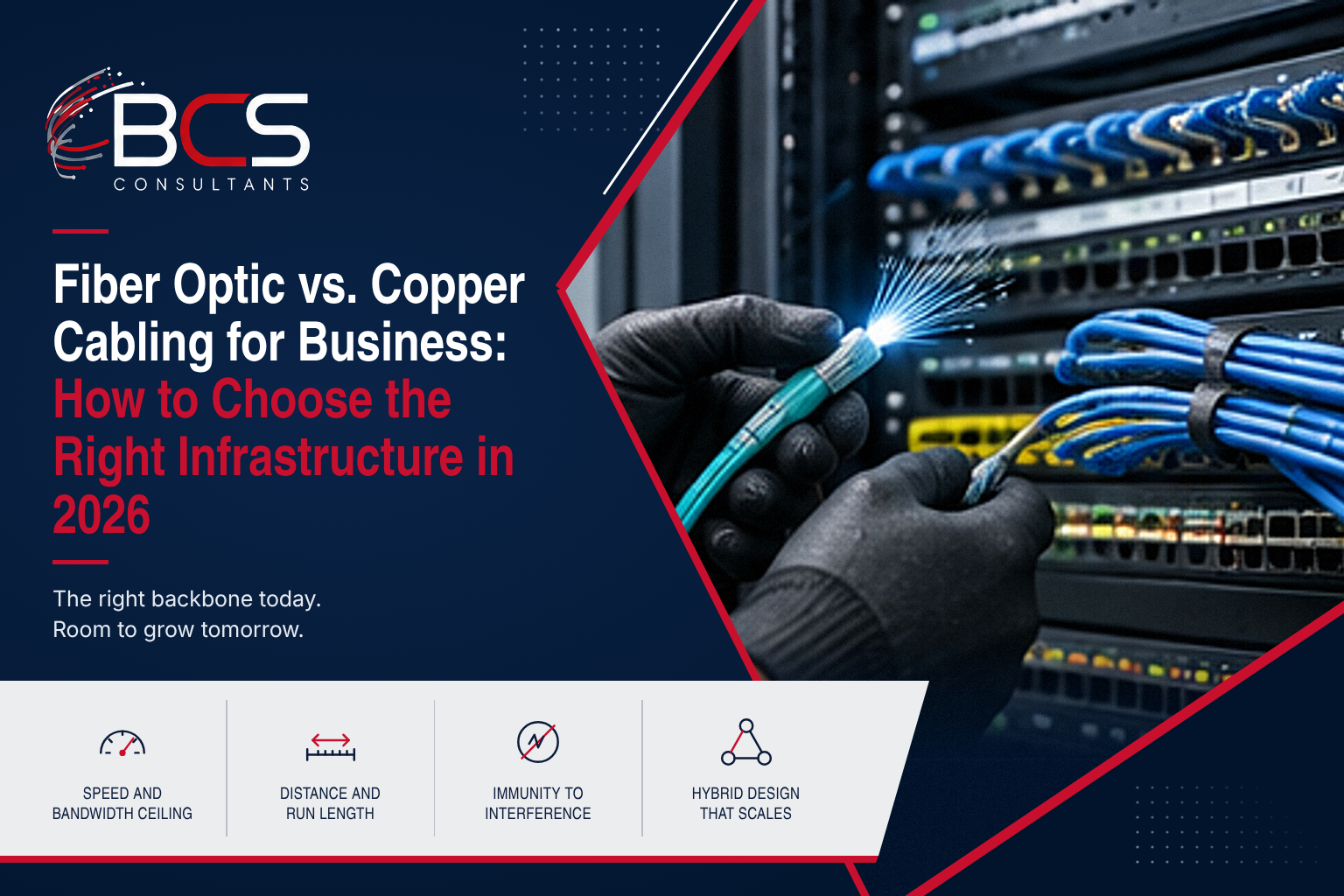
The cabling decision you make during a new office build or network upgrade will determine your infrastructure capacity for the next 15 to 25 years. Structured cabling is not a commodity — it is the foundation on which everything in your building communicates. Getting the fiber vs. copper decision right from the start avoids expensive remediation later.
BCS Consultants is an RCDD-certified structured cabling integrator serving commercial clients across Southern California. This guide explains the technical differences, cost realities, and use-case-by-use-case recommendation for fiber vs. copper in commercial environments.
How Fiber Optic and Copper Cabling Work Differently
Copper cabling (Cat6A is the current standard for most commercial installations) transmits data as electrical signals over twisted copper wire pairs. It is subject to electromagnetic interference (EMI), has distance limitations, and generates heat under high utilization.
Fiber optic cabling transmits data as pulses of light through glass or plastic fibers. It is immune to electromagnetic interference, supports much greater distances without signal degradation, and has virtually unlimited bandwidth potential as optical technology advances. A fiber cable installed today can support significantly higher data rates in the future simply by upgrading the transceivers at each end — the physical fiber does not change.
Performance Comparison: Fiber vs. Copper
Speed
Cat6A supports 10 Gbps up to 100 meters. Single-mode fiber supports 100 Gbps and beyond at distances exceeding 40 kilometers.
Distance
Cat6A: 100 meters maximum for 10 Gbps. Multimode fiber: 300–550 meters for 10 Gbps. Single-mode fiber: kilometers.
Bandwidth Ceiling
Cat6A is approaching its practical limit. Fiber's bandwidth ceiling is determined by transceiver technology, not the physical medium — meaning fiber installed today is future-proof in a way copper is not.
EMI Interference Resistance
Copper is susceptible to EMI from motors, HVAC systems, and other electrical sources. Fiber is completely immune — critical in industrial, healthcare, and manufacturing environments.
Latency
Fiber transmits at approximately 200,000 km/s (speed of light in glass). Copper transmission speed is roughly 60–70% of fiber. For most commercial applications the difference is imperceptible, but it matters for high-frequency trading, real-time video production, and latency-sensitive enterprise applications.
Cost Analysis: Installation vs. 5-Year TCO
Fiber optic cable and termination costs more per foot to install than Cat6A, primarily because of higher material costs and the precision required for fiber splicing and termination. However, when you factor in the 5-year total cost of ownership — including the ability to upgrade to higher speeds without recabling, the elimination of copper theft risk, and lower power consumption in high-density installations — fiber frequently delivers better long-term economics.
BCS Consultants provides structured cabling proposals with full 5-year TCO analysis so that clients can make decisions based on total investment, not just installation cost.
Use Case Guide: Which to Choose by Space Type
Server Room and Data Center Backbone
Single-mode fiber. No debate. The bandwidth capacity, distance capability, and future-proofing justify the cost premium. BCS Consultants installs fiber backbone in compliance with ANSI/TIA-942.
Campus Backbone (Building to Building)
Single-mode fiber. Copper cannot support inter-building runs without repeaters.
Horizontal Runs (Desk to Patch Panel, ≤100m)
Cat6A is typically sufficient and more cost-effective for desktop and access point connections. Fiber to the desk adds cost without benefit for most commercial workloads.
Warehouse and Industrial Environments
Fiber strongly preferred due to EMI immunity and longer run distances between access points. BCS Consultants has completed structured cabling installations in distribution centers and manufacturing facilities throughout Southern California.
The Hybrid Architecture: What BCS Consultants Recommends
Most modern commercial installations use a hybrid architecture: fiber backbone from the main distribution frame (MDF) to intermediate distribution frames (IDFs) on each floor or zone, with Cat6A horizontal runs from IDFs to workstations, access points, and devices. This provides the distance and bandwidth capacity of fiber where it matters most, with the cost efficiency of copper for shorter horizontal runs.
BCS Consultants designs hybrid fiber/copper structured cabling systems for office buildings, medical facilities, and multi-building campuses. Our RCDD-certified engineers produce a full set of as-built documentation for every installation.
How to Spec the Right Fiber Type for Your Application
Not all fiber is the same. The two primary categories — single-mode fiber (SMF) and multimode fiber (MMF) — have different performance characteristics, different cost profiles, and different appropriate applications. Choosing the wrong type adds cost without adding capability.
Single-Mode Fiber (SMF)
Single-mode fiber has a very small core diameter (8 to 10 microns) that allows only a single light path to propagate. This eliminates modal dispersion, allowing single-mode fiber to carry signals over much greater distances with much higher bandwidth potential than multimode fiber. Single-mode fiber is the right choice for building-to-building backbone runs, data center interconnects, and any run exceeding 300 meters. The transceivers required for single-mode fiber are more expensive than multimode transceivers, which is the primary cost trade-off. However, because the fiber itself can be upgraded simply by changing transceivers at each end, single-mode infrastructure installed today can support dramatically higher speeds in the future.
Multimode Fiber (OM3, OM4, OM5)
Multimode fiber has a larger core diameter (50 to 62.5 microns) that allows multiple light paths to propagate simultaneously. This introduces modal dispersion that limits both distance and maximum data rate. OM4 multimode fiber supports 10 Gbps up to 400 meters and 40/100 Gbps at shorter distances. OM5 (wideband multimode) extends these capabilities further. Multimode fiber is appropriate for shorter runs within a building — typically floor-to-floor backbone within a single building where runs are under 300 meters. Multimode transceivers are significantly less expensive than single-mode transceivers, which is the primary reason multimode is still specified for appropriate short-distance applications.
When to Use Each Type
BCS Consultants specifies single-mode fiber for inter-building campus backbone runs, data center backbone, and any run exceeding 300 meters. BCS Consultants specifies multimode fiber (OM4 minimum) for intra-building backbone runs under 300 meters where cost is a primary consideration. For most commercial office building deployments, the backbone runs between the MDF and IDF closets are short enough that either type works — but single-mode is increasingly preferred even for shorter runs because the cost differential has narrowed and future-proofing justifies the modest premium.
Frequently Asked Questions
Is fiber optic faster than Cat6A?
Yes, significantly. Cat6A supports 10 Gbps up to 100 meters. Multimode fiber supports 40–100 Gbps in the same distance range. Single-mode fiber supports 100 Gbps and beyond at distances far exceeding copper's limits.
How much does fiber optic installation cost for an office?
Fiber installation typically costs 20–40% more per run than Cat6A due to higher material costs and precision termination requirements. The premium is most justifiable for backbone infrastructure, long runs, and environments requiring EMI immunity or future bandwidth growth. BCS Consultants provides project-specific proposals.
What is the maximum distance for Cat6A vs. fiber?
Cat6A: 100 meters for 10 Gbps. Multimode fiber (OM4): 400 meters for 40 Gbps. Single-mode fiber: 40+ kilometers for 100 Gbps with appropriate transceivers.
When should I upgrade from copper to fiber?
Consider upgrading when: your current bandwidth is consistently at 70%+ utilization; you are expanding to multiple buildings or floors; your environment has significant EMI; or you are planning for 25 Gbps or higher speeds in the next 5 years.
Why Structured Cabling Standards Matter for Your Investment
All BCS Consultants structured cabling installations are designed and documented to ANSI/TIA-568 standards — the industry baseline for commercial cabling system performance. Standardized installations qualify for manufacturer system warranties that cover the entire channel (cable, connectors, and patch cords) for 25 years, not just the cable itself. BCS Consultants provides complete as-built documentation after every installation: the floor plan showing cable routes and outlet locations, the cable schedule mapping each outlet to its patch panel port, and the test reports confirming that every link meets or exceeds TIA category performance specifications. This documentation is the foundation for every future move, add, or change your facilities team will make in the space.
Work With BCS Consultants on Your Cabling Infrastructure
BCS Consultants is an RCDD-certified structured cabling integrator. Our engineers help commercial clients design the right fiber/copper mix for their specific buildings, budgets, and growth plans — backed by full documentation and ANSI/TIA-568 compliance.
→ Get a Cabling Infrastructure Assessment: https://www.bcsconsultants.com/solutions/structured-cabling/fiber-optics/
📞 Talk to a BCS Consultants Specialist: https://www.bcsconsultants.com/contact/contact-us/