
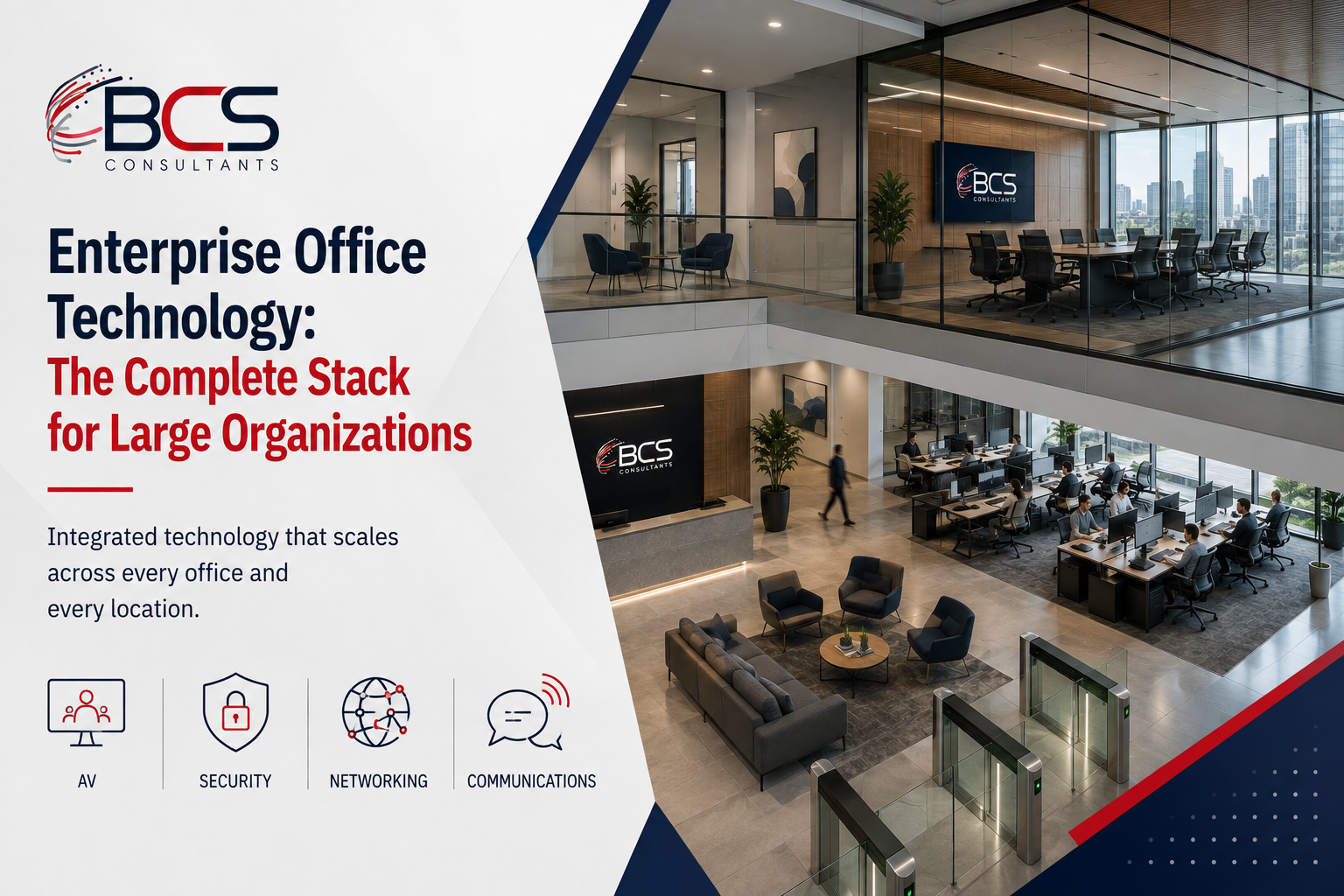
Enterprise organizations face a version of the office technology challenge that differs from what a small or mid-sized business encounters — not just in scale, but in complexity. When you are designing technology infrastructure for multiple floors in a single building, multiple buildings on a campus, or dozens or hundreds of locations across a region or nationally, the decisions made at the design phase have consequences that compound across every site.
This guide covers what a complete enterprise office technology stack looks like — the systems that large organizations need to plan and manage together rather than in isolation — and how BCS Consultants approaches enterprise technology projects.
The Enterprise Technology Stack
Layer 1: Structured Cabling Infrastructure
Enterprise cabling infrastructure starts with the network architecture: main distribution frame location, intermediate distribution frame locations on each floor or in each building, backbone pathways between them, and horizontal cabling from each IDF to every endpoint in the building.
For enterprise organizations, the cabling standard matters more than for smaller deployments because the scale of the investment means that under-specification today creates expensive remediation costs at scale tomorrow. Cat6A as the horizontal standard, OM4 or OM5 fiber for intra-building backbone, and single-mode OS2 for inter-building campus connections is the current enterprise standard that Consultants specifies for all new enterprise cabling projects.
Enterprise cabling projects also require a documentation standard that survives staff turnover. BCS Consultants delivers every enterprise cabling project with as-built drawings, patch panel schedules, and Fluke DSX certification reports for every run — the documentation that allows any qualified network engineer to understand the cabling infrastructure without calling the original installer.
Layer 2: Enterprise Wireless Infrastructure
Enterprise wireless for large organizations involves centralized management of potentially hundreds of access points across multiple floors and buildings. Cloud-managed platforms from Cisco Meraki and Aruba provide a single management dashboard that shows every access point in every location, with consistent monitoring, firmware management, and configuration capability.
For enterprise organizations with multiple geographic locations, the wireless infrastructure at each site must meet a consistent performance standard — device density planning, predictive survey methodology, and AP specification should all be standardized across the portfolio. BCS Consultants develops enterprise wireless standards for multi-location organizations and manages deployments to that standard across all sites.
Guest wireless, IoT device segmentation, and corporate device security policies that enforce authentication and traffic isolation are enterprise-specific requirements that BCS Consultants designs into the wireless architecture from the beginning rather than addressing as afterthoughts.
Layer 3: Video Conferencing and Collaboration
Enterprise video conferencing infrastructure involves deploying certified conference room systems — Microsoft Teams Rooms or Zoom Rooms certified hardware — across every room type in the portfolio, with a consistent AV standard for each room tier (huddle room, medium conference, large conference, boardroom) and centralized management through the platform's admin console.
The room inventory challenge at enterprise scale: an organization with twenty floors and multiple meeting rooms per floor may have hundreds of conference rooms. Deploying consistent, certified systems across that portfolio requires a standardized specification, a procurement and logistics capability, and an installation team that can execute across the full portfolio efficiently.
BCS's national rollout deployment capability means we have the project management infrastructure to deploy conference room systems across large building portfolios and multi-location organizations with consistent quality and documentation at every site.
Layer 4: Physical Security
Enterprise physical security integrates surveillance, access control, and alarm systems across the full property portfolio under centralized management. Cloud-based platforms like Verkada allow security administrators to view footage and manage access control from any location for every site in the portfolio.
For enterprise organizations, physical security also involves compliance considerations that do not apply at smaller scale: data retention requirements for certain industries, NDAA compliance for government-adjacent organizations, and integration with enterprise identity management platforms (Active Directory, Azure AD) for access control credential provisioning.
Layer 5: Communications Infrastructure
Enterprise communications infrastructure — the UCaaS platform, the certified room hardware, the network QoS configuration that supports voice and video — all runs on top of the cabling and wireless layers. The performance of the communications layer is entirely dependent on the quality of the infrastructure beneath it.
Enterprise organizations that deploy Microsoft Teams or Cisco Webex at scale without adequate network infrastructure — insufficient bandwidth, no QoS configuration, wireless that cannot handle the density of simultaneous video calls — consistently report poor user experience that is attributed to the platform but is actually an infrastructure problem.
Why Enterprise Organizations Choose BCS
BCS Consultants handles every layer of the enterprise technology stack in a single integrated project — not as separate scopes managed by separate vendors. This approach eliminates the coordination failures, accountability gaps, and integration surprises that multi-vendor enterprise technology projects consistently produce.
Our national deployment capability allows enterprise organizations with geographically distributed real estate to establish a technology standard and deploy it consistently across every location, with BCS Consultants managing the project from specification through installation and documentation at every site.
Frequently Asked Questions
Does BCS have capacity for large enterprise projects?
Yes. BCS Consultants has project management and field deployment infrastructure for enterprise-scale projects across our service regions and nationally through our rollout deployment model. We have managed deployments across dozens of concurrent sites for enterprise clients.
How does BCS Consultants coordinate with enterprise IT teams?
BCS Consultants works alongside internal IT teams on every enterprise project — coordinating network architecture decisions, providing equipment specifications for IT procurement review, documenting all configurations, and handing off every system with training and documentation appropriate for internal IT management.
What is BCS's geographic coverage for enterprise projects?
BCS Consultants is headquartered in Irvine, California with operations in Arizona, Ohio, and Oregon. National rollout projects are managed from BCS's project management team and executed using qualified subcontractors and BCS Consultants field teams depending on the project location and scope.
Ready to get started? Talk to BCS Consultant about your enterprise technology project.
