
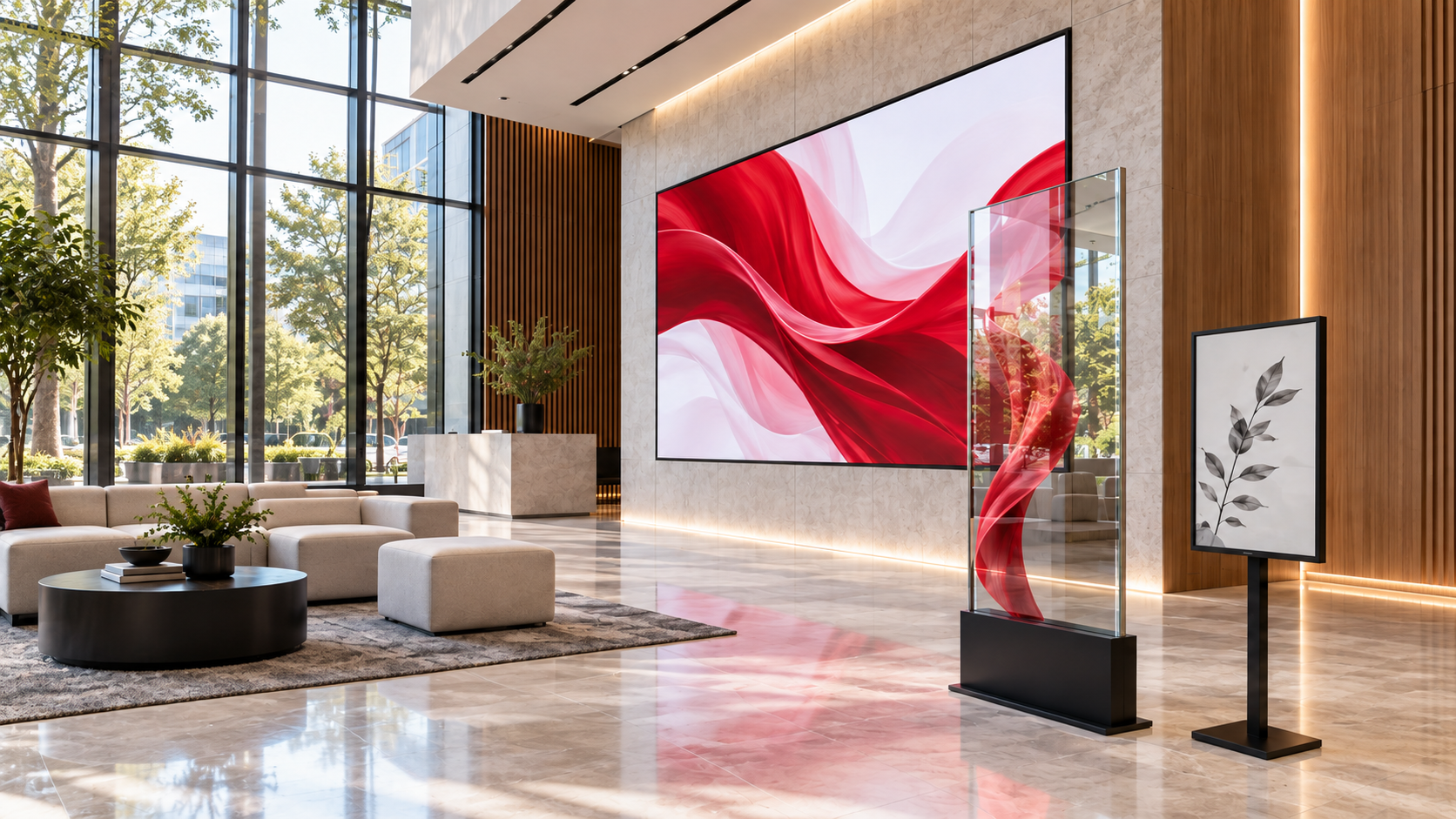
Commercial display technology is evolving beyond conventional screens. Displays are becoming easier to deploy, more energy-efficient, more adaptable to their surroundings, and simpler to manage across multiple locations.
LG’s Q3 2026 partner update highlights several developments that reflect this shift, including expanded direct-view LED options, transparent OLED applications, ultra-low-power e-paper signage, cloud-managed hospitality technology, and business devices built for hybrid work.
For organizations evaluating these technologies, the important question is not simply what is new. It is where each solution delivers practical value and how it should be integrated into the larger technology environment.
Direct-View LED Is Becoming More Accessible to Enterprise Environments
Direct-view LED was once associated primarily with stadiums, broadcast studios, and major public venues. New product formats are making the technology more practical for corporate conference rooms, auditoriums, control centers, retail environments, and executive briefing centers.
LG expanded its MAGNIT portfolio for 2026 with five display solutions designed for different performance requirements, applications, and budgets. The lineup includes modular Micro LED systems and all-in-one configurations intended to simplify deployment.
The new MAGNIT Gen 2 incorporates improvements such as deeper black levels, enhanced grayscale performance, 120Hz refresh-rate support, front-access alignment, and optical-fiber connectivity. LG’s new MAGNIT Essential introduces a 1.25-millimeter pixel pitch, front-service access, a slim cabinet, and a larger-module design intended to reduce installation complexity. LG’s InfoComm 2026 announcement provides more information about the expanded portfolio.
For organizations considering direct-view LED, display selection should be based on more than screen size. Important factors include:
- Viewing distance and pixel pitch
- Ambient lighting
- Content resolution and format
- Wall structure and service access
- Signal distribution
- Control-system integration
- Heat management
- Long-term maintenance requirements
An impressive display can still produce a disappointing experience when the room, infrastructure, and content strategy are not designed around it.
Transparent Displays Are Creating New Customer Experiences
Another highlight from LG’s newsletter is an AI-enabled transparent concierge kiosk developed by Glass-Media using a 55-inch LG Transparent OLED commercial display.
The kiosk combines transparent display technology with a camera and conversational AI interface. It is designed to welcome visitors, answer questions, provide directions, and support multilingual interactions. Kiosk Marketplace’s report describes the solution as a customer-engagement platform rather than a conventional information screen.
This distinction matters. Transparent displays allow digital content to appear within a physical environment without completely obstructing products, architecture, or activity behind the screen.
Potential applications include:
- Corporate lobby concierge systems
- Retail product showcases
- Museum and exhibit interpretation
- Hospitality guest services
- Campus wayfinding
- Interactive brand experiences
However, transparent displays are not appropriate for every space. Their effectiveness depends on lighting, background conditions, viewing angles, content design, and the intended interaction. The display must be treated as part of the physical environment, not simply mounted wherever an ordinary screen would have been installed.
E-Paper Offers an Alternative to Printed and Conventional Digital Signage
LG has also introduced a 32-inch e-paper display designed for commercial spaces. The QHD screen uses electronic ink technology and consumes power primarily when its content changes.
According to LG’s product announcement, the display includes a 72Wh battery, weighs approximately 3.1 kilograms with the battery installed, and measures 8.6 millimeters at its thinnest point. It can be managed through LG’s webOS platform, while SuperSign CMS supports content distribution across multiple units.
This format could be particularly useful for information that changes periodically rather than continuously, including:
- Restaurant menus
- Retail promotions
- Meeting and event schedules
- Directional signage
- Employee communications
- Campus notices
- Hotel information displays
E-paper can reduce the need to print, distribute, install, and remove temporary signage. Its lightweight construction also creates installation opportunities in areas where adding power and data infrastructure for a conventional display may be difficult.
It is important to recognize the limitations. E-paper does not replace bright, motion-based digital signage for every application. It is most effective when organizations need readable, largely static content with low power consumption and flexible placement.
Cloud Management Is Reshaping Hospitality Technology
LG’s Pro:Centric Cloud reflects a broader move away from isolated, property-level systems toward centralized technology management.
The cloud-native hospitality platform allows operators to remotely manage television content, services, software updates, and system performance without maintaining a dedicated server at every property. It is also designed to support scalable management across hotel portfolios.
For hospitality organizations, centralized management can provide several operational benefits:
- More consistent guest experiences
- Faster content and service updates
- Less dependence on on-site technical resources
- Central visibility across multiple properties
- Easier expansion as locations are added
- Reduced on-premises infrastructure
LG introduced the platform to the United States at HITEC 2026. Additional details are available in LG’s Pro:Centric Cloud announcement.
The move to cloud management does not eliminate the need for careful planning. Network readiness, device compatibility, account structure, security, support responsibilities, and property standards must still be defined before deployment.
Business Devices Must Support Work Across Multiple Environments
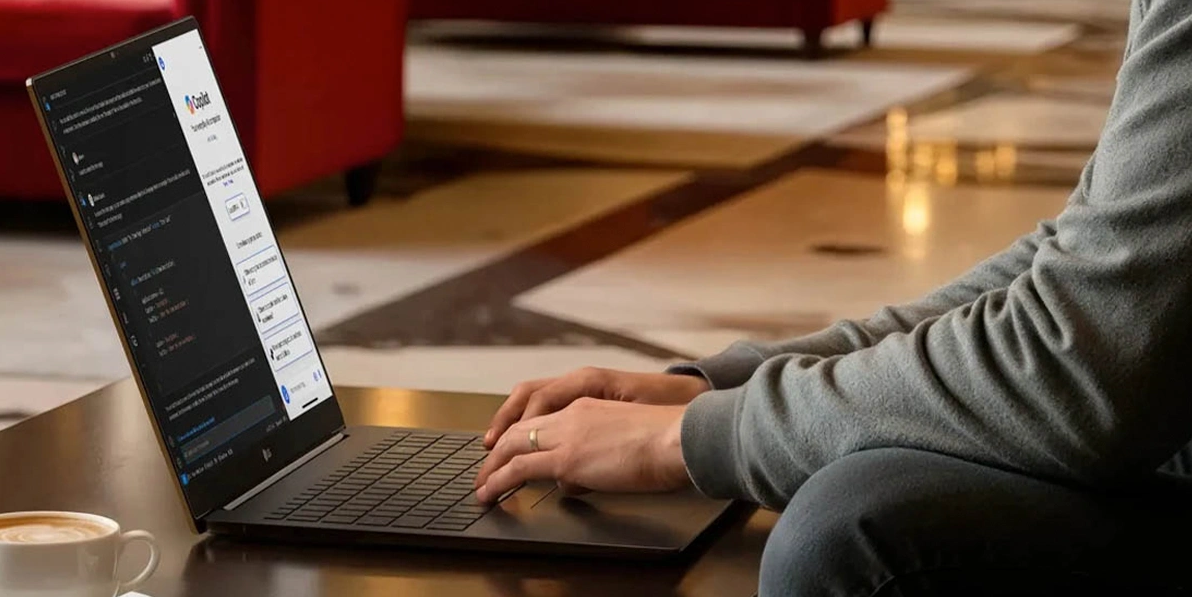
LG’s partner update also featured its 2026 gram business laptop lineup, developed for mobile and hybrid work.
The portfolio includes LG gram Pro, gram Pro 2-in-1, gram, and gram Book models for different professional workflows. Depending on the model, capabilities include Intel Core Ultra or AMD Ryzen AI processors, TPM 2.0 encryption, facial-recognition authentication, AI processing, and MIL-STD-810H-tested durability.
These devices are intended to support workflows such as collaboration, multitasking, live meeting transcription, and background-noise reduction. LG’s business laptop overview outlines the available portfolio.
For IT leaders, the broader lesson is that the endpoint and the room can no longer be planned separately. A mobile employee may move between a home office, huddle room, conference room, customer site, and airport during the same workday. Devices, collaboration platforms, displays, wireless presentation systems, networks, and room controls must work together consistently.
Sustainability Is Becoming Part of Technology Planning
Energy use and lifecycle impact are increasingly important considerations in technology procurement.
LG reported recognition across several design and sustainability programs in its Q3 update. The company received 27 honors at the 2026 Red Dot Design Award, including a Best of the Best distinction.
For commercial technology buyers, awards are less important than the design principles they may represent. Products that are easier to install, manage, update, and maintain can reduce operational friction over their service life.
The introduction of ultra-low-power e-paper also illustrates how sustainability can be addressed through application-specific technology selection. The most effective solution is not always the brightest or most powerful display. It is the technology that meets the communication requirement without adding unnecessary energy use, infrastructure, or maintenance.
Product Innovation Still Requires Thoughtful System Design
LG’s latest developments create compelling possibilities for corporate, retail, hospitality, education, and public environments. However, selecting a product is only one part of creating a successful system.
The complete design must consider:
- What users need to accomplish
- How the technology fits the physical space
- Whether the existing network and electrical infrastructure can support it
- How content will be created and managed
- How the system will integrate with other platforms
- Who will monitor and maintain it
- Whether the solution can be standardized across additional locations
BCS Consultants works with organizations to evaluate these requirements before specifying equipment. As an LG partner and experienced technology integrator, BCS helps clients connect product capabilities to practical business outcomes through system design, infrastructure planning, installation, configuration, commissioning, and ongoing support.
The goal is not to install technology simply because it is new. The goal is to build an environment that communicates more effectively, operates more efficiently, and remains manageable over time.
Planning a commercial display, digital signage, hospitality, or workplace technology project?
Contact BCS Consultants to discuss the right solution for your space and organization.
You must be logged in to post a comment.