
Cisco Meraki and Aruba (HPE) are the two dominant enterprise wireless platforms, and most organizations that are serious about enterprise WiFi end up evaluating both. The right choice depends on your environment, your existing infrastructure, your IT team's preferences, and the specific performance requirements of your applications.
This guide explains what makes the Aruba platform distinctive, where it performs best, and how BCS Consultants approaches Aruba wireless deployments.
What Is the Aruba Platform?
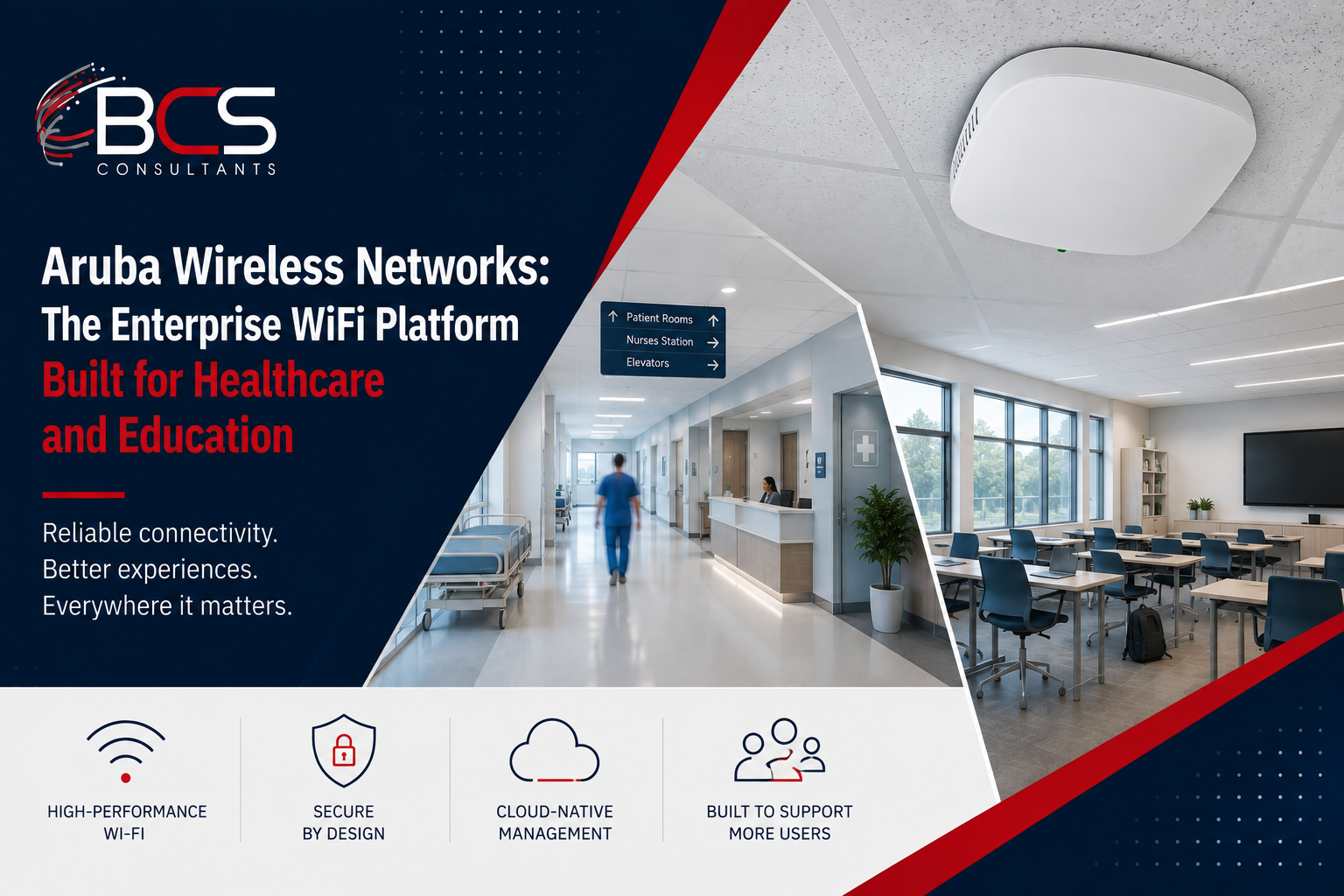
Aruba Networks, now part of Hewlett Packard Enterprise (HPE), is a leading enterprise networking company whose wireless access points, switches, and network management platforms are deployed extensively in higher education, healthcare, government, and large enterprise environments.
Aruba Central is the cloud-based management platform for Aruba wireless, switches, and SD-WAN infrastructure — the equivalent of Cisco Meraki's Dashboard. Like Meraki, Aruba Central provides a single-pane-of-glass view of the entire network infrastructure, automated firmware management, and AI-powered insights through AIOps.
AIOps is Aruba's AI-driven network intelligence layer. It continuously analyzes network performance data across all connected devices, identifies anomalies and degradation patterns before they affect users, and surfaces specific recommended actions. For IT teams managing large wireless deployments, AIOps reduces the reactive troubleshooting burden by identifying and often resolving performance issues automatically.
The Aruba AP-500 and AP-600 Series
Aruba's current-generation access points center on the AP-500 and AP-600 series, both supporting Wi-Fi 6 (802.11ax) as the baseline standard.
The AP-515 is Aruba's standard enterprise indoor access point, supporting dual-band 2.4GHz and 5GHz operation with MU-MIMO and BSS Coloring for reduced co-channel interference in high-density environments. It is the recommended specification for general office environments, healthcare facilities, and educational spaces with standard device density.
The AP-635 adds a third 6GHz radio (Wi-Fi 6E), providing the additional spectrum that high-density environments need to accommodate the growing number of Wi-Fi 6E capable devices. For facilities deploying or planning to deploy Wi-Fi 6E client devices — newer laptops, mobile devices, and IoT endpoints — the AP-635 provides the spectrum headroom to support them.
The AP-655 is Aruba's high-density access point, designed for environments where a very large number of devices are concentrated in a single area — auditoriums, lecture halls, conference centers, and dense open-plan workspaces. Its multi-radio architecture and advanced interference management make it the appropriate specification when standard enterprise access points would be overwhelmed by the client load.
For outdoor environments, the AP-577 provides weatherproof coverage for campuses, outdoor dining areas, athletic facilities, and building exteriors with the same Aruba Central management as indoor devices.
ClearPass Policy Manager: Zero-Trust Network Access
One of Aruba's significant differentiators in healthcare, government, and enterprise security-sensitive environments is ClearPass Policy Manager — Aruba's network access control (NAC) solution. ClearPass provides policy-based authentication and authorization for every device that attempts to connect to the network, regardless of whether it connects via wireless or wired infrastructure.
ClearPass enforces zero-trust network access principles: every device is authenticated before being granted network access, and access is granted only to the specific resources the device and user are authorized to reach based on device type, user identity, health status, and location. For healthcare organizations managing a mix of clinical workstations, medical devices, staff personal devices, and guest networks, ClearPass provides the granular policy control that simpler VLAN-based segmentation cannot achieve.
When Aruba Is the Better Choice
Aruba and Cisco Meraki are comparable in overall capability, but there are specific scenarios where Aruba consistently emerges as the better fit.
Existing HPE/Aruba infrastructure: Organizations already running HPE switches or Aruba access points in part of their network benefit from extending the Aruba platform rather than introducing a second vendor ecosystem.
Healthcare environments: Aruba's strong integration with healthcare-specific systems — electronic medical record platforms, clinical device management systems, and the ClearPass policy framework for HIPAA-compliant network segmentation — makes it the preference for many healthcare IT teams.
Government and regulated industries: Aruba's certifications for government security standards (FIPS 140-2, Common Criteria) and its track record in federal and state government deployments make it a strong choice for regulated environments.
On-premise controller preference: Unlike Meraki, which is cloud-only, Aruba supports both cloud management through Aruba Central and on-premise controller deployment through Aruba Mobility Conductor. Organizations that require all network management infrastructure to remain on-premise have an option with Aruba that Meraki does not provide.
How BCS Consultants Deploys Aruba Wireless Networks
BCS Consultants' Aruba deployment process mirrors our Cisco Meraki process: we begin with a predictive wireless survey using Ekahau AI Pro, produce a deployment plan specifying AP models, placement positions, and channel assignments, manage hardware procurement through our Aruba distribution relationship, and execute installation with post-deployment validation.
For healthcare clients, BCS Consultants designs the network segmentation architecture — including ClearPass policy definition for clinical device categories, staff and guest network separation, and medical device network isolation — as part of the wireless project.
Frequently Asked Questions
Is Aruba more expensive than Cisco Meraki?
Aruba and Cisco Meraki are broadly comparable in total cost of ownership at enterprise scale. Hardware pricing varies by model and volume. Subscription pricing for Aruba Central and Cisco Meraki Dashboard are both structured as annual per-device licenses. BCS Consultants can provide a comparison based on specific project requirements.
Can Aruba access points be managed without a cloud subscription?
Yes. Aruba access points can be managed using an on-premise Aruba Mobility Conductor controller without a cloud subscription. This option is available for organizations that cannot or do not want to use cloud-based management. Aruba Central cloud management provides additional capabilities including AIOps, and is the recommended approach for most deployments.
Does BCS Consultants support both Aruba and Cisco Meraki?
Yes. BCS Consultants is certified for both platforms and selects the appropriate platform for each client based on their specific environment, IT infrastructure, and requirements rather than a preference for one platform over the other.
Ready to get started? Get an Aruba wireless assessment from BCS Consultants https://www.bcsconsultants.com/contact/contact-us/
