
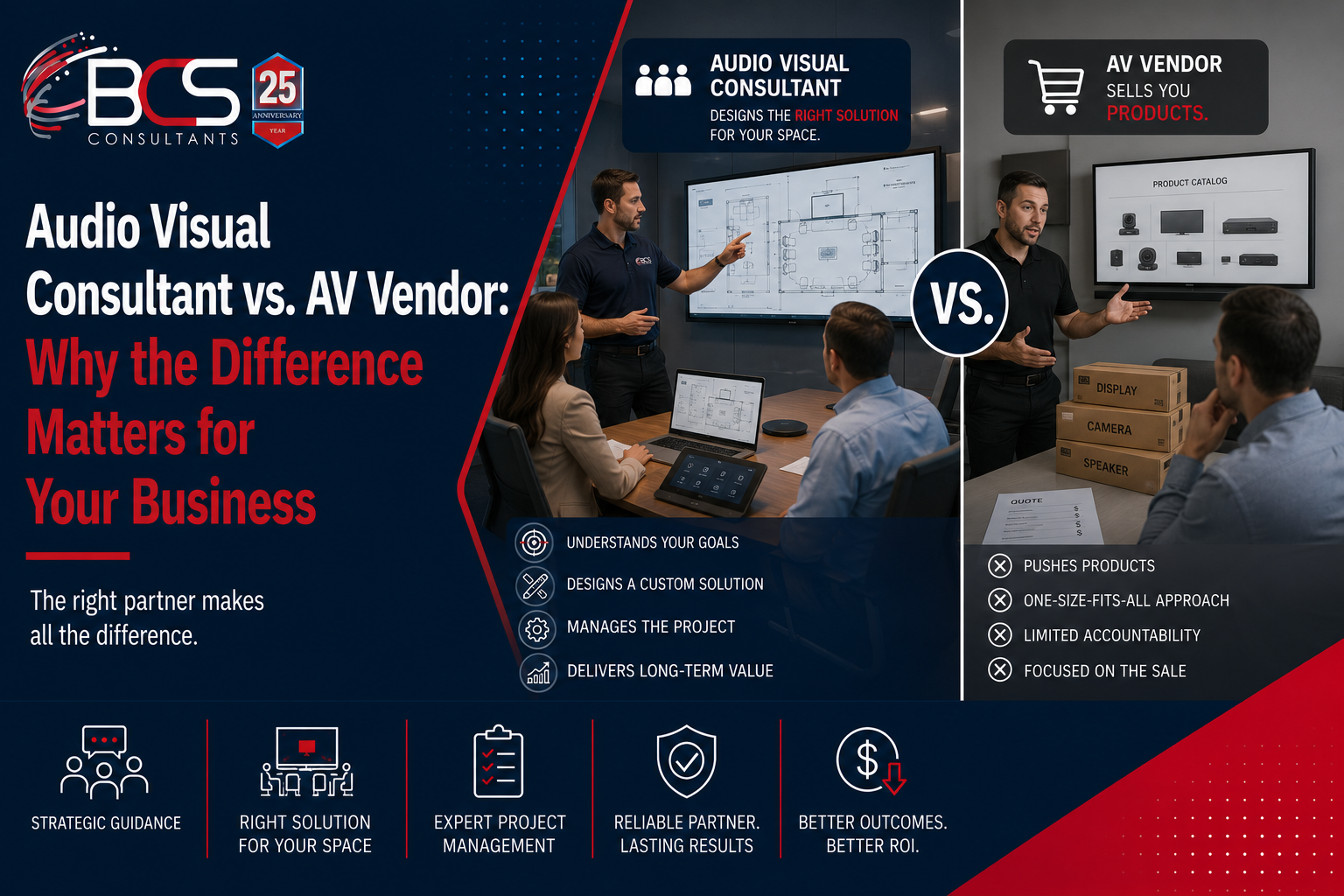
Organizations that have lived through a disappointing AV installation tend to trace the root cause back to the same place: they bought products from a vendor rather than engaging a consultant. The equipment arrived, it was installed, and it technically works — but the conference room camera does not cover the far end of the table. The microphone picks up the HVAC noise more clearly than the voices around it. The control system requires three steps to start a meeting that should take one. Meetings still do not start on time.
These are design failures, not product failures. The equipment may be perfectly capable — in a different room, with a different configuration, designed for the specific application rather than chosen from a catalog. The difference between a successful AV installation and a frustrating one is not which products were specified. It is whether the project was led by a design process or a sales process.
What an AV Vendor Does
An AV vendor sells audiovisual products and typically offers installation services. The business model is product-driven: revenue comes from the margin on hardware sales, which means the recommendations are shaped by inventory, margin, and the products the sales team knows how to configure. This is not dishonest — many AV vendors have technically competent installation teams who install what they sell correctly. The problem is the starting point.
When the recommendation begins with products — specifically, the products the vendor happens to carry — rather than with the requirements of the space and the people using it, the result is a system designed to accommodate the available inventory rather than optimized for the application.
An AV vendor typically produces a quote, not a design. The quote shows what will be installed. It does not show where the camera will be positioned relative to the table and why, what the microphone pickup pattern will cover, how the cable routing will be concealed, how the control system will be programmed, or how the AV will integrate with the network and the building's other systems.
What an Audio Visual Consultant Does
An audio visual consultant begins from requirements, not from products. The process starts with understanding how the space will be used: how many people, what meeting types, what platforms, what the sightlines are, what the acoustic environment is like, what the lighting conditions are throughout the day, what the IT infrastructure looks like, and what the users' level of technical sophistication is.
From that understanding, the consultant produces a design — not a quote. The design shows where equipment is positioned and why, what the camera field of view covers from each position, how the microphone array is configured for the table layout, how the signal path flows from input to output, how the control system will be programmed, and how the system integrates with the network, the calendar platform, and any other systems it needs to communicate with.
A consultant takes accountability for the outcome — the system working as designed — not just for the delivery of equipment. The measure of success is whether the room works well for its intended purpose, not whether the hardware was installed and powered on.
The Design-Build Difference in Practice
Consider a medium conference room: twelve seats, twenty-five feet long, used primarily for hybrid meetings on Microsoft Teams. A vendor-led approach might propose an all-in-one video bar at the front of the room, two large-format displays, and a Bluetooth speakerphone on the table — a reasonable-sounding configuration that looks professional on a quote.
In practice: the all-in-one video bar is positioned twenty-five feet from the participants at the far end of the table. Its camera cannot frame those participants at a useful size. Its microphones cannot reliably pick up voices from that distance in a room with hard acoustic surfaces. Remote participants hear a mix of voice and room noise and cannot easily tell who is speaking.
A consultant-led approach measures the room, models the camera coverage from different positions, specifies a dedicated PTZ camera with AI speaker tracking, designs a ceiling microphone array layout that provides even pickup across the full table length, specifies dual displays so video and content never compete for the same screen, and programs a one-touch meeting start that connects to the calendar meeting reliably every time.
The equipment cost may be similar. The outcome is not.
Credentials That Indicate a Professional AV Integrator
Several industry credentials indicate that an AV professional or firm has invested in meeting the standards of the field.
CTS (Certified Technology Specialist) is the foundational credential of AVIXA, the audiovisual industry association. CTS-D (Design) and CTS-I (Installation) specialist certifications indicate advanced expertise in system design and installation respectively. These certifications require passing examinations and maintaining continuing education.
RCDD (Registered Communications Distribution Designer) is the highest credential in the structured cabling industry, relevant for AV integrators who design and install the complete technology infrastructure including cabling.
Manufacturer certifications — Crestron, Cisco Meraki, Shure, Biamp, Verkada, and others — require training, examination, and ongoing deployment experience with specific products. A certified Crestron programmer is demonstrably qualified to configure a Crestron system correctly. A certified Biamp engineer understands DSP configuration at a level that a general AV installer may not.
These credentials are not trivially obtained. An integrator who holds relevant credentials has made a meaningful investment in professional competence. An integrator who cannot demonstrate credentials in the product categories they are specifying is telling you something important about the depth of their expertise.
What to Ask Before Engaging an AV Integrator
Before engaging any AV integrator for a meaningful project, the following questions are worth asking directly.
Will you visit the space before specifying any equipment? Room measurements, sightline analysis, acoustic evaluation, and lighting observation are prerequisites for a good design. Any firm that is willing to specify equipment from photographs or a floor plan drawing alone is operating as a vendor, not a consultant.
Will you produce a design document before a purchase order? A drawing, an equipment placement diagram, a signal flow schematic, or a control system functional description — some form of design documentation that shows what is going where and why — should exist before any hardware is purchased.
Who will program the control system, and what does that programming include? Control system programming is where the user experience is built. Knowing who will do it, what training they have, and what the programming will accomplish in terms of meeting start sequences and room automation integration tells you a great deal about what the installed system will actually be like to use.
What happens if the system does not perform as expected after installation? A professional integrator provides a warranty period during which design deficiencies are corrected at no additional cost. An integrator who views the installation as complete when the equipment is powered on and who characterizes any subsequent performance issues as service calls is signaling a different relationship.
BCS Consultants: Design-Build AV Integration
BCS Consultants is a design-build AV integrator. Every project begins with a space assessment, produces a documented system design before procurement, and is measured against that design at commissioning. We are certified by Crestron, Shure, Biamp, Cisco, Poly, Logitech, and the other manufacturers whose products we specify — and we hold RCDD credentials for the structured cabling component of our projects.
We serve corporate, healthcare, legal, educational, hospitality, and government clients across Southern California, Arizona, Ohio, and Oregon, handling the full technology infrastructure scope — AV, structured cabling, wireless, and security — as an integrated project rather than separate scopes assigned to different vendors.
Frequently Asked Questions
Does working with an AV consultant cost more than buying from a vendor?
Not necessarily, and the comparison is misleading when it focuses on initial cost rather than total outcome cost. A consultant who designs the right system the first time avoids the expense of remediation when a vendor-specified system underperforms. Over the life of the installation, a correctly designed system consistently costs less than a poorly specified one that requires modification, supplementation, or early replacement.
What is the difference between an AV consultant and an AV integrator?
A pure AV consultant designs systems and specifies equipment but does not install. An AV integrator designs, procures, installs, programs, and supports. BCS is a design-build AV integrator — we provide the complete service from initial design through ongoing support, which is the model most appropriate for the commercial organizations we serve.
How do I evaluate whether an AV integrator is genuinely design-led?
Ask for examples of previous projects in spaces similar to yours: the design drawings, the control system interface, and references from users who use the space daily. The quality of the design documentation and the user experience of the installed system are the most reliable indicators of whether an integrator is genuinely design-led.