
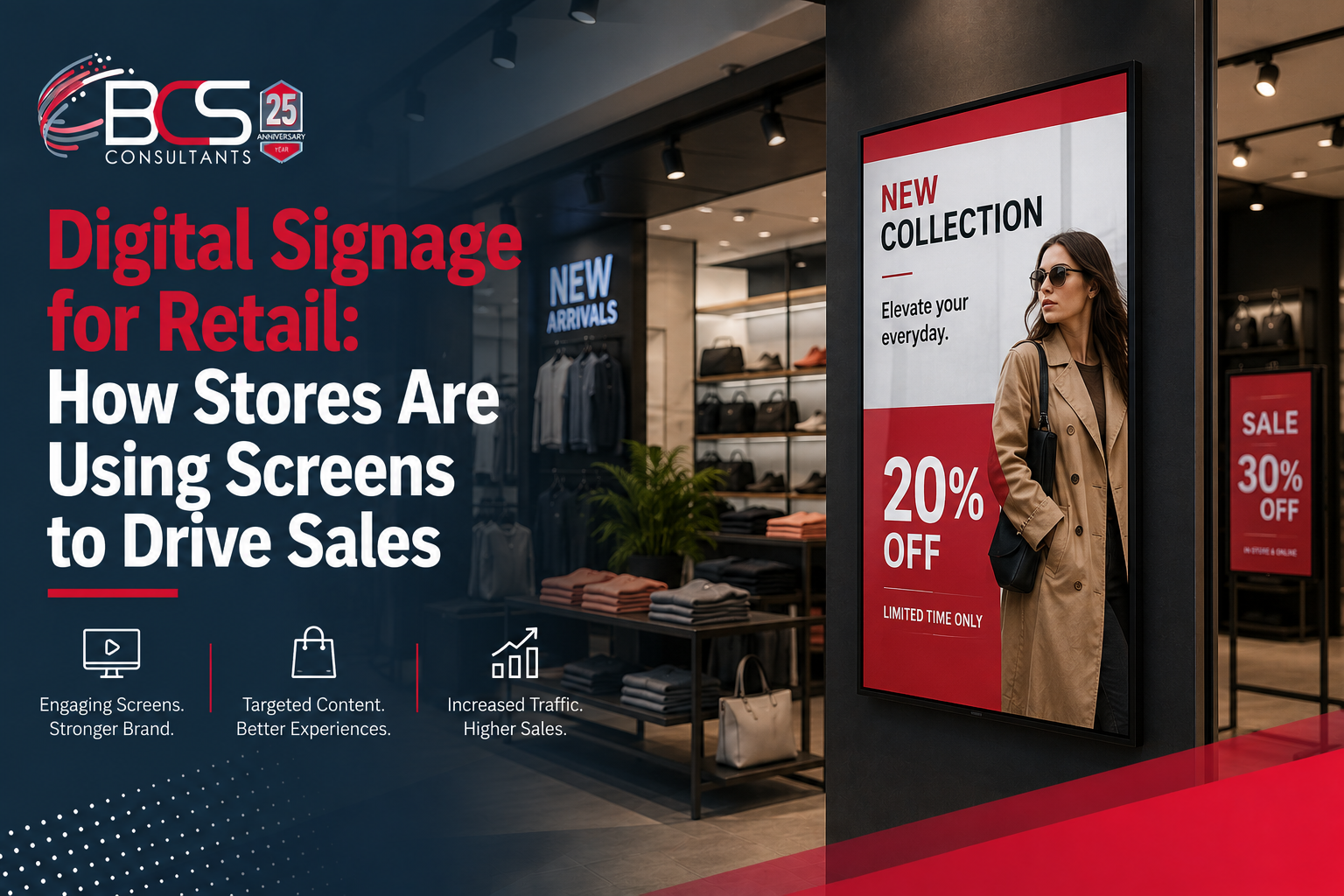
Digital signage has fundamentally changed what a retail environment can communicate — and how quickly it can change that communication. Where static printed signage commits a store to a single message until someone physically replaces it, a digital signage network can update every screen in every location simultaneously from a browser, in seconds.
For retailers managing promotional cycles, seasonal campaigns, dynamic pricing, or loyalty program messaging across multiple locations, this capability is transformative. This guide covers how retail organizations are deploying digital signage, what the hardware and software requirements look like, and how BCS Consultants manages retail digital signage installations.
The Retail Case for Digital Signage
Retail digital signage drives outcomes at every point in the shopping journey — from attracting foot traffic at the storefront to influencing purchase decisions at the shelf and reinforcing brand experience throughout the store environment.
Storefront window displays with high-brightness screens draw attention from pedestrians and passing vehicles in ways that printed signage cannot. Motion graphics, seasonal content, and promotional messages that update automatically for morning versus afternoon dayparts give retailers a dynamic street presence without ongoing print production costs.
In-store, digital menu boards and promotional displays allow retailers to feature limited-time offers, respond to inventory changes, and promote associated products without printed materials. For grocery and food retail, digital shelf edge displays allow pricing updates that would otherwise require manual labor across every tagged item.
For multi-location retailers, the management efficiency gain is significant. A promotional campaign that previously required printing, shipping, and manually placing materials across every location can be deployed to every screen in every store simultaneously, with the same content appearing at exactly the same time.
Retail Digital Signage Applications
High-Brightness Window Displays
Window-facing displays require significantly higher brightness than standard indoor commercial screens to overcome ambient daylight. Screens positioned in windows or near large glazed storefronts need brightness levels well above what standard indoor commercial displays provide, with commercial outdoor-rated or semi-outdoor displays specified for window installations where direct sunlight exposure is a factor.
These displays run content from a cloud-based content management system, allowing headquarters to update all window displays across the entire retail network simultaneously.
In-Store Promotional Displays
Free-standing display units, wall-mounted screens at product sections, and end-cap mounted displays allow retailers to draw attention to specific product categories, communicate pricing, and support promotional campaigns at the point of decision. Content management platforms with scheduling capabilities allow these displays to automatically switch between different promotional messages by time of day, day of week, or event triggers.
Digital Menu Boards
For food retail and specialty food departments within larger stores, digital menu boards replace printed menu panels with screens that display current offerings, pricing, and nutritional information. Menu boards can be configured to show different content at breakfast versus lunch versus dinner, to automatically remove sold-out items, and to highlight promotional items with motion graphics that static signage cannot achieve.
Wayfinding and Directional Signage
Large format retail — department stores, big-box retailers, shopping centers — uses digital wayfinding displays to help customers navigate complex floor plans. Interactive wayfinding kiosks allow customers to search for specific departments, products, or services and receive visual directions, reducing the demand on staff for navigation assistance.
Associate-Facing Displays
Not all retail digital signage faces customers. Back-of-house displays in staff areas, receiving docks, and manager offices communicate operational information — shift schedules, safety alerts, promotional campaign details, and performance metrics — to retail associates without requiring them to log into separate systems.
Hardware Requirements for Retail Digital Signage
Retail environments impose hardware requirements that go beyond what standard commercial installations face. Displays in retail must withstand extended operating hours, higher ambient temperatures in certain store areas, the physical proximity of customers and shopping carts, and in some cases outdoor or semi-outdoor conditions.
Commercial-grade displays rated for extended hours of daily operation are required for all retail applications — consumer televisions are not appropriate for retail use and will fail early in retail operating environments. For window-facing or outdoor-adjacent installations, higher-brightness models with appropriate thermal management are specified.
Media players for retail signage range from Android-based sticks for simple playback applications to dedicated commercial players for more complex content requirements. In retail chains where the same display hardware is deployed across hundreds or thousands of locations, hardware standardization and remote management capability are critical operational requirements that influence media player selection.
Content Management for Retail Networks
The content management platform is what gives retail digital signage its operational value. For multi-location retailers, the platform must provide centralized control — the ability to push content updates to every location simultaneously — while also allowing location-level customization where regional pricing, local promotions, or market-specific content is needed.
Platform capabilities that matter for retail include scheduling (content that changes automatically by daypart and day of week), proof-of-play reporting (confirmation that specific content aired at specific screens at specific times, useful for promotional compliance), integration with POS systems (allowing pricing to update dynamically from the point-of-sale database), and emergency override (the ability to push urgent messaging to all screens immediately, bypassing scheduled content).
BCS Consultants works with leading cloud-based digital signage platforms and advises on platform selection based on each retailer's content management workflow, IT infrastructure, and operational requirements.
Multi-Location Rollout Deployment
For retail chains deploying digital signage across multiple locations simultaneously, the installation approach is fundamentally different from a single-site project. BCS Consultants has national rollout deployment capability and manages multi-location retail digital signage projects with consistent hardware specification, installation quality, and configuration standards across all sites.
Our rollout process includes standardized site survey templates completed by each location manager or facilities team member prior to installation, centralized hardware staging and configuration before deployment, installation team coordination across multiple locations running concurrently, and a post-installation audit that verifies each site against the standard configuration before the project is marked complete.
Frequently Asked Questions
Do I need different hardware for each store location or can I standardize?
Standardization is strongly recommended for multi-location retail. A consistent hardware specification simplifies procurement, reduces spare parts inventory requirements, and ensures that the content management configuration works identically at every location. BCS develops a standard specification as part of every retail rollout project.
How do I update content across all my store locations at once?
Cloud-based content management platforms allow content to be updated from a central dashboard and pushed to every enrolled display simultaneously, regardless of location. Most platforms also support scheduled content, so updates can be prepared in advance and published automatically at the correct time.
Can digital signage displays stay on 24 hours a day?
Commercial-grade displays specified for retail are designed for extended operating hours. For locations where the store is not staffed overnight, displays can be scheduled to power down during closed hours and power back on automatically before opening, extending display lifespan without manual intervention.