
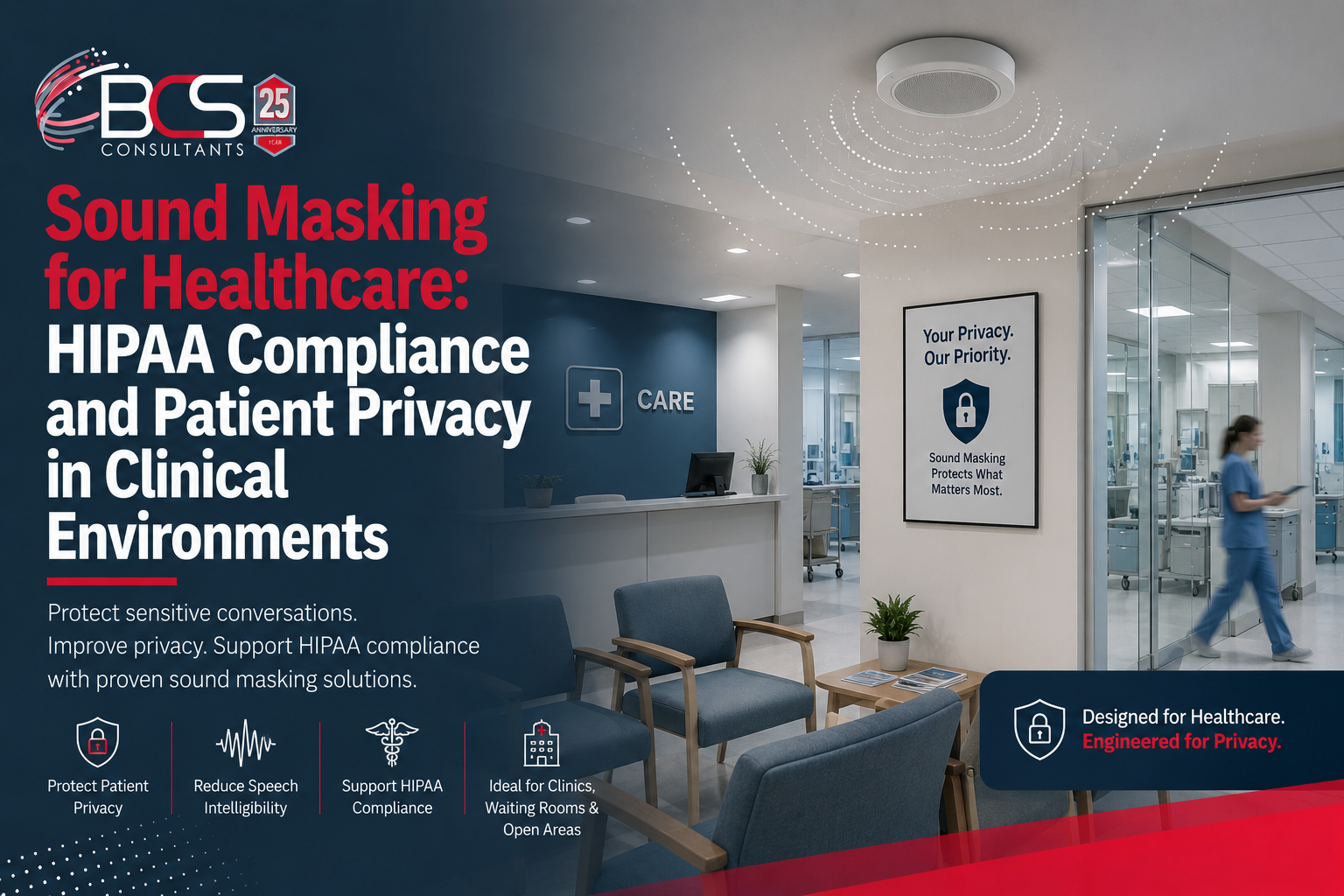
The HIPAA Privacy Rule requires covered entities to implement reasonable safeguards to protect protected health information from incidental disclosure. In a healthcare setting, this means that a patient discussing their condition with a clinician, providing insurance information to a receptionist, or describing symptoms to a nurse should not be overheard by other patients in the waiting room, other staff in adjacent areas, or visitors passing through corridors.
In modern healthcare facility design — which increasingly favors open clinical layouts, large-format reception areas, and glass-walled consultation spaces — meeting this requirement with construction alone is impractical and expensive. Commercial sound masking systems are the cost-effective, non-disruptive acoustic solution that healthcare organizations across the country use to meet their HIPAA obligations.
BCS Consultants installs commercial sound masking systems in healthcare environments across Southern California and nationally.
What HIPAA Requires for Acoustic Privacy
The HIPAA Privacy Rule does not specify a particular technology or construction standard for acoustic privacy — it requires covered entities to implement reasonable safeguards to protect against incidental uses or disclosures of protected health information. The Office for Civil Rights (OCR), which enforces HIPAA, has interpreted this standard to mean that covered entities should take practical steps to prevent conversations from being overheard in common areas.
Sound masking is explicitly recognized by the OCR as an appropriate technical safeguard for acoustic privacy. It is not the only acceptable approach — a private consultation room with walls that extend to the structural ceiling is also acceptable — but for facilities where full construction is impractical, sound masking provides documented, measurable acoustic privacy protection.
The practical implication: a healthcare organization that has deployed a properly designed and calibrated commercial sound masking system in its patient-facing areas has a defensible record of implementing reasonable safeguards, which is relevant both for proactive compliance and in the event of a HIPAA audit.
Where Sound Masking Is Needed in Healthcare Facilities
Reception and Check-In Areas
The reception desk is often the highest-risk acoustic area in a healthcare facility. Patients provide their name, date of birth, insurance information, reason for visit, and other protected health information at a counter that is typically in close proximity to a waiting area occupied by other patients. Sound masking in the reception and waiting zone reduces the intelligibility of these conversations for nearby patients.
Open Waiting Areas
Patients in waiting rooms frequently have conversations with the check-in staff, with healthcare providers who step out to greet them, and sometimes with family members about their condition. Sound masking in waiting areas reduces the chance that these conversations are clearly overheard by other patients — particularly important in larger waiting areas where multiple concurrent conversations may be occurring.
Open Clinical Areas and Treatment Bays
Emergency department treatment areas, open urgent care bays, and other clinical environments where multiple patients receive care in adjacent spaces without full-height wall separation between them present significant acoustic privacy challenges. Sound masking in these areas reduces the intelligibility of clinical conversations between providers and patients in adjacent treatment spaces.
Administrative and Billing Areas
Staff areas where billing, coding, and patient record management occurs involve frequent discussion of patient information. In open-plan administrative areas, sound masking protects the confidentiality of staff conversations about patient accounts and clinical records.
Corridors Adjacent to Examination Rooms
In facilities where examination room walls do not extend to the structural ceiling — a common design shortcut in older buildings — sound carries over the walls into adjacent corridors. Sound masking in corridors reduces the intelligibility of clinical conversations occurring in adjacent rooms for people passing through the corridor.
How Commercial Sound Masking Works in Healthcare
Commercial sound masking systems used in healthcare are not simply white noise machines. They are precisely engineered systems that introduce a background sound spectrum calibrated to the frequency range of human speech — making nearby conversations less intelligible without introducing a distracting or uncomfortable noise level.
The system consists of a signal generator, a distribution amplifier network, and ceiling-mounted loudspeakers (typically located in or above the ceiling plenum, invisible to building occupants). The sound level and frequency spectrum are calibrated by an acoustic specialist during installation to achieve the target speech privacy rating for each zone.
Zone controllers allow different areas of the facility to be tuned independently — the waiting room, the clinical area, the administrative space — each calibrated to the acoustic characteristics of its specific environment. Modern digital systems from Biamp (Cambridge Sound Management), AtlasIED, and Lencore allow remote monitoring and adjustment of the masking system from a facility management dashboard.
Installation in Active Healthcare Environments
Healthcare facilities present unique installation challenges that BCS addresses through careful project planning. Patient care cannot be interrupted for extended periods, infection control requirements in clinical areas restrict the type and duration of construction activity, and certain areas — operating rooms, ICUs, and active treatment areas — may have complete restrictions on installation work during occupied hours.
BCS schedules healthcare sound masking installations in phases that minimize disruption to clinical operations. Where ceiling tile access allows, above-ceiling speaker installation can often be completed during overnight and weekend work windows without any disturbance to the occupied space below. We coordinate all work with the facility's operations and infection control teams before any installation begins.
Frequently Asked Questions
Will the sound masking system be noticeable to patients?
A properly calibrated system operates below the threshold of conscious awareness for most occupants. Patients and staff quickly habituate to the background sound and typically do not consciously notice it after a brief adjustment period. The perception is that the environment simply feels quieter and more private.
Does sound masking replace the need for private consultation rooms?
Sound masking is a complement to physical design, not a replacement for it. For consultations involving highly sensitive clinical information, a private room with appropriate construction remains the preferred setting. Sound masking addresses the acoustic privacy gaps in the many areas of a healthcare facility where full private room construction is impractical.
How is a healthcare sound masking system calibrated?
BCS's acoustic technicians calibrate the system after installation by measuring the actual sound levels produced by the speakers throughout each zone and adjusting the signal generator output to achieve the target masking level. The calibration is documented and can be repeated on a scheduled basis to verify that the system continues to perform as specified.