
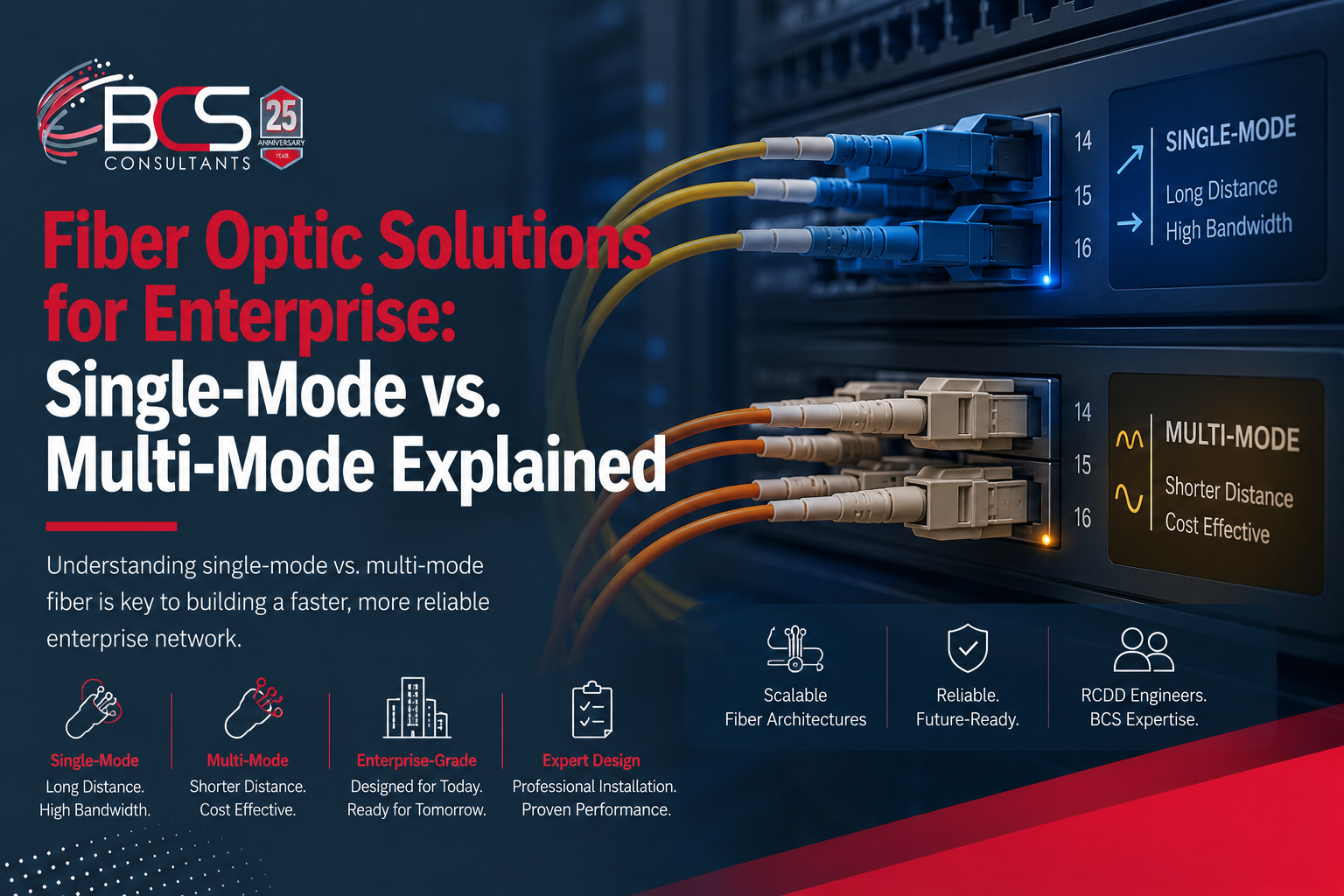
Fiber optic cabling is the backbone of enterprise network infrastructure — and the decision between single-mode and multi-mode fiber is one of the most consequential choices in any cabling project. Get it right and your infrastructure supports your organization's connectivity requirements for the next fifteen to twenty years. Get it wrong and you face expensive remediation when you try to upgrade your network to speeds the wrong fiber type cannot support.
BCS Consultants employs RCDD (Registered Communications Distribution Designer) engineers — the highest credential in the structured cabling industry — for exactly this reason. Fiber optic design is not a commodity task, and this guide will help you understand the decision before you engage an integrator.
Why Fiber Optic Instead of Copper?
Copper cabling — Cat6A at its best — supports ten gigabit Ethernet at a maximum distance of one hundred meters. For horizontal cabling from a telecommunications room to a workstation or access point, that is entirely adequate. But for backbone connections — between floors in a multi-story building, between buildings on a campus, or from the entrance facility to distribution frames — copper's distance limitations quickly become a constraint.
Fiber optic cable transmits light rather than electrical signals, which means it does not suffer from the electromagnetic interference that affects copper in industrial environments, it supports distances measured in kilometers rather than meters, and it supports bandwidth that scales to hundreds of gigabits per second over the same cable without needing to be replaced — you simply upgrade the transceivers at each end.
Fiber also provides a physical layer of security advantage: unlike copper, it does not radiate a detectable electromagnetic signal that can be intercepted without physically tapping the cable.
Multi-Mode Fiber: The Intra-Building Standard
Multi-mode fiber has a larger core diameter — typically fifty micrometers — that allows light to travel through it via multiple paths simultaneously. This makes it easier and less expensive to couple with LED and VCSEL light sources, keeping transceiver costs lower than single-mode. The tradeoff is that the multiple light paths create modal dispersion over longer distances, limiting the maximum run length for a given data rate.
For enterprise applications, multi-mode fiber is the standard choice for backbone runs within a building — from the MDF to IDFs on each floor, within data center environments, and for horizontal connections to high-performance workstations where the runs are well within multi-mode's distance limits.
The current standard for new enterprise multi-mode installations is OM4, which supports ten gigabit Ethernet over distances up to four hundred meters and one hundred gigabit Ethernet over shorter runs. OM5 wideband multi-mode fiber supports the same distances with the addition of short-wavelength division multiplexing (SWDM) for higher bandwidth applications. BCS specifies OM4 or OM5 for all new multi-mode backbone installations.
Single-Mode Fiber: The Campus and Long-Distance Standard
Single-mode fiber has a much smaller core diameter — nine micrometers — that allows only a single light path, eliminating modal dispersion and enabling signals to travel enormous distances without degradation. Single-mode transceivers are more expensive than multi-mode, but the cable itself is not significantly more expensive, and for any run beyond the distance limits of multi-mode, single-mode is the only viable choice.
For enterprise applications, single-mode fiber is the standard for inter-building connections on a campus, connections from a campus to a data center or colocation facility, and any connection where the run length exceeds what multi-mode can support for the required data rate.
OS2 is the standard single-mode fiber specification for enterprise use. It supports data rates from ten gigabit to eight hundred gigabit and beyond, limited only by the transceivers deployed at each end — not by the fiber itself. Installing OS2 single-mode fiber for a campus backbone connection today means the same fiber plant can support whatever speeds your network equipment evolves to over the life of the installation.
Connector Types and Hardware
Fiber optic connectors determine how cables terminate at patch panels, switches, and transceivers. The LC (Lucent Connector) duplex connector is the standard for most enterprise equipment — SFP and SFP+ transceivers almost universally use LC connectors. SC connectors are an older standard that remains in use in some applications.
For high-density data center applications where large numbers of fiber strands need to be managed in limited space, MPO (Multi-fiber Push-On) connectors allow twelve or twenty-four fibers to be terminated in a single connector, dramatically reducing the space and labor required for high-count fiber runs.
Fusion splicing is the preferred method for permanent fiber connections where performance and longevity are critical. Mechanical splices and field-installable connectors are used where fusion splicing equipment is not available or the application does not warrant it, but at a performance cost that is measurable with OTDR testing.
How BCS Designs Enterprise Fiber Optic Solutions
BCS Consultants' RCDD engineers design fiber optic solutions to BICSI TDMM (Telecommunications Distribution Methods Manual) and TIA-568.3-D standards. Every fiber installation is documented with OTDR test results for every installed strand — the optical time-domain reflectometer verifies that each fiber meets the specified insertion loss and return loss requirements and identifies any faults or high-loss events in the cable path.
Our fiber projects range from single-building backbone upgrades to multi-building campus infrastructure projects and data center fiber installations. We handle the complete scope: route planning, fiber pathway design, cable pulling, fusion splicing, connector termination, testing and certification, and documentation.
Frequently Asked Questions
Can single-mode and multi-mode fiber be used on the same network?
Yes, but they cannot be directly connected — the different core sizes are incompatible, and attempting to connect them creates significant signal loss. In practice, buildings often have both: multi-mode for intra-building backbone runs and single-mode for connections between buildings. Each segment is terminated with the appropriate transceiver for its fiber type.
How long does fiber optic cable last?
Properly installed fiber optic cable has a design life of twenty-five years or more. The cable itself does not degrade significantly over time. The practical limit on fiber lifespan is usually the connectors and splices, which can be replaced or re-terminated without replacing the entire cable run.
What is OTDR testing and why does it matter?
OTDR (Optical Time-Domain Reflectometer) testing sends a pulse of light down the fiber and measures the reflections that return, producing a trace that shows the loss profile of the entire fiber run, including any faults, high-loss connector terminations, and splice losses. OTDR test results are required documentation for any fiber installation that will be covered by a manufacturer warranty.