
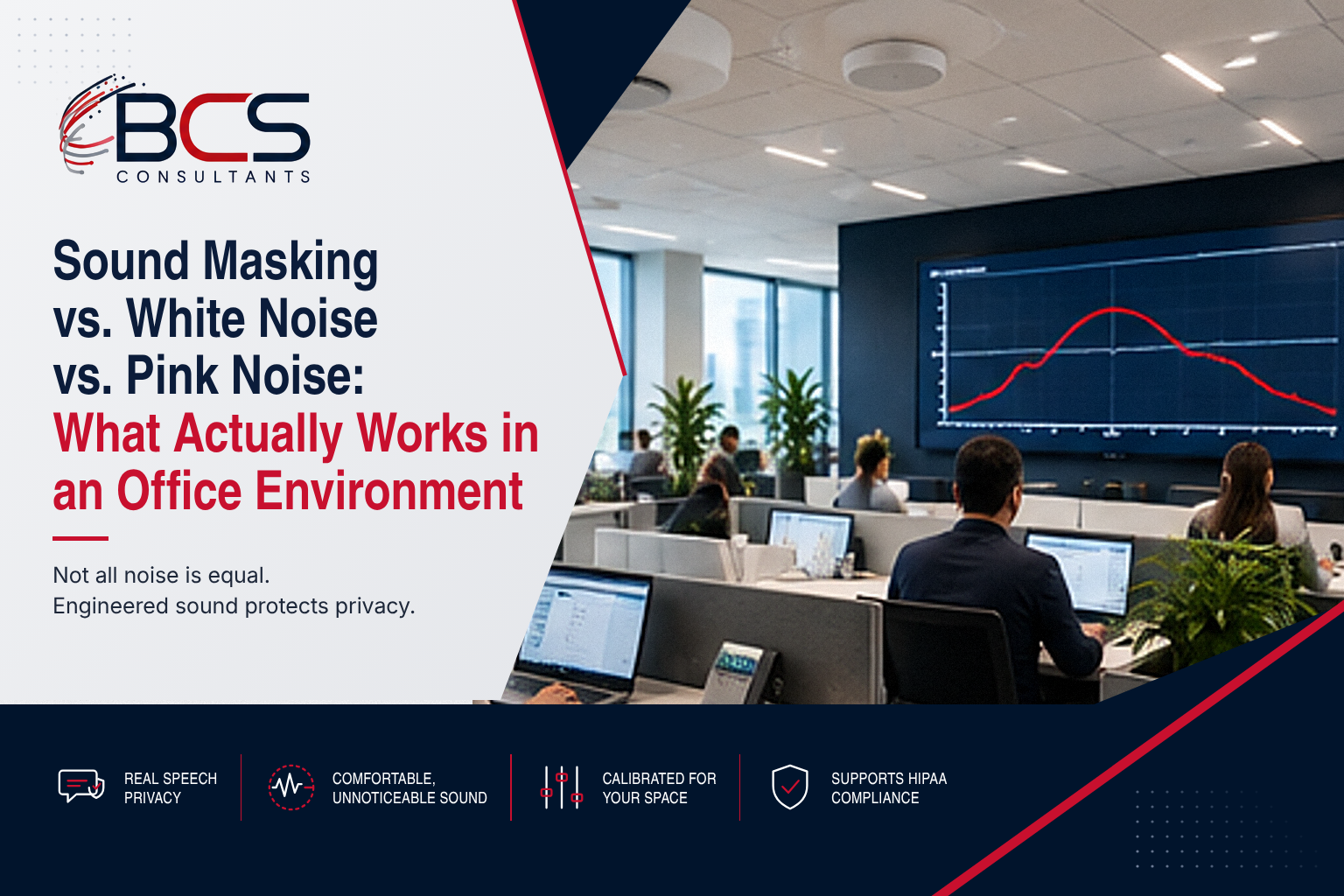
You have probably heard that white noise helps with concentration. There are entire playlists of it on Spotify. Some offices buy white noise machines from Amazon and place them in open-plan areas hoping to reduce distraction. Here is the problem: consumer white noise generators are designed for sleep, not for speech privacy in a professional environment. The science behind how humans perceive sound — and specifically speech — points to a different solution.
BCS Consultants designs and installs commercial sound masking systems for offices, healthcare facilities, law firms, call centers, and financial institutions across Southern California. This guide explains exactly what separates sound masking from white and pink noise — and why it matters for your organization.
What White Noise, Pink Noise, and Brown Noise Actually Are
These are categories defined by their frequency distribution — the relationship between the energy of the sound and the pitch (frequency) of that sound.
White Noise
Contains equal energy at every frequency across the audible spectrum (20 Hz to 20,000 Hz). Because higher frequencies carry more energy per octave, white noise sounds harsh and hissy to human ears — like a detuned radio or TV static. It is fatiguing to listen to over long periods.
Pink Noise
Has equal energy per octave rather than per frequency. This means lower frequencies have proportionally more energy than higher frequencies compared to white noise. Pink noise sounds softer and more natural — like a waterfall or steady rain. It is less fatiguing than white noise and is often used in acoustic testing and some sleep applications.
Sound Masking
Is a specifically engineered acoustic signal, not a random noise type. It is tuned to match the frequency profile of human speech — the range in which speech intelligibility is highest (roughly 500 Hz to 4,000 Hz). Because it targets the same frequencies as speech, it makes speech harder to understand at a distance, which is the technical definition of speech privacy. This is the core distinction that makes commercial sound masking a different category of solution entirely.
Head-to-Head Comparison: Sound Masking vs. White/Pink Noise
Speech Privacy
Sound masking: Engineered specifically for speech privacy. Effective at reducing speech intelligibility at distances where conversations could be overheard.
White/pink noise: Not tuned to speech frequencies. Provides some masking of ambient noise but is far less effective at specifically reducing speech intelligibility.
Occupant Comfort
Pink noise is the most comfortable of the noise types for extended listening. White noise is fatiguing over long periods. Sound masking is designed to be perceived as background environmental noise rather than an added sound — most occupants do not notice a properly installed system. A system calibrated by BCS Consultants typically operates at 45 to 48 dBA, similar to a quiet office HVAC hum.
HIPAA and Speech Privacy Compliance
Sound masking: Can be specifically calibrated to meet HIPAA physical safeguard requirements for speech privacy in healthcare settings.
White/pink noise generators: Not designed for regulatory compliance and cannot be calibrated or certified to specific speech intelligibility standards.
Installation and Calibration
Consumer white/pink noise generators: Plug-in devices, no installation required, no calibration possible.
Commercial sound masking systems: Professionally installed ceiling emitters with DSP (digital signal processing) control that allows zone-by-zone calibration to achieve consistent masking levels throughout a space.
Scalability and Central Management
Consumer generators cannot be networked or centrally controlled. Commercial sound masking systems from BCS Consultants cover entire floors or buildings with centralized management, scheduling, and zone control — allowing different masking levels for different areas at different times of day.
5 Scenarios Where Sound Masking Outperforms White Noise
- Open-plan offices with confidential HR conversations happening alongside open workstations — sound masking creates speech privacy without requiring closed offices.
- Law firms and financial institutions where attorney-client privilege and client confidentiality require that conversations in one area cannot be heard in adjacent areas.
- Healthcare facilities where HIPAA requires that patient health information cannot be overheard — sound masking satisfies the HIPAA Physical Safeguards requirement.
- Call centers where agent conversations need to be private from adjacent agents while maintaining a comfortable acoustic environment for all staff.
- Executive suites and boardrooms where conversation in corridors or adjacent spaces must not be audible within the meeting space — and vice versa.
How Sound Masking Systems Are Designed and Installed
A commercial sound masking installation involves more than placing speakers in a ceiling.
BCS Consultants follows a structured design process: acoustic assessment of the space (ceiling type, wall construction, floor plan, occupancy density), zone mapping, speaker placement modeling, and post-installation calibration with a sound level meter to verify that masking levels meet target dBA across all zones.
This calibration process is what separates a commercial installation from a consumer noise machine — and it is what allows the system to be documented, measured, and presented to an auditor as a defensible compliance measure.
5 Things Your Sound Masking Installer Should Do That Many Do Not
Not all sound masking installations are created equal. The difference between a system that works and one that creates more complaints than it solves comes down to how carefully the installation is designed, calibrated, and commissioned. BCS Consultants follows a structured process. Here is what to look for when evaluating any sound masking integrator.
1. Conduct an Acoustic Assessment Before System Design
The ceiling type, construction materials, ambient noise floor, and floor plan of the space all affect how sound masking performs. A system designed for a space with acoustic ceiling tile performs very differently than one designed for a hard ceiling with exposed ductwork. Before specifying speaker placement, a reputable installer walks the space, measures the ambient noise floor, and evaluates the acoustic characteristics that will affect system performance. BCS Consultants includes a pre-design acoustic assessment on every sound masking project.
2. Design Speaker Zones to Match the Floor Plan
Sound masking systems that use a single output level across an entire floor create uneven masking performance. Areas near HVAC equipment may already be loud enough to require a lower masking level; areas near exterior windows may need a higher level to compensate. A zoned design allows BCS Consultants to set different masking levels for different areas of the space — reception areas, open workstations, conference rooms adjacent to open spaces, and corridors each have different requirements.
3. Calibrate with a Calibrated Sound Meter After Installation
Speaker placement modeling determines where emitters go. Calibration after installation determines what level they produce. BCS Consultants uses a calibrated sound level meter to walk the entire space after installation and verify that masking levels are within the target range (typically 45 to 48 dBA) throughout all zones. Calibration findings are documented in a commissioning report delivered to the client.
4. Deliver a Commissioning Report
A commissioning report documents the pre-installation ambient noise floor measurements, the designed masking level targets, and the post-installation measurements at defined points throughout the space. This report is the evidence of compliance for HIPAA-regulated facilities and the performance baseline for future troubleshooting. BCS Consultants provides a commissioning report on every sound masking project as a standard deliverable.
Frequently Asked Questions
What is the difference between sound masking and white noise?
White noise contains equal energy at all frequencies and sounds harsh. Sound masking is an engineered acoustic signal specifically tuned to the frequency range of human speech — making conversations unintelligible at distance. Sound masking is a speech privacy tool; white noise is a sleep and ambient noise tool.
Does sound masking really work for speech privacy?
Yes, when properly designed and installed. A calibrated sound masking system reduces the radius of distraction from a conversation and makes speech unintelligible beyond a specified distance. Independent acoustic testing demonstrates that properly installed sound masking systems achieve ANSI/ASA S3.5 speech intelligibility targets.
How loud is a sound masking system?
A properly calibrated commercial sound masking system typically operates at 45 to 48 dBA — approximately the ambient noise level of a quiet office. Occupants typically perceive the system as the hum of the HVAC system rather than as an added noise source.
How much does sound masking cost for an office?
Commercial sound masking systems for open-plan offices typically range from $2 to $4 per square foot installed, depending on ceiling type, zone requirements, and system complexity. BCS Consultants provides site-specific proposals after an acoustic assessment.
Work With BCS Consultants on Your Office Acoustics
BCS Consultants designs and installs commercial sound masking systems for offices, healthcare facilities, law firms, call centers, and financial institutions across Southern California and nationally.
→ Explore Sound Masking Solutions: https://www.bcsconsultants.com/solutions/sound-masking/
📞 Talk to a BCS Consultants Specialist: https://www.bcsconsultants.com/contact/contact-us/