
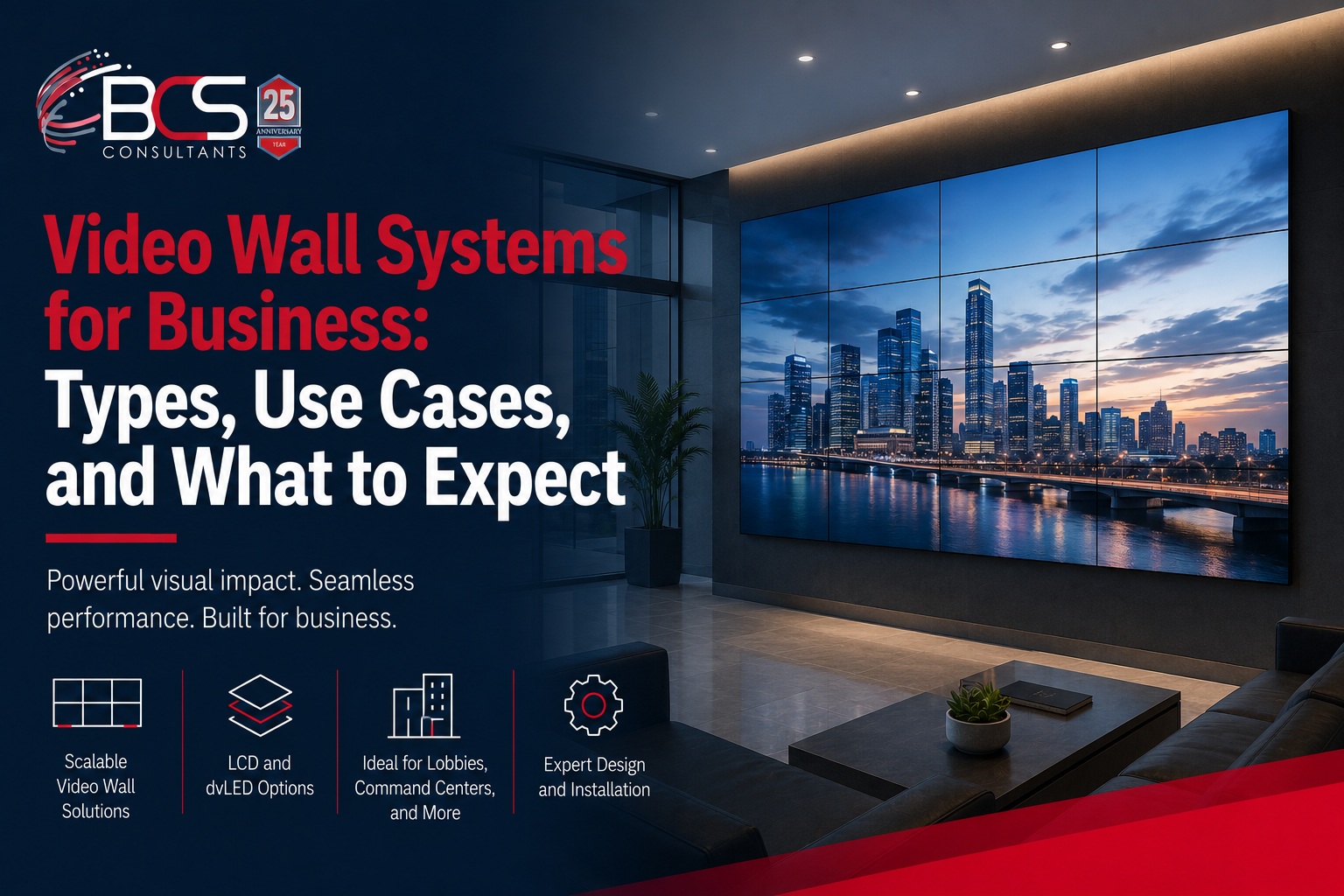
A video wall is not simply a very large display — it is a configurable array of screens or a continuous LED panel that can display a single coherent image across its entire surface, divide into independent display zones, and respond to content management and input switching in ways that a single display cannot.
For the right application — a corporate lobby, a network operations center, a broadcast studio, a command center, a large meeting space — a video wall creates a visual presence and operational capability that no single display can match. For the wrong application, it is an expensive solution to a problem that a large commercial display would have solved more simply.
This guide explains the two main video wall technologies, the commercial applications where they deliver real value, and what a professional video wall installation involves.
LCD Video Walls: The Established Standard
LCD video wall panels are commercial-grade displays specifically designed to be assembled in multi-screen arrays. Unlike consumer televisions or standard commercial displays, video wall LCD panels have ultra-narrow bezels — the frame around the screen — that minimize the visible seam between adjacent panels when assembled into an array.
The bezel width on a video wall system determines how visible the grid pattern is when the array displays a single coherent image. Ultra-narrow bezel panels have bezels of less than two millimeters on each side, producing a combined seam of around three to four millimeters between panels — visible at close range but not disruptive to the viewer experience at normal viewing distances.
LCD video walls are available in a range of tile sizes, with forty-six-inch and fifty-five-inch panels being the most commonly deployed formats for commercial installations. Array configurations range from simple two-by-two arrangements to complex custom configurations of any dimension.
LCD video walls are the established choice for budget-conscious installations, for applications where the content is mostly text and data rather than photographic imagery, and for environments where the visible bezel line is acceptable.
Direct-View LED: The Seamless Alternative
Direct-view LED (dvLED) video walls use arrays of tiny LED modules mounted on panels that tile together to create a seamless display surface — no bezel, no visible seam between panels, just a continuous luminous surface of any size and aspect ratio.
The key specification for dvLED is pixel pitch — the distance between adjacent LED pixels, measured in millimeters. Smaller pixel pitch means higher resolution per unit area and a higher-quality image at closer viewing distances, but also higher cost. Common pixel pitches for commercial indoor installations range from one to four millimeters, with fine-pitch panels below two millimeters appropriate for applications where viewers will be standing within a few feet of the display.
dvLED provides significantly higher peak brightness than LCD panels, making it suitable for installations in very bright environments — lobbies with large windows, outdoor-adjacent installations, and applications where the display needs to be visible from a distance in high ambient light. The seamless surface also enables creative configurations — curved installations, portrait-oriented columns, or non-rectangular shapes — that are not possible with tiled LCD panels.
The price of dvLED has decreased substantially in recent years, and mid-market commercial installations that previously could not justify the investment are now specifying dvLED for lobby features, large meeting spaces, and entertainment venues.
Video Wall Use Cases
Corporate Lobbies
A video wall in a corporate lobby creates an immediate visual statement about the organization. Large-format content — brand imagery, product photography, company values, financial data, or real-time operational metrics — displayed on a floor-to-ceiling video wall transforms an otherwise generic lobby into a distinctive brand environment. For organizations that host frequent client visitors, a video wall is a powerful first impression.
Network Operations and Command Centers
Operations centers that monitor network infrastructure, security systems, physical infrastructure, or logistics require real-time visibility across a large number of data sources simultaneously. A video wall that can display multiple independent data streams — network monitoring dashboards, camera feeds, mapping systems, alert queues — in independently controlled zones provides operators with the situational awareness that a desk full of individual monitors cannot match.
Large Meeting and Presentation Spaces
For meeting rooms larger than a standard boardroom — executive briefing centers, large training facilities, auditoriums — a video wall provides the display size needed for content to be readable from the back of the room, the visual presence appropriate for high-stakes presentations, and the flexibility to display multiple content sources simultaneously during complex presentations.
Retail and Hospitality Environments
Retail flagship stores and hospitality venues use video walls as experiential design elements — creating immersive brand environments, displaying curated content that reinforces the brand aesthetic, and providing the large-scale visual presence that distinguishes flagship locations from standard retail environments.
Video Wall Infrastructure Requirements
A video wall requires more infrastructure than a single display. The video processor — the hardware that receives input signals and distributes them across the display panels — needs to be sized for the resolution of the complete array and the number and type of input sources. For a four-by-two array of fifty-five-inch panels, the native resolution of the complete display surface is determined by the panel resolution and the array configuration, and the video processor must handle that full native resolution.
Content management for video walls requires software that can address the full display surface as a single canvas, create and recall independent zone configurations, and handle input switching from multiple sources. BCS integrates video wall control with the room's AV control system so that operators manage the display configuration from the same touch panel as every other room system.
Structural requirements for wall-mounted video walls must be evaluated before installation — the combined weight of the display panels and mounting hardware can be significant, and wall reinforcement may be required in some installation locations. BCS coordinates with structural engineers on installations where the wall construction requires evaluation.
Frequently Asked Questions
How much maintenance does a video wall require?
LCD video wall panels have a design life of fifty thousand to one hundred thousand hours of operation. dvLED panels have similar lifespans. Practical maintenance involves periodic dust removal from ventilation areas and monitoring for any panels that develop dead pixels or brightness variations over time. BCS Consultants provides maintenance agreements that include periodic inspections and priority service response for video wall installations.
Can a video wall display a Teams or Zoom meeting?
Yes. A video wall configured with an appropriate video processor can display a video conferencing session across the full display surface or as one zone within a multi-zone configuration. This is a common requirement for large meeting spaces and executive briefing centers.
What is the typical lead time for a video wall installation?
Video wall hardware — particularly custom-configured dvLED installations — typically has a lead time of four to eight weeks from order to delivery. Installation scheduling adds additional time. BCS recommends beginning the procurement process as early as possible in a construction or renovation project to avoid delaying the overall project schedule.