
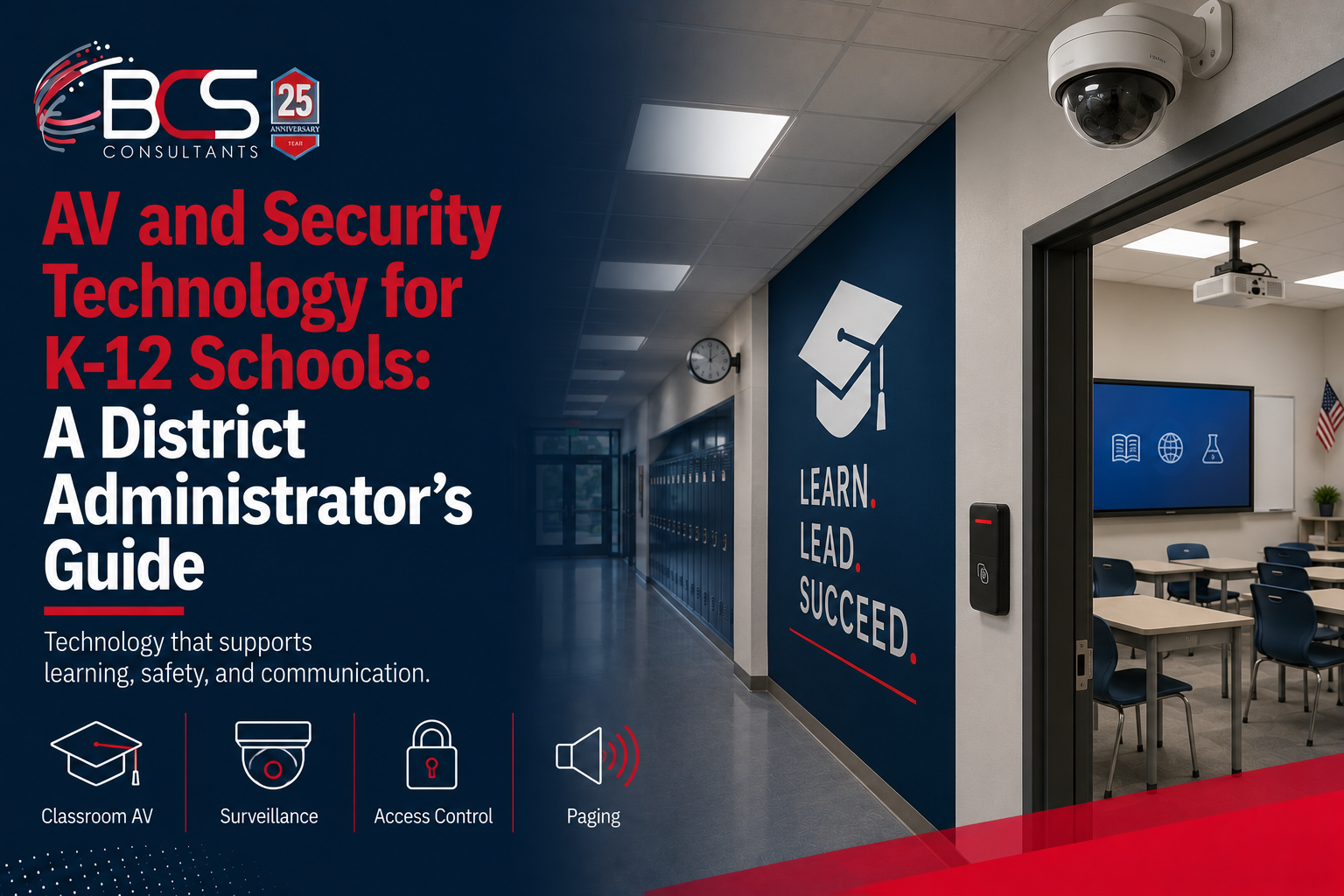
School districts occupy a unique position among the organizations that BCS serves. The technology requirements of a K-12 environment span an unusually broad range — from the classroom AV that shapes how students learn every day, to the security infrastructure that protects students and staff, to the communications systems that coordinate operations across multiple buildings and campuses, to the wireless infrastructure that enables one-to-one device programs that are now standard in most districts.
Managing this breadth of technology — often across dozens of school buildings, each with its own infrastructure characteristics and operational requirements — requires a partner who understands education environments, can plan multi-site projects coherently, and can deliver consistent results across every building in a district rollout.
This guide covers the technology systems that K-12 school districts need to plan and manage, and how BCS Consultants approaches school district technology projects.
Classroom AV: The Foundation of Effective Teaching
Interactive Flat Panels
Interactive flat panels have largely replaced projectors as the primary classroom display technology in new construction and renovation projects. They provide a bright, high-contrast display that remains readable in fully lit classrooms without window shading, a touch interface that allows instructors to interact with content directly on the screen, and a flat profile that is safer and easier to maintain than a projector-and-screen combination.
For districts standardizing on a single classroom AV platform, the choice of interactive flat panel platform determines the software ecosystem, the professional development investment, and the long-term support and replacement path. BCS advises on platform selection and manages multi-building deployments with consistent installation standards across every classroom.
Document Cameras
Document cameras remain a valuable instructional tool in K-12 classrooms, particularly in elementary and middle school environments. They allow teachers to display physical objects, student work, textbook pages, and hands-on demonstrations to the full class at high resolution — a capability that the interactive flat panel alone does not provide. Modern document cameras are compact, connect via USB, and integrate cleanly with interactive panel software.
Wireless Content Sharing
Wireless content sharing allows students and teachers to share their device screens to the classroom display without cables or adapters. In classrooms with one-to-one device programs where every student has a Chromebook, iPad, or laptop, the ability for any student to share their work to the room display supports collaborative learning activities and makes student presentations practical in the daily workflow.
Campus Security: Protecting Students and Staff
Access Control for Exterior Entrances
Access control at school entrances is a foundational physical security measure. Electronic locks with video intercom systems at main entrances allow office staff to see and verify visitors before buzzing them in, without staff needing to leave the office. Card-based access control for staff entrances allows teachers and administrators to enter the building without keys, with an audit trail of every entry event and the ability to immediately revoke a credential if it is lost or an employee separates from the district.
BCS designs access control systems for school campuses that balance security requirements with the operational reality of a school environment — accommodating student arrivals and dismissals, after-hours access for athletic and community programs, and emergency egress requirements.
IP Video Surveillance
IP surveillance cameras in K-12 environments provide deterrence, incident documentation, and the visual monitoring capability needed for large campuses where staff cannot be physically present in every area simultaneously. Camera coverage typically includes all exterior entrances and perimeters, parking areas, corridors, common areas, and portable classroom areas.
For school districts, cloud-based surveillance platforms offer significant advantages over traditional on-premise NVR systems: centralized management of all schools in the district from a single platform, no on-site server maintenance requirements at each school, and remote access for district security staff and law enforcement coordination.
Visitor Management
Visitor management systems at school front offices capture visitor identification, check visitors against sex offender databases, print visitor badges, and create a digital log of every visitor who enters the campus. Integrated with access control, visitor management systems can issue temporary credentials tied to the visitor's badge that expire automatically at the end of the visit.
Emergency Paging and Mass Notification
Emergency paging systems in K-12 schools serve both routine and emergency communication functions. Routine functions include morning announcements, class change bells, and administrative announcements to specific zones or the entire campus. Emergency functions include lockdown announcements, evacuation directions, severe weather alerts, and all-clear notifications — situations where clear, reliable, campus-wide audio communication is critical for student and staff safety.
Modern school paging systems from AtlasIED and Biamp integrate with IP networks, allowing any authorized administrator to initiate a campus-wide announcement from any computer or phone on the network. They also support integration with external mass notification systems that can automatically initiate specific alert sequences in response to triggers from intrusion detection, fire alarm, or other security systems.
Wireless Infrastructure for One-to-One Programs
One-to-one device programs — where every student has a personal computing device — have become standard in K-12 education. Implementing a one-to-one program on an inadequate wireless infrastructure produces predictable results: slow connections, dropped sessions, and instruction time lost to technology troubleshooting.
Wireless infrastructure for K-12 needs to support a device density that is higher than most commercial environments — a classroom with thirty students each running a Chromebook or tablet creates a very different wireless challenge than a corporate conference room. Professional access point sizing based on a predictive wireless survey, with appropriate AP placement for classroom coverage patterns and sufficient capacity for concurrent device connections, is the correct approach.
BCS designs and deploys enterprise wireless infrastructure for school campuses using Cisco Meraki and Aruba platforms, with network segmentation that separates student, staff, and building management traffic on appropriate VLANs.
Planning a District-Wide Technology Rollout
Multi-building school district technology projects require careful planning to maintain consistency across all sites while accommodating the individual characteristics of each building. BCS's national rollout deployment capability means we have the project management infrastructure to execute district-wide projects with consistent hardware specification, installation quality, and documentation standards across every school in the district.
We coordinate with each school's principal and operations team on scheduling, work with the district's IT department on network integration, and manage the complete project from design through final documentation — giving the district a single accountable partner for the entire technology infrastructure.
Frequently Asked Questions
Are there funding programs available for school technology infrastructure?
Yes. K-12 schools have access to several funding mechanisms for technology infrastructure including E-Rate (the FCC's Schools and Libraries Program, which subsidizes networking and communications infrastructure), ESSER funds (COVID-related federal education funds, with remaining balances in many districts), and state-level education technology grants. BCS can advise on which systems qualify for E-Rate reimbursement — structured cabling, wireless infrastructure, and networking equipment are typically eligible.
How does BCS minimize disruption to instruction during installation?
BCS schedules the majority of installation work during non-instructional periods — evenings, weekends, and summer break. For security systems that require brief interruptions to the occupied school day (such as fire alarm integrations that require a short panel test), we coordinate the timing with the principal and facilities team to minimize impact on instructional time.
Can BCS handle a district with twenty or more school buildings?
Yes. BCS's national rollout deployment model is specifically designed for multi-building projects. We develop a standard specification for each system type, establish a consistent installation and commissioning process, and deploy across all sites with parallel work streams that compress the total project schedule compared to sequential site-by-site deployment.