
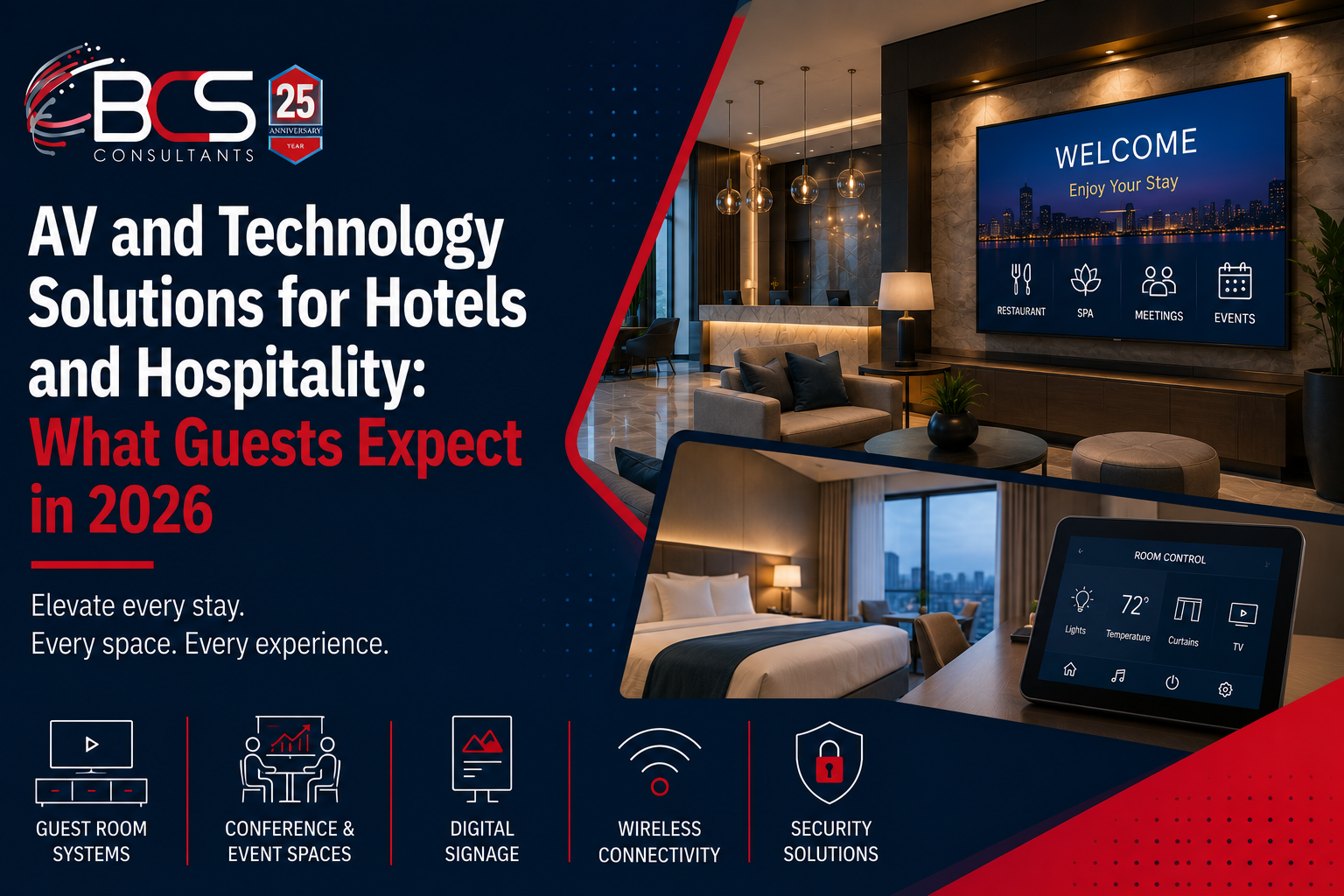
Hospitality technology has always been a reflection of guest expectations — and those expectations have changed substantially. Guests who connect seamlessly with enterprise-grade wireless at their office, watch high-definition content on demand at home, and participate in high-quality video meetings from wherever they happen to be do not lower their technology expectations when they arrive at a hotel.
Meeting those expectations requires hospitality AV and technology infrastructure that is designed for the specific demands of the environment: high device density, continuous operation, rapid guest turnover, diverse user technical sophistication, and the need for everything to work without staff intervention.
BCS Consultants installs AV, wireless, digital signage, and security systems for hospitality environments. This guide covers the full scope of technology that modern hotels and hospitality venues need to plan and manage.
Guest Room AV and Connectivity
The guest room technology experience begins with the in-room display. Commercial-grade displays specified for hospitality — not consumer televisions — provide the extended operating hours, centralized management capability, and integration with the property management system that hospitality environments require. HDMI input for guest device connection, cast capability that allows guests to stream their own content from a phone or tablet, and integration with the in-room control interface are standard expectations.
Bedside USB charging, sufficient power outlets for guests traveling with multiple devices, and intuitive lighting control all contribute to the guest experience in ways that guests notice when they are absent but quickly take for granted when done well.
Wired network access in guest rooms — an often-eliminated feature in recent years — remains valued by business travelers who need reliable connectivity for video calls, large file transfers, and applications where wireless performance is inconsistent.
Wireless Infrastructure for High-Density Guest Environments
Hotel wireless infrastructure faces one of the most demanding density challenges in the commercial world. A hotel floor with forty guest rooms, each potentially occupied by two or three guests each carrying multiple devices, combined with meeting rooms, corridors, and public spaces below, can place hundreds of simultaneous wireless clients on the access points serving a single floor.
Enterprise-grade wireless access points from Cisco Meraki or Aruba, sized and placed based on a professional predictive wireless survey for the specific hotel floor plan and construction type, are the appropriate solution. Consumer or prosumer wireless equipment consistently fails to deliver satisfactory performance in hotel environments.
Network segmentation is also critical: guest wireless traffic should be completely isolated from the property management system, point-of-sale, back-of-house staff networks, and building management systems — a requirement that enterprise wireless platforms with VLAN support handle natively.
Conference and Event Space AV
Hotel conference and event spaces serve a wide range of functions — corporate meetings, training sessions, social events, hybrid conferences, and presentations to audiences ranging from ten to several hundred. The AV infrastructure must be flexible enough to support this variety without requiring significant reconfiguration between events, and reliable enough that events run without technical failures that reflect on the property.
Large format displays or projection systems appropriate for the room size, distributed audio coverage throughout the space, wireless content sharing for presenters, and video conferencing integration for hybrid events are the baseline requirements. For properties that want to compete for high-value corporate event business, professional-grade AV comparable to dedicated conference facilities is necessary.
BCS designs conference and event space AV for scalability: infrastructure that supports the current use case and can be expanded for larger or more technologically demanding events without requiring a full renovation.
Digital Signage in Hospitality Environments
Digital signage serves both operational and experiential functions in hospitality environments. In the lobby and arrival areas, large-format displays welcome guests, display current weather and local information, and set the brand tone for the property. Wayfinding displays direct guests to meeting rooms, restaurants, fitness facilities, and other amenities, reducing demand on front desk staff for navigation assistance.
In conference and event areas, event listing displays outside meeting rooms show current and upcoming event names and times, replacing the printed cardboard signs that create a dated aesthetic and require manual updates. Digital compendium displays in corridors provide on-demand access to hotel services, local recommendations, and property information without requiring guests to navigate an in-room interface.
For food and beverage outlets within the property — restaurants, bars, pool areas — digital menu boards and promotional displays allow content to be updated from a central management system without printed materials.
Security Systems for Hospitality Properties
Hospitality security requirements balance guest safety and property protection with the expectation of a welcoming, non-institutional environment. IP surveillance cameras in common areas — lobby, corridors, parking, entrances, and back-of-house areas — provide the coverage needed for incident response and investigation without creating an atmosphere of surveillance in guest spaces.
Access control for back-of-house areas, service entrances, and staff-only spaces keeps unauthorized individuals out of areas where guest valuables, POS systems, and sensitive hotel operations are conducted. Integration with the property management system allows guest room key access to be provisioned and deactivated automatically at check-in and checkout.
Cloud-based platforms like Verkada are well-suited to hospitality environments because they eliminate on-site server infrastructure, provide remote management capability for security staff and corporate security teams, and integrate cameras with access control in a single dashboard.
Frequently Asked Questions
Can BCS handle the AV for an entire hotel property including all room types?
Yes. BCS designs and installs AV systems across all areas of a hospitality property — guest rooms, meeting and event spaces, food and beverage outlets, public areas, and back-of-house. Our project management capability allows us to coordinate the full scope as a single project with consistent standards throughout the property.
How does BCS minimize installation disruption in an operating hotel?
BCS schedules installation work to minimize disruption to guest-facing operations. Common area work is typically scheduled during off-peak overnight windows. Guest room work is phased through room blocks that are taken out of inventory sequentially, allowing installation to proceed while the majority of the property remains fully operational.
What wireless performance should guests expect in a professionally designed hotel WiFi network?
Guests should be able to connect reliably from anywhere on the property, achieve sufficient speeds for HD video streaming and video calling simultaneously on multiple devices, and experience consistent performance regardless of how many other guests are online at the same time. These outcomes require enterprise-grade equipment properly sized for the property — outcomes that are consistently achievable with a professionally designed and installed wireless network.