
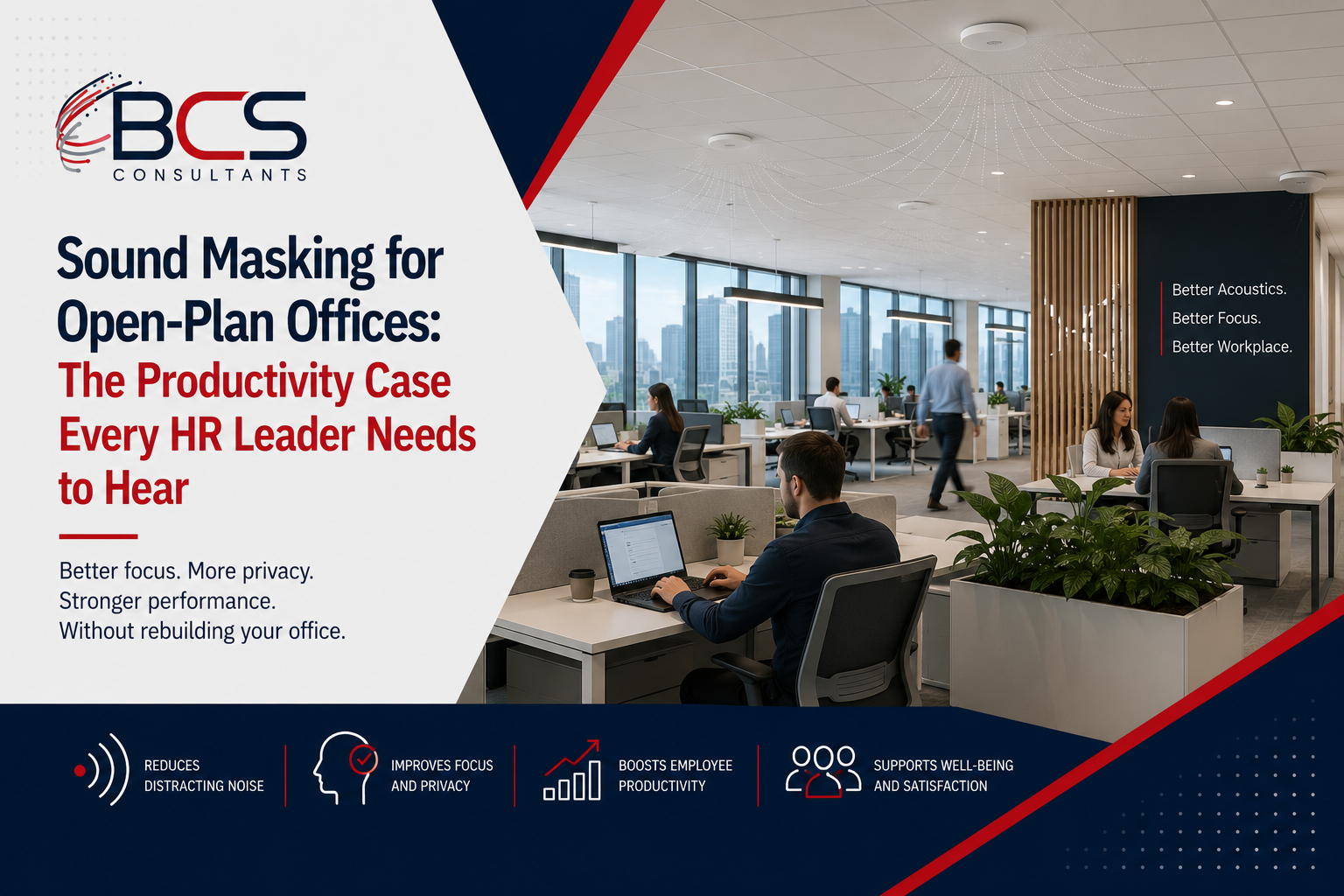
The open-plan office was designed to foster collaboration. The research on what it actually produces tells a different story. Studies across workplace design, cognitive psychology, and organizational behavior consistently find that uncontrolled noise is the leading source of dissatisfaction in open-plan work environments — and that the cognitive cost of acoustic distraction is significant, measurable, and directly linked to the inability of employees to do their best work.
HR leaders and facilities managers are increasingly aware of this problem. What many do not yet know is that there is a practical, non-disruptive solution that does not require rebuilding walls or returning to private offices. This guide makes the productivity case for commercial sound masking systems — specifically for the HR and facilities decision-maker who is approaching this as a workplace quality investment rather than a technical compliance requirement.
The Open-Plan Noise Problem
In a private office, the background noise level is relatively low and consistent — the sound of the building's HVAC system, perhaps muffled sounds from adjacent offices. The brain can tune this consistent background out and focus on the task at hand.
In an open-plan office, the noise environment is different in kind, not just degree. The brain does not tune out intelligible speech the way it tunes out consistent mechanical noise. When a nearby colleague's phone call is audible enough to follow — even partially — the brain involuntarily allocates attentional resources to processing that speech. This happens without conscious choice, and it disrupts the cognitive processes involved in complex thinking, writing, analysis, and any task that requires sustained concentration.
The research finding that most effectively captures the scale of this problem is the attention restoration time: after a significant distraction, it takes a substantial amount of time to regain the full depth of concentration that was present before the interruption. In an open-plan office where employees experience multiple significant audio interruptions per hour throughout the workday, the cumulative attention deficit is large.
What Sound Masking Does — and Does Not Do
Sound masking does not create silence. It does not block sound, reduce volume, or prevent noise from occurring. What it does is reduce the intelligibility of nearby speech — it makes conversations less easy to follow, even when they remain audible as a background sound.
This is the critical acoustic principle behind sound masking: human distraction from nearby conversations is driven primarily by intelligibility, not by volume. A conversation that can be followed, even partially, is far more distracting than one that is audible as a background murmur but cannot be understood. Sound masking shifts nearby conversations from the first category to the second.
A commercial sound masking system introduces a precisely calibrated background sound — engineered to match the frequency profile of human speech — that raises the apparent noise floor of the space and reduces the signal-to-noise ratio of nearby conversations below the intelligibility threshold.
Why Commercial Sound Masking Is Different from White Noise
Many organizations attempt to address open-plan noise with consumer white noise machines placed around the office. This approach consistently underperforms for the same reason: white noise — an equal distribution of energy across all frequency bands — sounds harsh and fatigue-inducing over extended exposure. Employees find it uncomfortable and counterproductive over the course of a full workday.
Commercial sound masking systems produce a different sound. The frequency spectrum is shaped to match the frequency range of human speech — typically emphasizing the frequencies between one thousand and five thousand hertz where speech intelligibility lives — with a sound profile that most people experience as similar to the sound of a well-functioning ventilation system: present but unobtrusive.
The key difference is calibration. A commercial system is tuned by acoustic professionals who measure the ambient noise levels in the space, target the appropriate masking level for the specific environment, and adjust the frequency response and output level until the system is performing correctly in that specific room. A white noise machine has no calibration process.
The HR and Business Case
The business case for workplace sound masking is straightforward. If acoustic distraction is reducing the productive output of knowledge workers — the employees whose compensation represents the largest cost center in most organizations — the cost of distraction measured in lost productive hours far exceeds the cost of a sound masking system.
Beyond productivity, workplace acoustics directly affect employee experience and retention. Open-plan noise is consistently ranked among the top complaints in employee engagement and workplace satisfaction surveys. Organizations that invest in acoustic quality as a component of workplace design signal to employees that their environment matters — a signal that has relevance for recruitment and retention in competitive talent markets.
Sound masking also has a specific value for the hybrid workforce: an open-plan office where employees can conduct video calls, client phone calls, and sensitive internal discussions without worrying about being overheard by the entire floor is a better working environment for the post-pandemic reality where communication tasks occur across a wider range of contexts than they once did.
How BCS Consultants Installs Sound Masking in Corporate Offices
BCS Consultants begins every sound masking project with an acoustic assessment: measuring the existing ambient noise levels in the space, identifying the areas of greatest acoustic exposure, evaluating the construction characteristics that affect sound propagation, and establishing the target masking levels for each zone.
Installation in occupied corporate offices is typically performed during off-hours — evenings and weekends — with above-ceiling speaker installation that produces no disruption to the occupied workspace. Post-installation calibration is performed by an acoustic technician who tunes the system in the specific acoustic environment of the space.
Frequently Asked Questions
Will employees find the sound masking system annoying?
A correctly calibrated commercial system operates below the conscious awareness threshold for most occupants. The adjustment period is typically a few days, after which occupants simply experience the space as quieter without attributing the change to any specific cause.
Can sound masking be added to an open-plan office without construction?
Yes. In most drop-ceiling office environments, sound masking speakers can be installed above the ceiling tiles without any visible construction activity in the occupied space. In open-ceiling environments, surface-mount speaker options and alternative delivery methods are available.
How is a corporate sound masking project scoped?
BCS Consultants scopes sound masking projects by square footage and zone count. We provide a design and estimate after the initial acoustic assessment, which we conduct at no charge as part of our project development process.
Ready to get started? Schedule a sound masking consultation with BCS Consultants bcsconsultants.com/contact/contact-us/
