
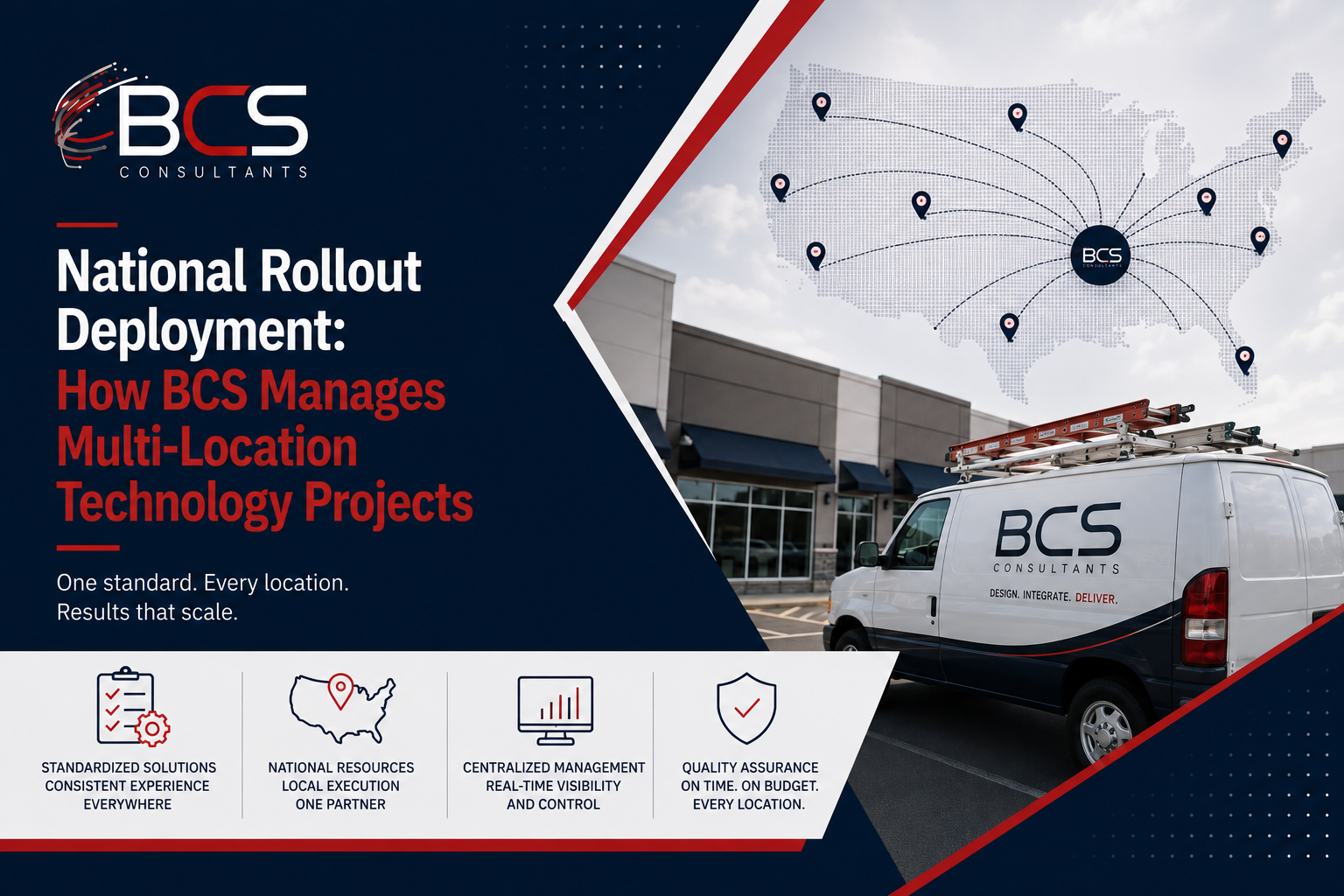
When an organization needs to deploy the same technology system — a new structured cabling standard, a digital signage network, a video conferencing room system, an access control platform — across dozens or hundreds of locations simultaneously, the project management challenge becomes fundamentally different from a single-site deployment.
A single-site project has one site plan, one installation team, one set of site-specific challenges, and one commissioning event. A national rollout has many of all of these, multiplied by every location in scope, with the additional challenge of maintaining consistency across all of them while managing the logistics of hardware, labor, scheduling, and documentation at scale.
This guide explains what a national rollout deployment actually involves, why most local AV and cabling contractors cannot execute at this scale, and how BCS Consultants manages multi-location technology projects.
What Makes National Rollout Different
Scale creates complexity that does not exist at the single-site level. A problem that is a minor inconvenience on a single-site project — a hardware delivery delay, a site access scheduling conflict, a network configuration that differs from the standard — is a systemwide event on a national rollout if it is not anticipated and managed within a consistent framework.
The organizations that hire BCS Consultants for national rollouts are facing specific challenges that drive that decision: they need the same hardware specification installed the same way at every location, producing the same user experience regardless of site. They need project tracking that shows the status of every site simultaneously, not a separate status call with each local contractor. They need a single documentation standard that their IT and facilities teams can use to understand every installed system without site-specific tribal knowledge.
These requirements are what distinguish a national rollout from a portfolio of individual projects managed by different local contractors, each with their own methods, documentation formats, and hardware preferences.
Phase 1: Standard Specification Development
Every national rollout begins with standard specification development — defining exactly what will be installed at every location, and what the acceptable variations are for sites that differ from the standard (different ceiling types, different room dimensions, different existing infrastructure).
The specification covers hardware models and part numbers, cabling category and component brands, configuration parameters for software-configured systems (content management platforms, room control software, access control systems), testing and acceptance criteria, documentation format, and labeling standards.
BCS Consultants develops the specification in collaboration with the client's IT, facilities, and operations teams, ensuring that the standard reflects the client's actual requirements and constraints across the full site portfolio. The specification is reviewed and approved before any procurement or installation begins — changes to the specification after the rollout is underway are expensive.
Phase 2: Pre-Construction Site Survey
Before installation begins at any location, each site receives a standardized pre-construction survey. The survey captures the information needed to plan the installation at that specific site: existing infrastructure, access constraints, building management contacts, network port locations, and any site-specific conditions that deviate from the standard.
For large rollouts, site surveys are conducted by local survey teams using standardized survey templates that BCS develops. The completed surveys are reviewed by BCS's project management team, who identify sites that require non-standard approaches and plan for those deviations before the installation team arrives.
Phase 3: Hardware Procurement and Staging
National rollout hardware procurement is managed centrally — BCS Consultants procures all hardware for all sites through its supply chain relationships, ensuring consistent hardware specification and pricing across the entire project. Hardware is received at BCS's staging facility, inspected, and in many cases pre-configured before delivery to the site.
Pre-configuration at the staging facility dramatically reduces the on-site installation time. For video conferencing room systems, this means the codec is configured, the Teams Rooms or Zoom Rooms application is installed and updated, and the resource account is provisioned before the installation team arrives. For access control systems, it means the panels are configured with the base programming before shipping to the site.
Phase 4: Parallel Deployment
The defining operational advantage of a professional national rollout over a sequential site-by-site approach is the ability to deploy at multiple sites simultaneously. BCS Consultants coordinates installation teams — its own field engineers supplemented by qualified regional partners where geography requires — across multiple locations running concurrently.
Project management tracks the status of every site through a single project management system: pre-construction survey complete, hardware delivered, installation scheduled, installation complete, commissioning complete, documentation delivered. At any point in the project, the client's project team and BCS's project management team can see the aggregate project status across every site simultaneously.
Phase 5: Quality Control and Commissioning
Quality control for national rollout projects requires a consistent commissioning standard that every site is measured against. BCS Consultants develops a commissioning checklist that covers every installed system at every site — the same tests, the same acceptance criteria, and the same documentation format at every location.
For systems where remote commissioning is possible — cloud-based platforms like Verkada for security and Teams Admin Center for video conferencing — BCS Consultants' project management team verifies commissioning remotely as installation teams complete each site, accelerating the project schedule without requiring a separate site visit for each commissioning event.
Phase 6: Documentation Delivery
Every site receives a consistent documentation package: as-built drawings, system configuration records, Fluke DSX certification reports for cabling installations, and user guides. The documentation is delivered in the client's preferred format — print, electronic, or both — and is organized so that any IT or facilities team member can understand the installed system at any location without additional explanation.
Who Hires BCS Consultants for National Rollout Deployments
National rollout clients are organizations with a technology need that spans multiple locations and requires consistency across all of them. Retail chains deploying digital signage networks across hundreds of stores. Financial institution networks deploying access control upgrades across dozens of branches. Corporate real estate portfolios standardizing conference room AV across multiple buildings. School districts deploying structured cabling and wireless infrastructure across multiple schools. Each of these clients needs what BCS Consultants delivers: consistent specification, parallel deployment capability, centralized project management, and standardized documentation.
Frequently Asked Questions
How does BCS Consultants manage rollout projects in geographic areas where it does not have field staff?
BCS Consultants maintains a network of qualified regional partners who are vetted for workmanship quality and compliance with BCS's installation standards. Regional partners execute installations under BCS's supervision, using BCS's specifications and documentation requirements. BCS Consultants' project management team coordinates the full project regardless of which field resources are executing at any given site.
What is the typical timeline for a national rollout project?
Timeline depends on the number of sites, the complexity of the installation at each site, and the client's scheduling constraints. BCS Consultants has managed projects ranging from ten sites completed in four weeks to hundreds of sites completed over twelve months. We develop a detailed project schedule during the specification phase based on the client's requirements.
How does BCS handle sites that deviate significantly from the standard specification?
Sites that cannot be served by the standard specification are flagged during the pre-construction survey phase and receive individual design attention before installation is scheduled. The deviation is documented in the site-specific scope of work, and the client is notified before any non-standard work proceeds.
Ready to get started? Talk to BCS Consultants about your multi-location deployment project · bcsconsultants.com/contact/contact-us/
