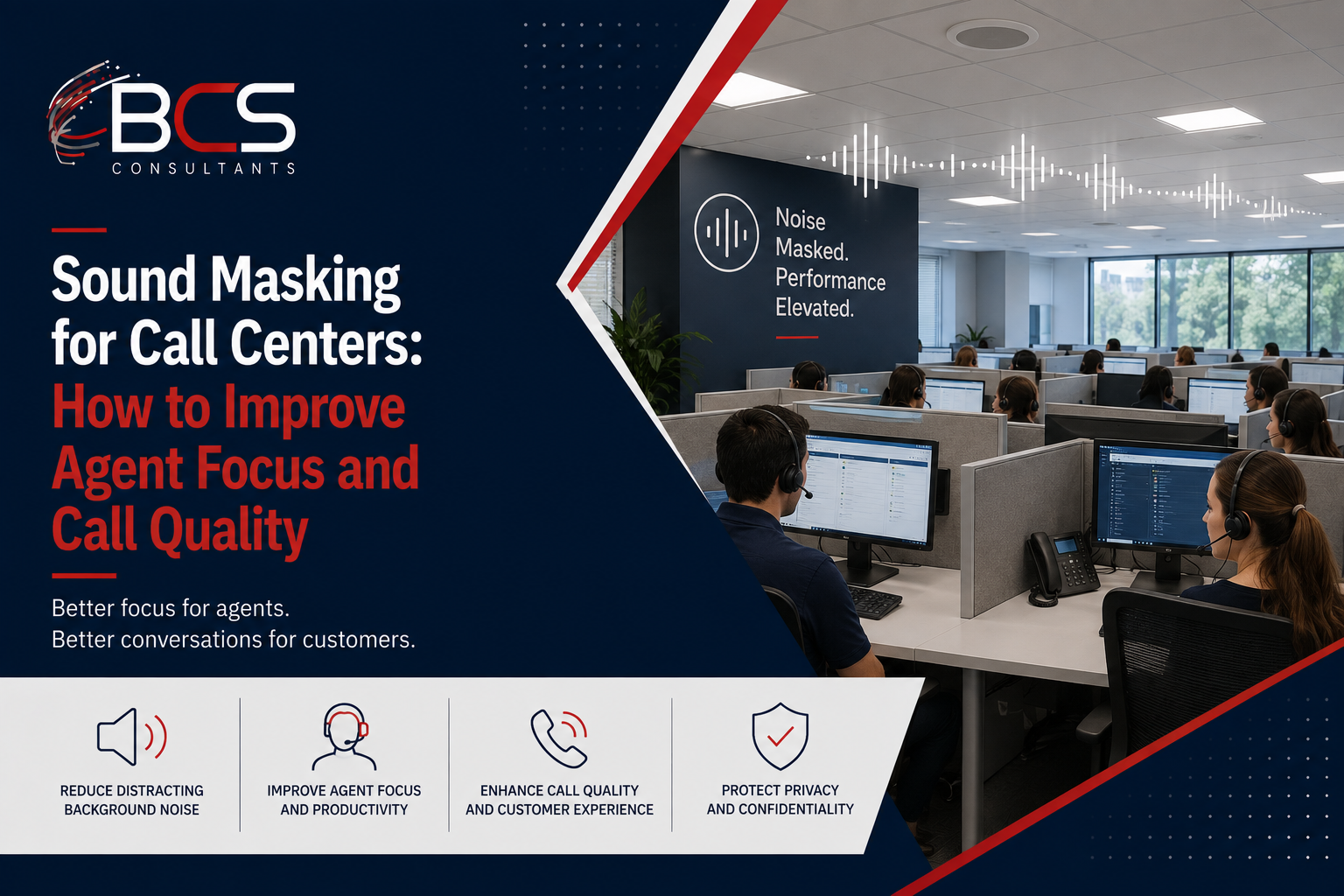
The call center is the most acoustically demanding open-plan work environment in the commercial world. Every agent is simultaneously on a call — talking, listening, and processing information — while surrounded by the sound of dozens of other agents doing the same thing. The noise environment this creates is not incidental to the work; it is a direct impediment to doing the work well.
The call center acoustic problem has two sides. Agents struggle to maintain focus and concentration in an environment where the sound of adjacent conversations competes for cognitive attention. Customers hear the background noise of the call center through the phone, which reduces confidence in the professionalism of the interaction. Sound masking addresses both sides of this problem simultaneously.
The Two-Sided Call Center Noise Problem
Side 1: Agent Focus and Cognitive Performance
Call center agents perform cognitively demanding work: listening carefully to customers, processing complex information, navigating software systems, and formulating responses — all simultaneously, and continuously for the duration of their shift. Acoustic distraction from adjacent conversations does not just make the environment unpleasant — it degrades the cognitive performance required to do the work accurately and efficiently.
The specific mechanism is speech-on-speech interference: the brain processes intelligible speech involuntarily, even when the listener is trying to ignore it and focus on a different conversation. When an agent's ears can follow pieces of the call happening at the adjacent desk, that comprehension process consumes cognitive resources that the agent needs for their own call. The result is increased errors, reduced first-call resolution rates, and greater agent fatigue over the course of a shift.
Side 2: Call Quality and Customer Perception
The acoustic environment of a call center is audible to customers on the other end of the phone. Background call center noise heard through the phone — a chorus of other agents' conversations — creates a specific perception: the customer knows they are talking to a call center, and the noise level communicates something about the volume and anonymity of the operation.
For organizations that have invested in customer experience and brand positioning, background call center noise audible to customers undermines that investment. For financial services, healthcare, and legal organizations where the sensitivity of the subject matter makes a private, professional atmosphere important, call center noise on the phone is a reputational consideration.
How Sound Masking Addresses Both Problems
Sound masking raises the ambient noise floor in the call center uniformly, which has specific effects on both problems.
For agent focus: When the ambient noise floor rises, the signal-to-noise ratio of adjacent conversations decreases. Nearby conversations that were previously intelligible — followable, distracting — become less so. They are still audible as a background presence, but the speech content becomes harder to follow, which reduces the involuntary comprehension process that competes with the agent's own call.
For call quality: Sound masking adds a consistent, spectrally shaped background sound that occupies the frequency range where speech intelligibility operates. Telephone microphones in agent headsets are designed to pick up close-speaking agents and reduce the sensitivity to distant background sounds — with appropriate headset technology, the effect of even reduced call center background noise on the transmitted audio is small. The primary benefit to customers is the reduction in the subjectively perceivable noise level on the line.
Zone Design for Call Center Sound Masking
Call center floor plans are typically open-plan, but not acoustically uniform. Agent workstation areas, supervisor stations, glass-walled manager offices, break rooms, and call coaching areas all have different acoustic characteristics and different sound masking requirements.
BCS Consultants designs call center sound masking systems with zone configurations that account for these differences. Agent workstation zones are typically the highest-masking-level zones in the system — the areas where the two-sided acoustic problem is most acute. Supervisor stations may require slightly different masking levels to support their monitoring and coaching functions. Enclosed coaching areas and manager offices may benefit from masking independent from the open floor.
Zone controllers in the sound masking system allow different areas of the floor to be adjusted independently, so changes in one zone — for a staffing reconfiguration or a temporary high-acuity campaign area — do not require system-wide adjustments.
Integration with Paging Systems
Call center facilities frequently run paging systems for operational announcements — shift changes, supervisor escalations, emergency notifications, and performance updates. The sound masking system integrates with the paging infrastructure so that paging announcements override the masking sound automatically, ensuring that announcements are clearly audible throughout the floor without requiring the masking system to be manually adjusted.
Modern distributed paging and sound masking platforms from AtlasIED and Biamp integrate both functions in a single hardware and software ecosystem, simplifying the system architecture and providing a single management interface for both masking and paging.
Frequently Asked Questions
Does sound masking affect agents' ability to hear their customers?
No. Agents' phone or headset audio is transmitted directly through the headset — it does not compete with the room acoustic environment. The masking system affects what the agent hears through their ears in the room, not through their headset. Agents in a properly designed sound masking environment typically report that the system makes it easier to hear their customers, not harder, because the background noise that was previously competing for their attention is reduced.
Can sound masking be adjusted for different times of day or staffing levels?
Yes. Modern sound masking systems support scheduling that automatically adjusts masking levels for different time periods — higher levels during peak staffing hours, lower levels during overnight or reduced-staffing periods when the ambient noise floor is naturally lower. Manual override is also available from the system management interface.
How does sound masking in a call center affect agents who are on video calls rather than phone calls?
Agents participating in video calls from open-plan call center environments benefit from sound masking in the same way as standard call center agents — the reduction in intelligibility of adjacent conversations reduces distraction and improves focus. The camera and microphone in the video call system may capture some background sound masking, but at correctly calibrated levels, this is perceived as consistent white noise rather than distracting speech.
Ready to get started? Schedule a call center sound masking consultation with BCS · bcsconsultants.com/contact/contact-us/
