
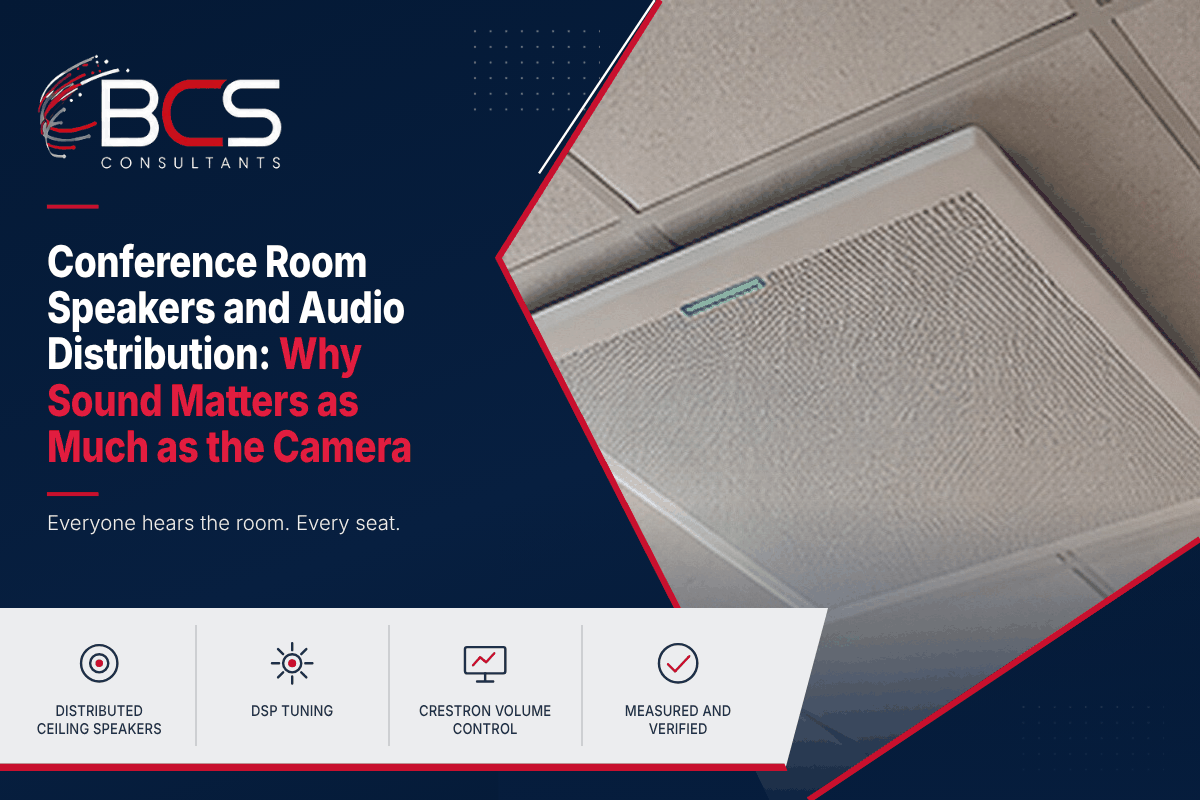
The audio problem in conference rooms is almost always framed from the microphone's perspective — whether the people in the room are being picked up clearly for the remote participants. Less frequently discussed is the speaker side of the equation: whether the remote participants' audio is being delivered clearly to everyone in the room.
This asymmetry in how conference room audio is evaluated leads to a common installation pattern: a high-quality Shure ceiling microphone array capturing excellent audio from every seat, feeding into a codec that delivers clear audio to remote participants — while the room's own audio output comes from a single small soundbar positioned at the display end of the room, audible clearly to the participants closest to it and increasingly difficult to hear for participants at the far end of a twelve-seat conference table.
Clear audio reproduction for in-room participants is as important to meeting quality as clear microphone pickup, and conference room speakers require the same intentional design approach that goes into any set of conference room audio solutions.
Less frequently discussed is the speaker side of the equation: whether the conference room speakers deliver the remote participants' audio clearly to everyone in the room.
Why Soundbars Fall Short in Medium and Large Rooms
Soundbars and single-point loudspeakers work well in small rooms where the entire participant group is within a few feet of the speaker. Their audio output falls off with distance — the physics of sound propagation means that sound intensity falls with the square of the distance from the source, roughly six decibels for every doubling of distance. A participant six feet from the soundbar hears it at a comfortable level; a participant twelve feet away hears it roughly six decibels lower, which listeners perceive as noticeably quieter.
In a conference room where participants are distributed around a table of ten or twelve feet, a single soundbar at one end of the room produces a listening experience where the participants closest to the display hear the remote audio clearly and those at the far end struggle to follow — or need to lean toward the speaker, which is both uncomfortable and disruptive.
This is particularly problematic for hybrid meetings where in-room participants need to hear remote participants clearly to engage effectively in the discussion. If the in-room audio is consistently poor for participants at one end of the room, those participants disengage — not because they are not interested, but because the technology is preventing participation.
Distributed Ceiling Speakers for Conference Rooms: The Solution
A distributed ceiling speaker system places multiple speakers throughout the conference room, positioned above the participants at regular intervals along the table length. Each speaker serves the participants directly below it and overlapping into the coverage of adjacent speakers, producing consistent audio levels throughout the entire room regardless of table position.
The design principle is even coverage: every participant in the room should hear the remote audio at approximately the same level, within a few decibels. Achieving this requires calculating the coverage footprint of each speaker type at the ceiling height in question, spacing speakers appropriately for that footprint, and confirming with post-installation measurement that levels are consistent throughout the seating area.
Commercial ceiling speakers specified for conference room applications are designed for intelligible speech reproduction, with frequency response optimized for the vocal range and dispersion patterns that provide even coverage at conference room ceiling heights. BCS Consultants specifies speaker models from Biamp, AtlasIED, and similar manufacturers with documented performance specifications for each application.
DSP Role in Room Audio Output Management
The digital signal processor is as important for the output side of conference room audio as it is for the input side. The DSP manages the audio routing from the far-end codec to the room's speakers, applies equalization to compensate for the acoustic characteristics of the room, manages output levels across all speaker zones, and integrates the speaker output with the acoustic echo cancellation algorithm to prevent the speakers from being re-captured by the room microphones.
Level management through the DSP allows different zones of the room to receive different output levels — adjusting for acoustic asymmetry in rooms where one end has more absorption than the other, for example — while presenting a single unified volume control to the room occupant via the Crestron touch panel.
Control System Integration
As part of a room automation design, the conference room speakers integrate with the Crestron room control system so that in-room participants can manage audio volume from the touch panel. Volume adjustments, mute control, and the preset volume levels associated with different room modes — a meeting start preset that sets the volume to a standard level, a presentation mode that manages audio routing for content sharing — are all managed through the Crestron interface.
Integration also allows the room control system to manage the speaker output in coordination with other room functions. When the meeting ends, the speaker output is muted as part of the room reset sequence. When a video conferencing session is active, the DSP applies the appropriate audio processing profile for the codec. When background music is enabled in the lobby mode (for rooms that serve lobby functions when not in use for meetings), the speaker system delivers that audio at the appropriate level.
Specifying Conference Room Speakers: Layout, Power, and Testing
A conference room speaker system follows a few practical rules. Speaker spacing is set by ceiling height and the coverage angle of the speaker, amplifier power is chosen with enough headroom to avoid distortion at speech peaks, and equalization is applied to correct the room's response. Whether the speakers run at low impedance or on a 70-volt line, the design should be documented so that later changes do not upset the balance.
Testing closes the loop. BCS Consultants measures levels at every seat using test signals, checks that the echo canceller handles the speaker output without artifacts, and then runs a live call with a remote participant who confirms how the room sounds from the far end. Seats at the far end of the table are checked first, because they are where weak coverage shows up.
Soundbar or Ceiling Speakers? A Quick Decision Guide
A soundbar is generally adequate for a small room where everyone sits within a few feet of the display. As the table grows, as in a full-size conference room solution, or when seating surrounds the table on several sides, ceiling speakers give more even coverage. Boardrooms and training rooms, and any room with a dedicated DSP, usually benefit from distributed ceiling speakers designed for the space.
Common Conference Room Speaker Problems
Common problems include uneven volume between seats, harsh or boomy sound from untreated surfaces, hum or noise from poor grounding, and echo caused by a mismatch between the speaker feed and the echo canceller. Careful design, calibration, and testing address each of these before the room is handed over.
Another frequent problem is volume control. If users can adjust a hidden volume control that was set differently by another team, calls will vary from day to day. A single, locked-down level with a user-friendly volume range on the room controller produces consistent results.
Frequently Asked Questions
How do I know if my conference room speakers are adequate?
Listen to remote participant audio from the far end of the table — the seat farthest from the display — during a real video call. If the audio is noticeably harder to understand than from the seat nearest the display, the speaker system is not providing even coverage. BCS Consultants can measure audio levels throughout the room and provide a recommendation based on the measurement data.
Can BCS Consultants add ceiling speakers to a conference room that already has a soundbar?
Yes. In most cases, ceiling speakers can be added to a conference room that has an existing AV system. The integration path depends on the existing codec and DSP infrastructure. BCS Consultants evaluates the existing system and recommends the addition that produces the best coverage improvement for the specific room configuration.
Do ceiling speakers require acoustic treatment in the conference room?
Ceiling speakers perform better in rooms with appropriate acoustic treatment — acoustic panels that reduce reverberation and reflections improve both speech intelligibility from the speakers and microphone pickup quality. However, ceiling speakers are effective even in rooms without formal acoustic treatment, as long as the speaker system is designed for the room's specific acoustic characteristics.
How many ceiling speakers does a conference room need?
It depends on the room size, ceiling height, and speaker coverage pattern. The goal is even coverage at every seat rather than a particular count. A designer calculates spacing from the speaker specification and the ceiling height, and then verifies levels with measurements after installation. Larger or longer rooms usually need several speakers distributed over the seating area.
Can existing ceiling speakers be reused in a conference room upgrade?
Sometimes. Speakers from an older paging or background music system are often not designed for clear speech at conference table distances. BCS Consultants checks the model, condition, wiring, and spacing of existing speakers and reuses them only when they will meet the target coverage and clarity, which saves cost without compromising meeting quality.
Ready to get started? Talk to BCS Consultants about conference room audio for your meeting spaces · bcsconsultants.com/contact/contact-us/