
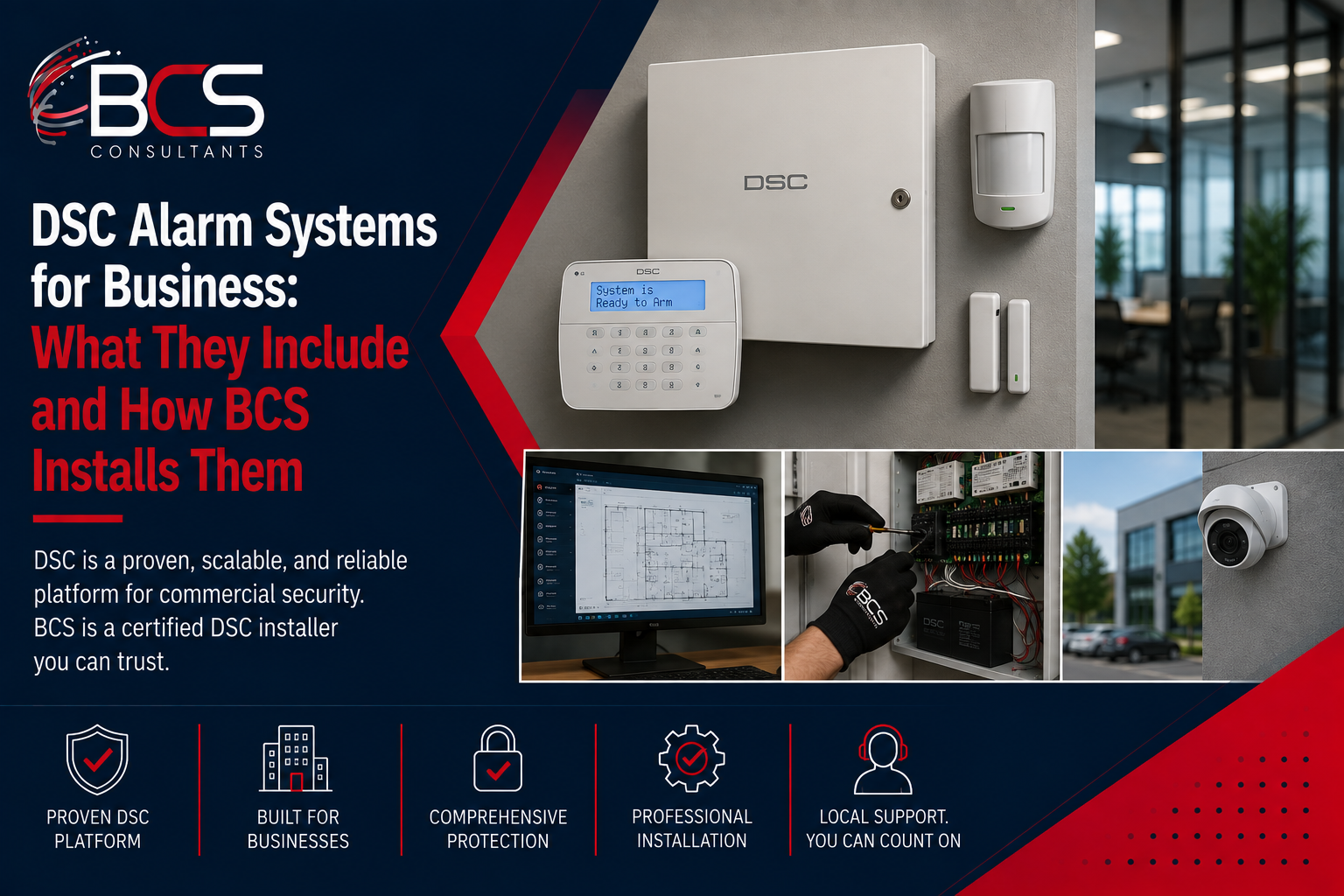
DSC (Digital Security Controls) is one of the most trusted names in commercial intrusion detection — and for good reason. The DSC PowerSeries Neo platform has been deployed in millions of commercial buildings across North America, combining reliable hardware with flexible software and deep integration capabilities that make it a strong choice for businesses that want an on-premise alarm system with professional-grade capability.
BCS Consultants is a certified DSC installer. This guide explains what the DSC PowerSeries Neo ecosystem includes, who it is right for, and what a professional DSC installation involves.
The DSC PowerSeries Neo Platform
PowerSeries Neo is DSC's current-generation commercial alarm platform. It is built around a central control panel that manages all detection devices, keypads, and communicators in the system, with a modular architecture that allows the system to scale from small single-zone installations to large commercial deployments with hundreds of zones across multiple buildings.
The HS2128 panel is DSC's flagship commercial control panel, supporting up to one hundred and twenty-eight zones — each zone representing an independently monitored detection circuit covering one or more sensors. The HS2016 covers up to sixteen zones and is appropriate for smaller commercial applications. Both panels use the same detector technology, software, and communicator infrastructure, making them part of a consistent ecosystem.
DSC PowerG Wireless Detection Devices
One of the most significant capabilities of the PowerSeries Neo platform is its support for PowerG wireless devices — a two-way wireless protocol developed by DSC that operates at 912 MHz in North America. PowerG wireless devices communicate bidirectionally with the panel, allowing the panel to confirm that every detector is online and reporting correctly, not just receive signals when events occur.
PowerG motion detectors, door and window contacts, glass break detectors, panic buttons, and environmental sensors (smoke, carbon monoxide, flood) all connect wirelessly to the panel without requiring dedicated alarm wiring at each sensor location. This makes PowerG particularly valuable in retrofit installations — existing commercial spaces that need intrusion detection added without the disruption and cost of running new low-voltage wiring throughout the building.
PowerG devices include anti-jamming and anti-substitution security features that detect and report attempts to interfere with the wireless signal, addressing a vulnerability that older wireless alarm platforms have faced.
Keypads and User Interface
DSC Neo keypads provide the user interface for arming and disarming the system, navigating alarm events, and managing user credentials. The HS2LCD and HS2LCDP keypads are character-based displays with a conventional button interface. The HS2TCHP is a touchscreen keypad with a graphic interface and proximity card reader capability for sites that want card-based arming and disarming.
For commercial applications where multiple people need to arm and disarm the system with individual credentials, the PowerSeries Neo manages a user database with unique PINs for each user, providing an audit trail of who armed and disarmed the system and at what time.
Central Station Connectivity
Every commercial alarm system should be connected to a professional central monitoring station. The PowerSeries Neo communicates with the monitoring station via multiple pathways: cellular communication (the most reliable primary communicator for commercial applications), broadband over the local internet connection, and traditional landline as a legacy option.
BCS connects every DSC installation to a licensed monitoring partner. Dual-path communication — cellular plus broadband — provides redundancy that ensures the monitoring station receives alarm signals even if the internet connection at the site is disrupted.
EntraPass Integration: Access Control and Alarm in One Platform
For organizations that are deploying or already have a Kantech access control system, the DSC PowerSeries Neo integrates directly with Kantech's EntraPass software. This integration allows security managers to view alarm events alongside access control events in a single interface, receive combined notifications, and respond to integrated events — for example, automatically locking all access-controlled doors when an alarm is triggered.
This level of integration is not available between DSC and arbitrary access control systems — it is specifically supported through the Kantech-DSC product relationship within the Johnson Controls portfolio. For organizations using Kantech access control, specifying DSC for the alarm system provides a native integration path that third-party alarm panels cannot match.
What a BCS DSC Installation Looks Like
BCS Consultant begins every DSC project with a security assessment: a walk-through of the facility that identifies all areas requiring intrusion detection coverage, evaluates existing infrastructure that can be reused, determines the zoning strategy for the panel, identifies optimal keypad locations for user access, and evaluates communication pathway options.
From the assessment we produce a system design, handle hardware procurement through our authorized DSC distribution relationship, and manage the complete installation — panel mounting and wiring, detection device placement and installation (wired or PowerG wireless), keypad installation, communicator configuration, central station programming, and user credential setup.
Before handoff, we conduct a full point-to-point test of every zone in the system and verify that central station signals are received correctly for every alarm and tamper condition. We train the designated system administrators on arming, disarming, user management, and alarm response procedures.
Frequently Asked Questions
Can DSC PowerSeries Neo be expanded after initial installation?
Yes. The PowerSeries Neo architecture is designed for expansion. Additional detection zones can be added by adding zone expander modules to the panel. Additional wireless PowerG devices can be enrolled without any panel modification up to the panel's maximum zone count.
What is the difference between a supervised and an unsupervised alarm zone?
A supervised zone continuously monitors the integrity of the wiring between the panel and the sensor, alerting the panel if the wire is cut or the connection is interrupted. Supervised zones are required for commercial UL-listed alarm systems and provide significantly higher security than unsupervised installations.
How long does a commercial DSC alarm installation take?
The timeline depends on the number of zones, whether wired or wireless devices are used, and the size and complexity of the facility. A small commercial installation of fifteen to thirty zones using PowerG wireless devices typically takes one to two days. Larger wired installations in multi-floor buildings take longer and are planned in phases.
Ready to get started? Schedule a DSC alarm system assessment with BCS Consultants.
