
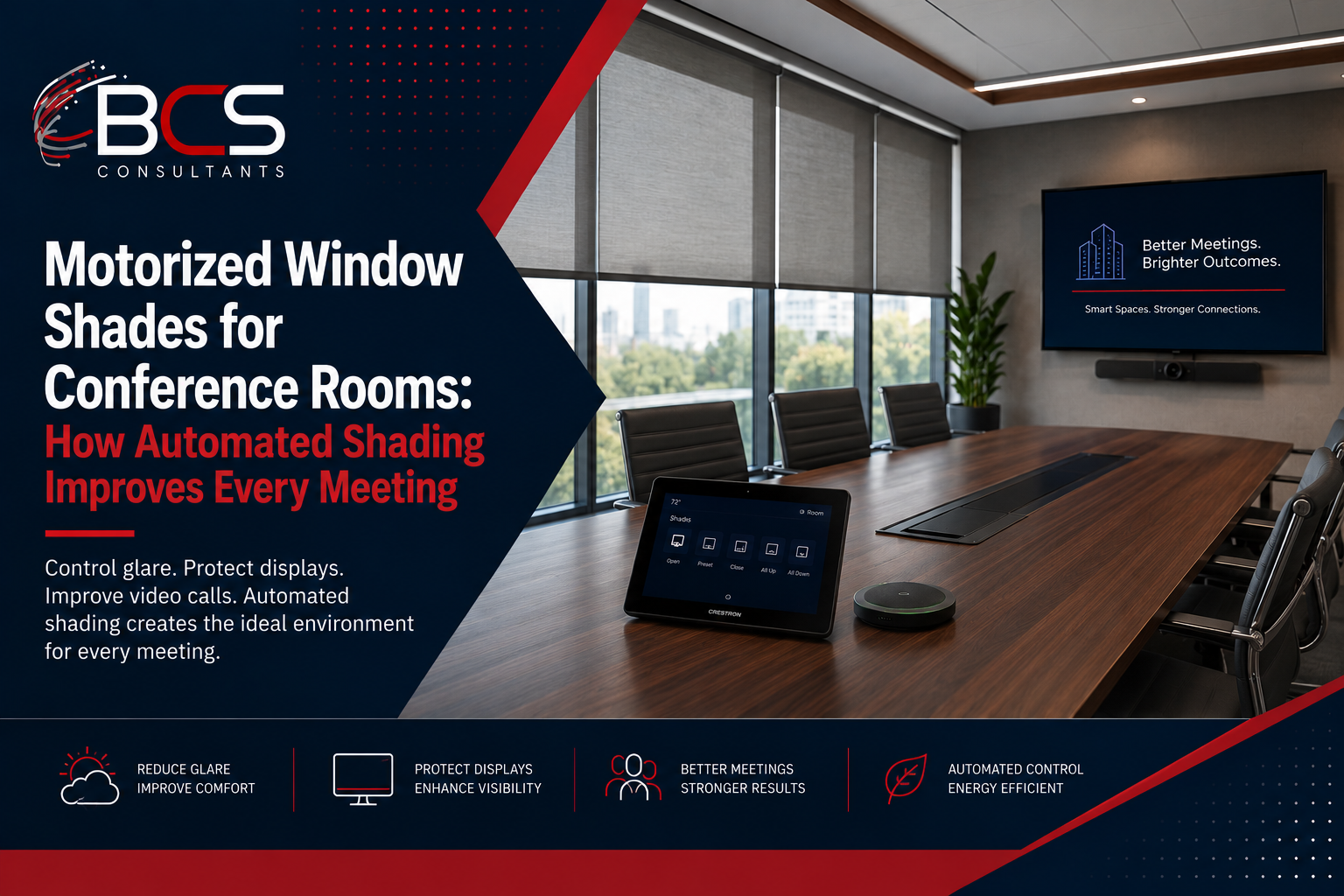
Every conference room that faces east, west, or south has a problem that occurs at some point during the day: sunlight that washes out the display, blinds participants in the camera frame, or makes it impossible for someone at one end of the table to see the screen. In rooms without motorized shades, the solution is manual — someone gets up mid-meeting, pulls the shade cord or twists the blind wand, and the meeting pauses while the room is adjusted.
In rooms with automated motorized shades integrated into the Crestron room control system, this problem does not exist. The shades close automatically when a presentation starts. They open when the meeting ends. No one gets up. No one interrupts the meeting. The room just works.
Why Window Shading Matters for Conference Room AV
The impact of uncontrolled natural light on conference room AV performance is often underestimated during the design phase and consistently complained about during operation.
For displays, the problem is washout: ambient light reflecting off the display surface reduces effective contrast ratio dramatically. A display that delivers excellent image quality in a darkened room may be difficult to read when afternoon sunlight is entering the space behind the viewer's position. The brightness specifications of commercial displays — typically five hundred to seven hundred nits — are calibrated for controlled ambient light environments. Uncontrolled sunlight can easily exceed those levels.
For video calls, the problem is backlighting. When a participant at the near end of the table is backlit by a window, the camera — which exposes for the average scene brightness — underexposes the participant's face, making them appear as a dark silhouette against a bright background. Remote participants cannot see facial expressions or read lip movement, which significantly degrades the communication quality of the call.
For other participants, direct sunlight or bright sky glare in the field of view creates uncomfortable viewing conditions that reduce focus and cause eye fatigue over the course of long meetings.
How Motorized Shade Integration Works in Crestron
Crestron integrates motorized window shades through dedicated shade controllers that communicate with shade motors via RS-485 or wireless protocols, depending on the shade system specified. The shade position is a parameter that the Crestron control processor can set, read back, and include in any programmed room behavior.
In a typical Crestron room automation configuration, shade behavior is tied to meeting mode presets. When the room enters presentation mode — triggered either by a participant selecting the presentation source on the touch panel or automatically when a cable or wireless presentation connection is detected — the shades lower to a preset position appropriate for the ambient light conditions and display orientation in that specific room.
When the meeting ends and the room resets to standby, the shades return to the default open position, restoring natural light to the space.
Manual shade control is always available from the Crestron touch panel — individual shade channels can be raised or lowered on demand by any room occupant, with position adjustment in increments that allow fine-tuning without fully closing or opening.
Shade Types and Selection
Not all shade fabrics provide the same performance in a conference room environment. The selection of shade material is as important as the motorization and control system.
Blackout shades provide complete light blockage when fully closed, eliminating all ambient light from the space. They are appropriate for rooms used for presentation or video viewing where complete darkness is needed, but they also eliminate natural light entirely — which many conference room users find unpleasant for extended meetings.
Solar shades, also called screen shades, allow diffused natural light to pass through while blocking direct sunlight glare and reducing the amount of light that reaches the room. They maintain a view to the outside while controlling glare — a balance that many users prefer for standard meeting conditions. Solar shades are rated by openness factor, with lower openness factors providing more light control.
Light-filtering shades fall between solar and blackout in performance — they reduce direct sunlight significantly while allowing soft, diffused natural light into the space. They are appropriate for many conference room environments where the balance between light control and natural light retention is the design goal.
BCS Consultants recommends shade type based on the orientation of the windows relative to sun path, the time of day when the room is most heavily used, and the preference of the client for the trade-off between light control and natural light retention.
Integration with Lighting Control
Automated shading delivers the most value when integrated with the room's lighting control system. When shades close for a presentation, the room lighting can simultaneously shift to a presentation scene that supplements the reduced natural light with appropriate artificial illumination — bright enough to remain comfortable for participants while not competing with the display.
This coordination between shading and lighting is what makes a Crestron-controlled room feel genuinely automated rather than simply motorized — the environment reconfigures itself holistically for the meeting type, not just in one isolated dimension.
Frequently Asked Questions
Can motorized shades be added to a conference room that already has an AV system?
Yes, in most cases. If the room has a Crestron control system, shade control can be added by installing shade motor controllers, motorizing the existing shade or replacing them with motorized units, and adding the shade control programming to the existing Crestron configuration. BCS Consultants handles this as a retrofit project.
What shade brands does BCS Consultants work with?
BCS Consultants works with leading commercial motorized shade brands including Lutron, Crestron Shade, and others compatible with Crestron control. Shade brand selection depends on the type of shade mounting, fabric selection, and control interface requirements for each project.
How long does motorized shade installation take in a conference room?
Shade installation in a standard conference room typically takes half a day to a full day, depending on the number of windows, the shade mounting type, and whether the Crestron programming already includes shade control capability or needs to be added.
Ready to get started? Add automated shading to your conference rooms — talk to BCS Consultants· bcsconsultants.com/contact/contact-us/
