
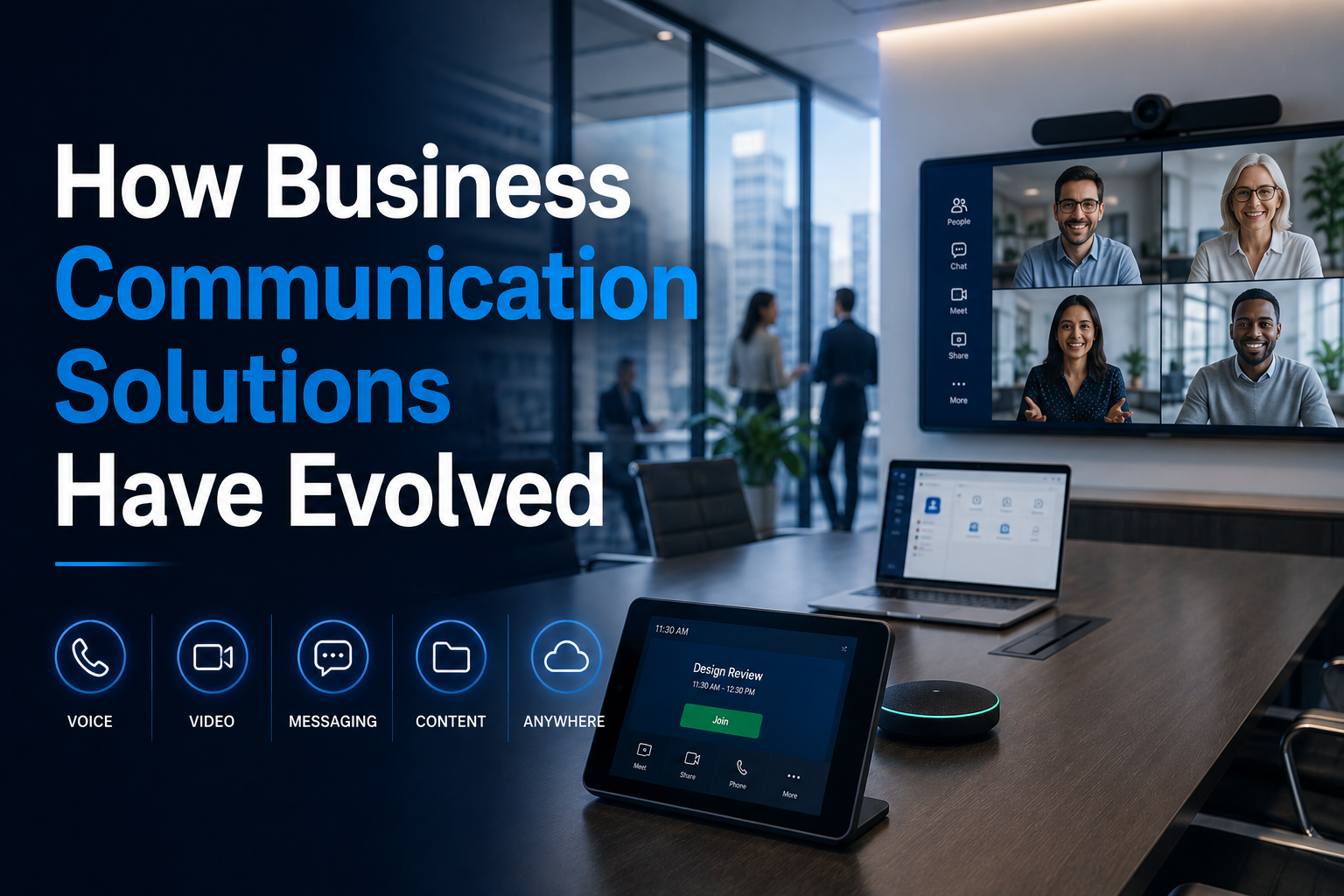
How Business Communication Solutions Have Evolved
Business communication solutions have changed more in the last decade than in the previous fifty years. The era of the desk phone, the conference bridge, and the printed memo gave way to unified platforms that combine voice, video, messaging, and content into a single experience accessible from anywhere. The pace of change has accelerated through hybrid work, and the businesses that get communication right are the ones that treat it as a single integrated stack rather than a collection of independent tools. This guide traces how business communication solutions evolved, what they look like today, and how BCS Consultants brings them together for clients.
The Shift From Phones to Unified Business Communication Solutions
For most of the modern business era, communication meant the phone on the desk and the meeting in the room. Each technology lived in its own silo, with its own vendor, its own infrastructure, and its own IT support burden. Adding video conferencing meant new hardware, new training, and new failure points. Adding messaging meant another login. Adding mobile meant another set of expenses.
Unified business communication solutions ended that fragmentation. Voice, video, messaging, presence, and content sharing now live in a single platform, accessible from a single client, supporting users across desks, conference rooms, and mobile devices. The shift simplified IT and transformed how people actually communicate.
What UCaaS Means for the Modern Workplace
Unified Communications as a Service — UCaaS — delivers business communication solutions from the cloud. The provider operates the platform, the infrastructure, the updates, and the global reach. The business gets a service that scales as headcount grows, follows users between offices and homes, and integrates with the rest of the cloud applications the organization already runs.
UCaaS removed the capital expense, the upgrade cycles, and the regional limitations of on-premise telephony. It also opened the door to a new generation of integrations — embedding communication into CRM systems, ticketing platforms, and the workflows where work actually happens.
Video, Audio, and Digital Signage as One Integrated Solution
Modern business communication solutions extend well beyond the user's laptop. Conference room video systems, audio infrastructure, digital signage, and unified communication platforms are most effective when they are designed together rather than purchased separately. A meeting room that uses one platform for video, another for audio, and a third for room scheduling is a meeting room with three places to fail. A meeting room designed as a coordinated system simply works.
The same logic applies across the workplace. Digital signage tied into the communication platform broadcasts internal news automatically. Conference room scheduling pulls from the same calendar that handles personal meetings. Audio systems in lobbies, training rooms, and event spaces feed from the same infrastructure that powers daily meetings. An integrated communication stack is greater than the sum of its parts.
Hybrid Work and the New Communication Stack
Hybrid work made meeting equity a defining requirement of business communication solutions. Industry research consistently shows that the majority of knowledge workers now operate in hybrid models, with significant percentages of meetings including at least one remote participant. A communication stack that does not deliver for the remote participant is a stack that does not deliver.
The implications reach into every part of the workplace technology footprint. Cameras in meeting rooms have to follow the conversation. Microphones have to capture every voice equally. Displays have to be sized for the people who are not in the room as well as the people who are. Networks have to handle the load. The right architecture treats all of this as one design problem with one coordinated answer.
How BCS Brings It All Together
BCS Consultants designs and integrates business communication solutions across the full stack — video, audio, digital signage, structured cabling, and the platforms that tie them together. We work with leading communication platforms and partner with the hardware manufacturers our clients trust to deliver coordinated systems that work the way modern teams need them to.
Our approach starts with how the organization actually communicates and works backward from there to the technology decisions that support it. That is what integration looks like in practice.
Modernize How Your Team Communicates
Ready to modernize how your team communicates? BCS Consultants designs integrated business communication solutions — schedule a consultation to map yours out.
You must be logged in to post a comment.