
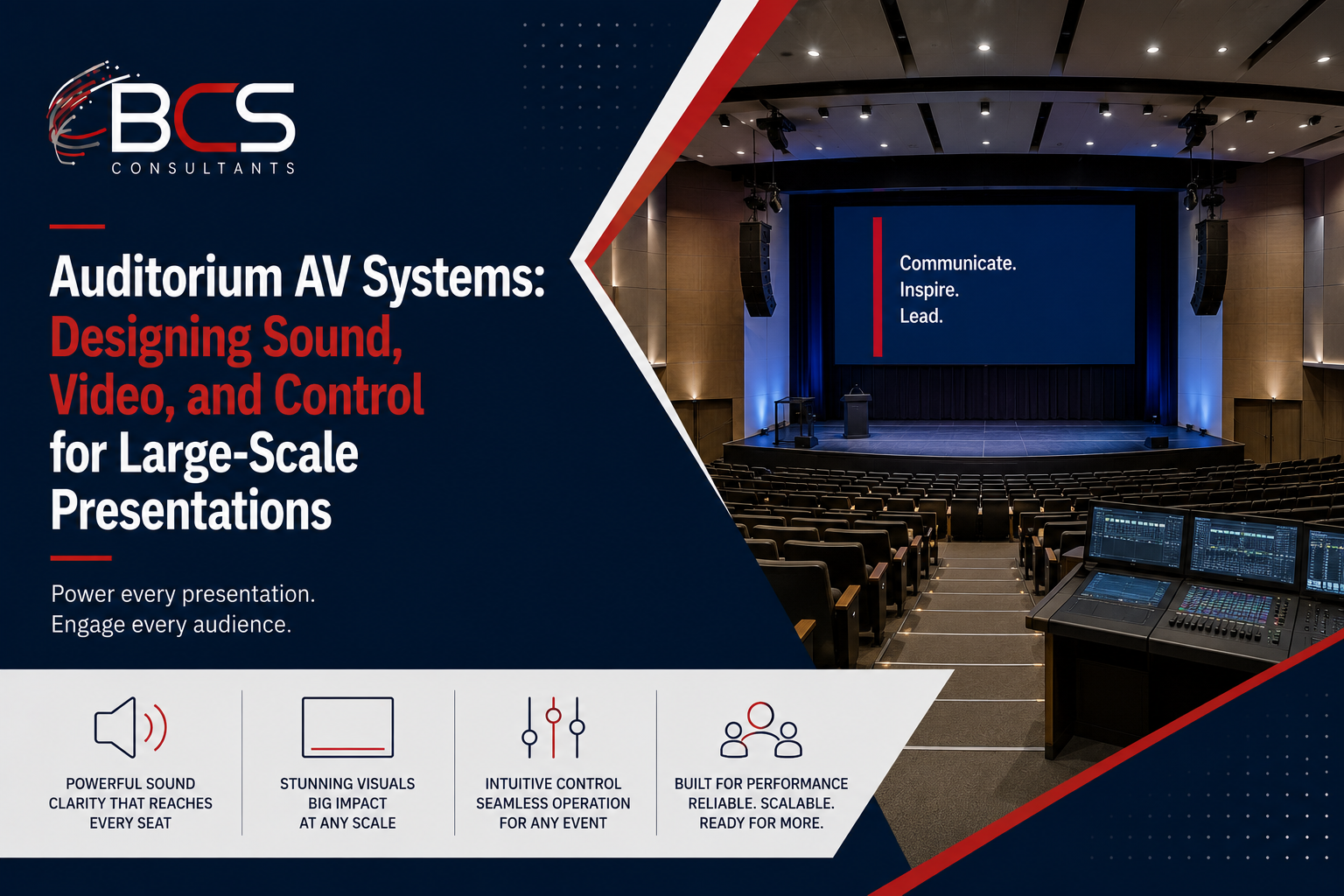
An auditorium is the highest-stakes AV environment in the commercial world. When an organization hosts an all-hands meeting for five hundred employees, a keynote presentation for a major client conference, or a commencement ceremony for an academic institution, the AV system performance is not background — it is the primary interface between the presenter and the audience. When it works, it is invisible. When it fails, it defines the event.
Auditorium AV design is correspondingly more technically demanding than conference room AV design, involving considerations — acoustic modeling, line-array speaker system design, large-format projection or LED display engineering, broadcast and streaming integration, and multi-source control system programming — that simply do not appear in smaller room applications.
This guide covers what auditorium AV systems include and what the design and installation process for a professional auditorium looks like.
Sound Reinforcement: The Foundation of Auditorium AV
Sound reinforcement — the amplification and distribution of presenter audio to the entire audience — is the most technically complex component of auditorium AV. The goal is consistent, intelligible sound at every seat in the house, without the coloration, echoing, or uneven levels that characterize a poorly designed system.
Line-Array Speaker Systems
Line-array speaker systems are the professional standard for medium to large auditoriums. A line-array is a vertical column of individually driven speaker elements that work together to project sound in a controlled, directive pattern — high-intensity coverage in the direction of the audience, with minimal sound directed at the ceiling, floor, or side walls where it would cause reflections and reverberation that degrade speech intelligibility.
The coverage pattern of a line-array system is engineered through the number, spacing, and physical alignment of the individual speaker elements. Professional acoustic modeling software calculates the required array configuration for a specific venue — length, number of elements, and deployment angle — based on the venue dimensions, seating geometry, and desired coverage pattern. BCS Consultants uses this modeling as a standard part of every auditorium audio design.
For smaller auditoriums or multi-purpose spaces, point-source speaker systems — single speakers or speaker clusters mounted at specific positions — can provide adequate coverage without the complexity and cost of a full line-array installation.
DSP Processing for Auditorium Audio
The digital signal processor is the center of the auditorium audio system. It receives all microphone and source inputs, applies equalization and delay alignment to compensate for the physical distances between speaker positions, provides the acoustic echo cancellation required for video conferencing integration, manages the loudspeaker protection and limiting functions, and routes audio to the appropriate output channels for the main house speakers, stage monitoring, broadcast feeds, and recording outputs.
For auditoriums with complex acoustic characteristics — irregular geometry, significant reverberation from hard surfaces, or multiple speaker positions that need precise delay alignment — the DSP configuration is a specialized task that requires acoustic measurement equipment and professional calibration.
Video Systems for Auditoriums
The display system in an auditorium must be visible and legible from every seat in the house — from the front row to the back of the room, and from any seating position at the sides. This typically requires either a large-format projection system, a large direct-view LED display, or multiple displays positioned for optimal sightlines from all seating areas.
Projection Systems
For auditoriums with controlled lighting and a viewing distance of more than fifteen to twenty feet from the front row, projection remains a cost-effective choice for the primary display. High-lumen laser projectors provide the brightness needed for visibility in partially lit auditoriums and have longer maintenance-free operating lives than lamp-based projectors. Acoustically treated motorized projection screens allow the screen to be retracted when not in use, maintaining the sightlines to a stage or presentation area.
For large auditoriums where a single screen cannot be seen clearly from all seating positions, dual or triple projection systems — or a main screen supplemented by confidence monitors or balcony-hung displays — extend the visual coverage to the full house.
Direct-View LED Displays
Direct-view LED displays provide higher peak brightness than projection systems and are not dependent on ambient light control for legibility. For auditoriums with windows or where full blackout is not practical, LED is often specified over projection. LED displays also eliminate the need for the screen-to-projector clear zone that projection requires.
Presenter Support Systems
A professional auditorium AV system includes presenter support elements that the audience does not see but that directly affect the quality of the presentation. Confidence monitors — displays positioned at the front of the stage facing the presenter — allow speakers to see their slides and notes without turning to look at the main screen. Presenter timer displays show remaining time. Stage monitoring speakers allow presenters to hear return audio from the system.
Wireless microphone systems from Shure — the Axient Digital platform for professional auditorium use — provide the audio quality and RF management capability needed for multi-microphone auditorium applications, supporting handheld microphones for presenters and panelists, lavalier microphones for hands-free presenter movement, and wireless earpieces for translation or stage direction.
Broadcast and Streaming Integration
Modern auditorium events increasingly need to be broadcast to remote audiences, recorded for on-demand viewing, or both. Broadcast integration requires dedicated video outputs from the presentation switcher for streaming encoders, a separate audio mix for the broadcast feed (often different from the house mix), and sufficient network infrastructure to support the streaming bandwidth requirements.
BCS Consultants designs broadcast integration as a standard component of auditorium AV systems for clients where remote broadcast is a planned use case, ensuring that the infrastructure is in place from the initial installation rather than added as an afterthought.
Control System Design for Auditoriums
Auditorium control systems are among the most complex Crestron programming projects because they must accommodate multiple operators with different technical sophistication — from the audio technician who manages a professional broadcast, to the administrator running a standard all-hands meeting without AV staff, to the department head holding a smaller event in the same space.
BCS programs auditorium control systems with user interface modes appropriate for each user type: a simplified guided interface for non-technical presenters running standard events, and a full-feature technical interface for AV staff managing complex productions. The system handles the complexity of multi-source switching, speaker volume management, and recording control, presented in the appropriate level of simplicity for each operator.
Frequently Asked Questions
How long does an auditorium AV installation take?
Auditorium AV projects typically take two to six weeks of installation time depending on the complexity of the speaker system, the display technology, and the degree of broadcast integration. Projects involving structural rigging for line-array systems or custom millwork for equipment integration may take longer and require coordination with structural engineers and general contractors.
Can an auditorium AV system support both in-person and remote hybrid events?
Yes. BCS designs auditorium AV systems with hybrid event capability as a standard option — video conferencing codec integration, dedicated broadcast outputs, and camera systems that provide the appropriate coverage for remote participants. The control system manages the hybrid workflow, routing video and audio appropriately for both the in-house audience and remote viewers.
What is the maintenance requirement for an auditorium AV system?
Auditorium AV systems should receive periodic professional maintenance — typically annually — that covers speaker system inspection and level verification, DSP calibration verification, projection lamp or LED driver status, wireless microphone battery and RF performance, and control system firmware updates. BCS Consultants provides maintenance agreements for auditorium installations.
Ready to get started? Design your auditorium AV system with BCS Consultants · bcsconsultants.com/contact/contact-us/
