
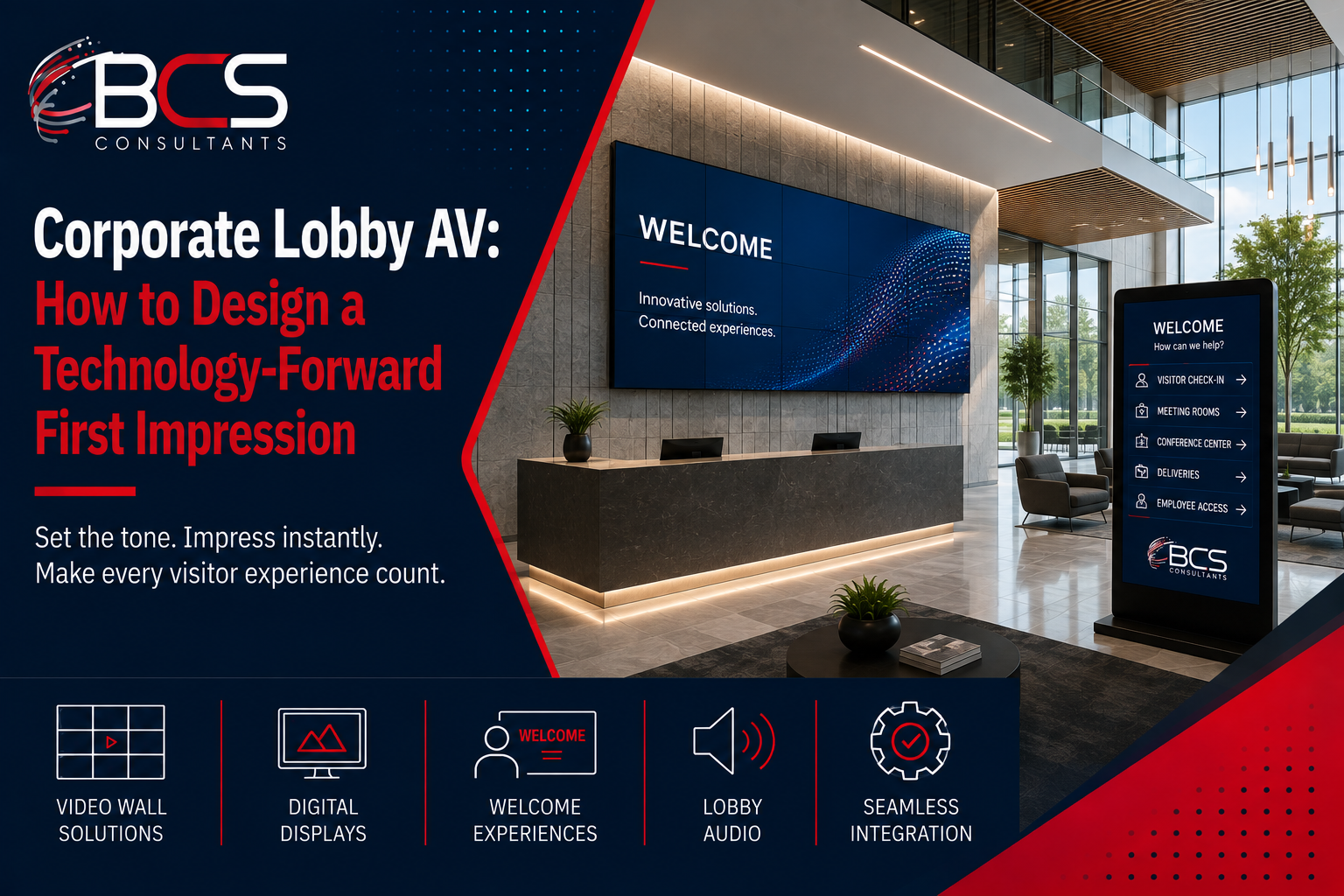
The corporate lobby is the first physical experience a visitor has of your organization — and it communicates something about your values, your sophistication, and your investment in the people who walk through your doors before a single word is spoken. A well-designed lobby AV environment does not shout technology. It works seamlessly, projects confidence, and makes visitors feel welcomed and oriented.
This guide covers what a corporate lobby AV solution actually includes, what the design decisions look like, and how BCS Consultants approaches lobby technology projects.
What Corporate Lobby AV Actually Includes
Corporate lobby AV is not a single product. It is a coordinated set of systems — display technology, content management, audio, visitor management, and often security integration — that together create the lobby environment.
The anchor element is typically a large-format display or video wall. This might be a single oversized commercial display for smaller lobbies, or a direct-view LED or LCD video wall for flagship environments where the visual statement needs to be proportionate to the space. The display runs brand content, welcome messaging, corporate announcements, or ambient visual content — managed from a cloud-based content management platform that allows the marketing team to update messaging without IT involvement.
Flanking or supplementary displays serve functional purposes: a welcome screen at the reception desk that shows visitor check-in instructions, a wayfinding display that shows floor maps and office locations for large campuses, or directional signage displays that guide visitors to specific meeting rooms or amenities.
Background audio in the lobby — a distributed ceiling speaker system running ambient music or branded audio content — contributes to the sensory environment without calling attention to itself. The speaker system is zoned separately from any conference room or meeting space adjacent to the lobby so that music does not bleed into active meetings.
Display Technology for Corporate Lobbies
The appropriate display technology depends on the scale of the lobby, the sightlines, the ambient light conditions, and the content being shown.
For standard corporate lobbies with modest ceiling heights and controlled lighting, a large-format commercial display in the eighty-six inch to one hundred inch range mounted at an appropriate height provides a clean, professional presence without the complexity and cost of a multi-panel installation. Commercial displays rated for extended operation hours are specified rather than consumer televisions.
For flagship lobbies, financial institution branch environments, or large corporate reception areas where the visual scale needs to match the architecture, a direct-view LED video wall delivers a seamless, high-brightness display surface that can be configured in any size and aspect ratio. The absence of bezels between panels makes LED video walls particularly effective for photographic and video content.
For environments with significant natural light from windows or skylights, display brightness specifications need to account for ambient light levels — displays that look excellent in a darkened room can be washed out in a bright lobby environment.
Content Management for Lobby Displays
The display is only as effective as the content being shown and the ease with which that content can be updated. Cloud-based digital signage platforms allow lobby content to be managed from any browser, with scheduled content that automatically transitions between welcome messaging, corporate announcements, and ambient brand content based on time of day or calendar events.
For organizations that host frequent client visits, visitor-specific welcome messages — a personalized screen showing a client's company name and the host's name and office location — create a memorable arrival experience. These messages can be pre-loaded by the reception team from the content management platform before the client arrives.
Content template libraries make it practical for marketing or communications teams to update lobby content without graphic design resources. A well-designed template set provides consistent brand presentation while allowing fresh messaging to be published quickly.
Visitor Check-In Integration
In organizations where visitor management is a security or compliance requirement, the lobby AV system integrates with a visitor management platform. Tablet-based or dedicated kiosk displays at the reception desk allow visitors to self-check-in, have their identification captured and verified, receive a printed or digital visitor badge, and notify their host automatically.
For high-security organizations, visitor management integration with the access control system means that visitor credentials are provisioned at check-in and automatically expire when the visit ends — all without manual configuration by security staff.
Lobby Audio Design
Background audio in a corporate lobby requires careful acoustic design. A lobby with hard surfaces — stone floors, glass walls, high ceilings — is a reverberant acoustic environment where sound reflects significantly. A distributed ceiling speaker layout designed for even sound pressure levels throughout the lobby prevents the uneven listening experience where areas directly under speakers are loud and areas between speakers are quiet.
Audio levels in a lobby should be comfortable for conversation — background music that requires visitors to raise their voice to speak with reception staff is calibrated incorrectly. A properly designed lobby audio system provides a pleasant ambient soundscape at levels that complement rather than compete with the human environment.
How BCS Designs Corporate Lobby Solutions
BCS Consultants begins every lobby project with a space assessment: measuring the lobby dimensions, evaluating the ambient light levels throughout the day, identifying structural constraints for display mounting and speaker placement, and understanding the brand and content objectives.
From the assessment we produce a system design that specifies display technology, mounting approach, content management platform, speaker layout, and any visitor management integration. We coordinate with the interior designer or architect where the lobby is under construction or renovation, ensuring that the technology integration is built into the design rather than retrofitted after construction.
Frequently Asked Questions
What is the difference between a lobby display and a standard commercial display?
Commercial lobby displays are specified for extended operating hours — often sixteen to twenty-four hours per day — and for the higher brightness levels needed in daylit lobby environments. They include management interfaces for remote monitoring and scheduled on/off that consumer displays do not provide.
Can lobby content be updated without IT involvement?
Yes. Cloud-based content management platforms are designed for non-technical users. Marketing or communications staff can update lobby content from any browser without software installation or IT support.
How is the lobby display connected to the network?
Lobby displays connect to the corporate network over a standard Ethernet connection from the nearest network switch or telecommunications room. BCS handles the full cabling scope as part of every lobby installation.
Ready to get started? Design your corporate lobby AV system with BCS Consultants
