
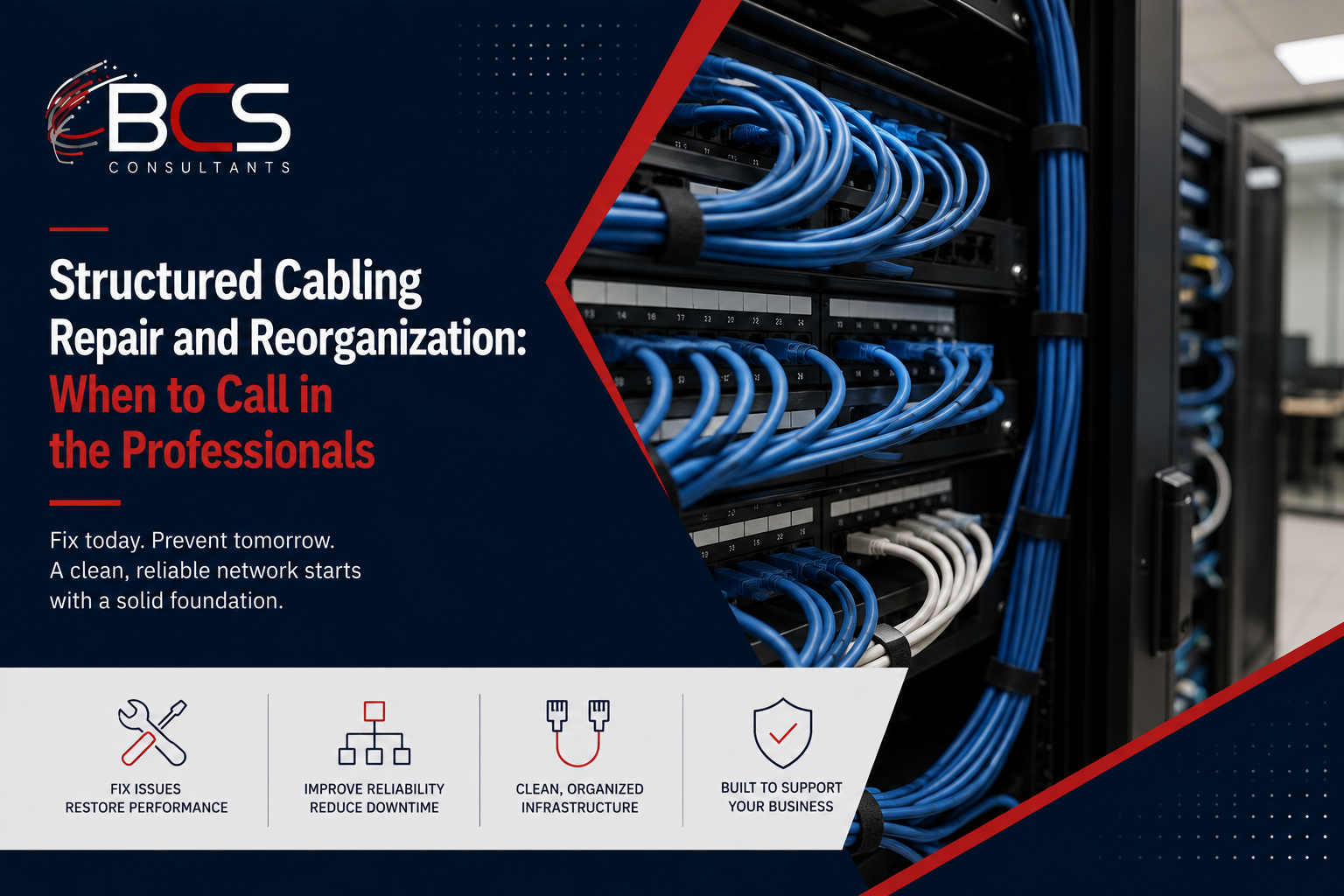
Every network has a physical layer, and when that physical layer is degraded or disorganized, the network problems it creates are indistinguishable at the software level from configuration errors, switch failures, and application problems. Network engineers spend hours investigating software and configuration when the actual cause is a cable run that has developed a marginal termination after years of vibration, a patch panel port where someone forced a cable at an angle and damaged the contacts, or a telecommunications room where years of adds and changes have created a tangled mess where individual cables can no longer be traced.
This guide explains the warning signs that structured cabling is contributing to network problems, what a professional cabling repair and reorganization project involves, and when the right answer is to call a cabling contractor rather than continuing to investigate at the software level.
Warning Signs That Cabling Is the Problem
Intermittent link failures on specific ports: When a network port works most of the time but occasionally drops and reconnects, or fails to negotiate at the expected speed, the cause is often a marginal cable performance issue — a cable that passes basic connectivity testing but fails the tighter performance requirements of Gigabit or multi-gigabit Ethernet. This is common in older Cat5e installations where the cable has developed alien crosstalk issues that affect speed negotiation without completely breaking the connection.
Speed negotiation failures: When a port consistently negotiates at 100 Mbps instead of Gigabit, or at Gigabit instead of multi-gigabit, despite the connected equipment being capable of the higher speed, the cable run is often the cause. A Fluke DSX test will typically reveal the specific performance parameter that is marginal.
Increased error rates on specific interfaces: Network switches report error counters at every port — input errors, output errors, CRC errors, and similar metrics. A port with elevated error rates compared to its neighbors, in the absence of other obvious causes, is worth investigating at the cable layer.
Ports that work with some cables but not others: If a wall plate outlet works with a three-meter patch cable but not with a five-meter patch cable, the aggregate insertion loss of the cable system — the permanent link from patch panel to outlet plus the patch cables at each end — may be marginal, passing with shorter patch cables and failing with longer ones.
Unidentified or unlabeled connections: When no one can confirm where a cable goes without tracing it physically, the telecommunications room has become a liability rather than an asset. The first step of any network troubleshooting in that environment is physically tracing cables rather than checking documentation — which means troubleshooting takes hours instead of minutes.
The Assessment Process
Before any cabling work begins, BCS Consultants conducts a systematic assessment of the existing infrastructure. The assessment has two components: documentation audit and physical testing.
The documentation audit reviews whatever cabling records exist — as-built drawings, patch panel schedules, cable test reports — and identifies the gaps. In most cases that warrant a cabling repair project, the documentation is incomplete, outdated, or nonexistent. The assessment establishes what the current state of the documentation is.
Physical testing uses a Fluke DSX cable analyzer to test every cable run that is suspected of causing problems, and in many cases every run in the telecommunications room. The test results identify which cables pass current performance standards, which cables are marginal but passing, and which cables are failing outright. Failing cables are the first priority for repair.
The assessment report provides a prioritized list of cabling issues and recommendations for repair, with a clear scope of work for the remediation project.
The Repair Process
Cable repair in a structured cabling installation most commonly involves three types of work.
Termination repair: A significant portion of cable performance issues can be resolved by re-terminating the affected end of the cable. Terminations that have been made with incorrect pair separation, with damaged contacts, or with connectors that have been compromised by repeated insertions and removals can be re-terminated to restore the cable to its full performance potential without replacing the cable itself.
Cable replacement: When a cable run has been mechanically damaged — kinked by a ceiling tile being replaced, pinched by a conduit fitting, or damaged by vermin — the affected segment must be replaced. In open-ceiling environments, cable replacement involves running a new cable and terminating both ends. In closed wall or conduit environments, replacement may require pulling the old cable out and pulling a new one through the same pathway.
Patch panel and outlet replacement: Patch panel modules and keystone jacks have finite contact cycles — they can be connected and disconnected a limited number of times before the contacts wear and performance degrades. In telecommunications rooms with very active patch management, patch panel modules may need to be replaced. Wall plate keystones at outlets with high adapter connection frequency may similarly need replacement.
The Reorganization Process
Cabling reorganization is a separate project from repair — it addresses the documentation, labeling, and cable management deficiencies rather than the electrical performance of the cables themselves.
A reorganization project begins with documentation: creating or updating the patch panel schedule to accurately reflect every connection in the room. This requires physically tracing every cable — following it from one end to the other to confirm that the documentation matches the actual installation. In complex telecommunications rooms, this is a painstaking process.
Following documentation, cable management is addressed: installing or replacing horizontal and vertical cable managers, replacing patch cables that are too long with correctly sized replacements, applying labels at both ends of every cable, and organizing cables into the managed pathways in a way that allows individual cables to be identified and removed without disturbing others.
The project concludes with updated as-built documentation — a new patch panel schedule, updated floor plan showing outlet locations, and a complete Fluke DSX test report for every cable that was repaired or replaced.
Frequently Asked Questions
How much disruption does a cabling repair and reorganization project cause to the network?
BCS Consultants plans repair and reorganization projects to minimize network disruption. Cable testing is typically non-disruptive — the Fluke DSX tester can be used on live network cables without interrupting traffic. Termination repair and cable replacement require brief outages on individual ports, typically measured in minutes. Full telecommunications room reorganization requires coordination with the IT team on a maintenance window for any work that affects active ports.
Can BCS Consultants work in a telecommunications room that has no existing documentation?
Yes, and this is the common starting condition for reorganization projects. The assessment phase creates the baseline documentation from scratch. The reorganization project then builds on that baseline to leave the room with a complete, accurate documentation package.
Is it better to repair an old cabling installation or replace it entirely?
This depends on the condition of the existing cabling and the organization's plans for network speed upgrades. If the existing cabling is Cat5e and the organization plans to deploy ten gigabit to workstations or install Wi-Fi 6E access points requiring full ten gigabit uplinks, replacement with Cat6A is likely the right investment. If the existing cabling is Cat6 in reasonable condition and ten gigabit to workstations is not a near-term requirement, targeted repair is the more cost-effective approach. BCS Consultants provides this analysis as part of the assessment.
Ready to get started? Request a cabling repair and reorganization assessment from BCS Consultants - bcsconsultants.com/contact/contact-us/
