
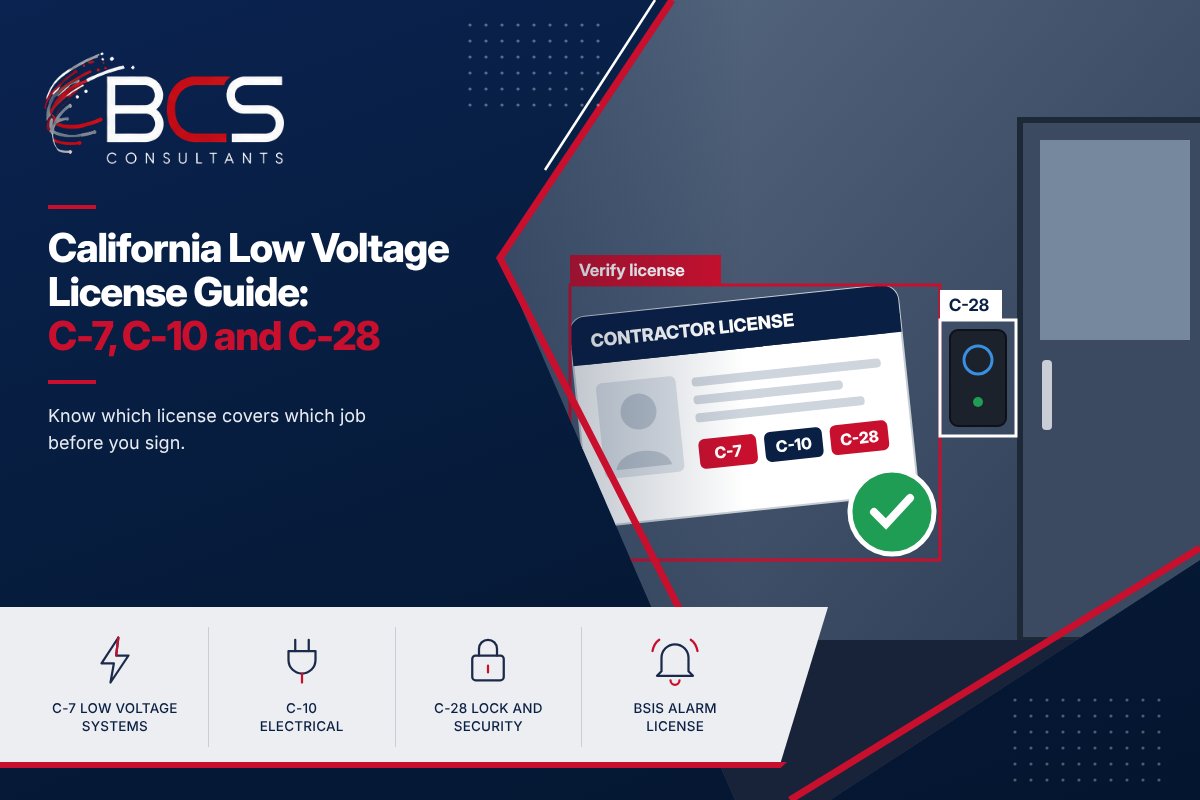
In California, the contractor who pulls your network cable, installs your access control or wires your alarm system needs the right state license for that work. Two agencies are involved: the Contractors State License Board (CSLB), which licenses construction trades, and the Bureau of Security and Investigative Services (BSIS), which licenses alarm companies. This California low voltage license guide explains which license covers which job, and how to verify a contractor before you sign.
It is written for facility managers, procurement teams and IT managers who hire low-voltage contractors. It is general information, not legal advice. For a specific project, check the current rules with CSLB or BSIS.
When a California low voltage license is required
Since January 1, 2025, a CSLB license is required when a project's combined labor and materials cost is $1,000 or more, when the work requires a building permit, or when the person doing it uses employees, even if the job costs less. This change came from Assembly Bill 2622, which raised the previous $500 limit, as described in this CSLB industry bulletin on AB 2622.
The minor-work exemption is narrow. It applies only when all of its conditions are met: the combined cost of labor, materials and all other items is under $1,000, no building permit is required, and no employees are used. It also does not apply to work that is part of a larger project, and a larger job cannot be split into contracts under $1,000 to qualify, as CSLB explains in its list of who is exempt from licensing.
Most commercial low-voltage projects, such as office cabling, security cameras or access control for a building, exceed that threshold or are part of a larger construction project. The real question is not whether a license is needed, but whether the contractor holds the right classification.
C-7 license: Low Voltage Systems
A C-7 license is the classification most people mean by a low-voltage license. The C-7 classification covers contractors who install, service and maintain communication and low-voltage systems that are energy limited and do not exceed 91 volts. CSLB's examples include telephone systems, sound systems, cable television, closed-circuit video systems, satellite dishes, instrumentation and temperature controls, and low-voltage landscape lighting (CSLB C-7 classification).
CSLB's definition also states that low-voltage fire alarm systems are specifically not included in the C-7.
In practice, the C-7 is the license most buyers expect from a contractor installing structured cabling and network infrastructure, audiovisual systems or video surveillance.
C-10 vs. C-7: when the electrical license applies
The C-10 vs. C-7 question comes up often on cabling and AV projects. The C-10 is California's Electrical Contractor classification. It covers placing, installing and connecting electrical wiring, fixtures, appliances and apparatus that generate, transmit, transform or use electrical energy (CSLB C-10 classification).
The practical difference for buyers:
- A C-7 contractor is limited to energy-limited systems of 91 volts or less.
- A C-10 contractor's classification covers electrical work broadly, which is why many electrical contractors also perform low-voltage work.
- Projects that need new power circuits, for example for a new telecom room, digital signage or door hardware, include work outside the C-7 scope. Ask who will perform that portion and under which license.
Neither classification is better in general. The right one depends on the scope of your project.
C-28 license: Lock and Security Equipment
The C-28 lock and security license is the classification most often tied to access control. The C-28 classification covers doors and door assemblies, locks and locking devices, panic and fire-rated exit devices, gate and door operators, and safes and vaults. CSLB's definition expressly includes card-activated and electronic access control systems, motion and other detectors, and computer systems for controlling and auditing those systems (CSLB C-28 classification).
Like the C-7, the C-28 definition states that fire alarm systems are specifically not included.
The C-28 matters most for access control system installation, where the job often involves door hardware, electrified locks and exit devices as well as cabling and software.
Alarm company operator license (BSIS)
Security alarm systems involve a second agency. In California, an alarm company operator is a business that sells alarm systems at the buyer's home or business, or installs, monitors, maintains, services or responds to them. That business needs an Alarm Company Operator license from BSIS, as the BSIS alarm company fact sheet explains.
Key points from BSIS and the Department of Consumer Affairs:
- Each alarm company must have a qualified manager. That person needs two years (4,000 hours) of paid alarm company experience, or the equivalent, and must pass a written exam.
- Employees who sell, install or service alarm systems for the company are registered with BSIS as alarm agents.
- Alarm company contracts must include the company's BSIS license number, according to the Department of Consumer Affairs' consumer guide to alarm companies.
The BSIS exemption for security alarm work
A security alarm company operator licensed by BSIS does not need a separate CSLB license to install, maintain, monitor, sell, alter or service alarm systems. CSLB includes these operators in its list of who is exempt from contractor licensing, based on Business and Professions Code section 7054.
The exemption has limits. It covers work on alarm systems, so other scope on the same project, such as general network cabling, electrical work or door hardware, may still require the appropriate CSLB classification. Ask how each part of the job is licensed. Our guide to intrusion alarm systems explains their main components and how they integrate with video surveillance and access control.
Security alarms vs. fire alarms
Fire alarm work follows different rules. The Alarm Company Act's definition of an alarm system excludes fire protection systems, and CSLB states that fire alarm company operators must be licensed by CSLB. The BSIS exemption therefore does not cover fire alarm installation, and both the C-7 and C-28 definitions exclude fire alarm systems.
Which license matches which low-voltage job?
- Structured cabling, network and fiber: C-7 or C-10. Check whether the scope also includes new electrical circuits.
- Audiovisual and sound systems: C-7 or C-10. Sound systems are named in the C-7 definition.
- Security cameras (CCTV): C-7 or C-10. Closed-circuit video systems are named in the C-7 definition.
- Access control and door hardware: C-28, plus the classification needed for any cabling or electrical work. Electronic access control is named in the C-28 definition.
- Security and intrusion alarm systems: a BSIS Alarm Company Operator license. A BSIS-licensed operator is exempt from CSLB licensing for the alarm work itself; other scope on the project may need a CSLB classification.
- Fire alarm systems: a CSLB license. The BSIS exemption does not apply, and the C-7 and C-28 definitions exclude fire alarm systems, so confirm the correct classification with CSLB.
Large projects often combine several of these scopes. A single integrator holding the needed classifications can reduce coordination between trades, but confirm that each license covers its part of the work.
How to verify a contractor license in California
Knowing how to verify a contractor license protects you before work starts. Verification takes a few minutes and should happen before you sign a contract.
- Ask for every license number the contractor will work under. Contractors are required by law to put their CSLB license number in all advertisements, according to the CSLB owner-builder guide.
- Check CSLB licenses with the CSLB Check a License tool. Search by license number, business name or personnel name, and confirm the business name, status and classifications.
- Check BSIS licenses with the Department of Consumer Affairs License Search. CSLB licenses are not in that system, so use both tools when a contractor works under both types of license.
- Match the names. The business on the license should be the business on your contract.
- Match the scope to the classification, using the list above.
- Keep a copy of the verification results in your project file.
If anything does not match, ask the contractor to explain before work starts.
Frequently asked questions
What license do I need for low voltage work in California?
Most low-voltage contracting requires a CSLB license. The C-7 Low Voltage Systems classification is the most common. C-10 electrical contractors may also perform this work, and access control and door hardware fall under the C-28 classification.
What is the difference between a C-7 and a C-10 license?
A C-7 covers energy-limited communication and low-voltage systems that do not exceed 91 volts. A C-10 covers electrical wiring and equipment broadly. Projects that include new power circuits need a contractor licensed for that work.
Does an access control installer need a C-28 license?
CSLB's C-28 classification expressly includes card-activated and electronic access control systems. Many access control projects also include cabling or electrical work, so ask which licenses cover each part of the job.
Do alarm installers need a BSIS license or a CSLB license?
For security alarm systems, the company needs an Alarm Company Operator license from BSIS, and its employees who do the work are registered as alarm agents. A BSIS-licensed operator does not need a separate CSLB license for the alarm work itself. Fire alarm systems are different: they require a CSLB license.
How do I check a contractor's license in California?
Use CSLB's Check a License tool for contractor licenses and the Department of Consumer Affairs License Search for BSIS alarm licenses. Confirm the business name, status and classifications.
Can an unlicensed contractor do small low-voltage jobs?
Only if every condition is met: the total cost of labor, materials and all other items is under $1,000, no permit is required, no employees are used, and the work is not part of a larger project or split from one. For commercial projects, hire a licensed contractor.
Choose a licensed low-voltage integrator
Checking a California low voltage license takes a few minutes and protects your project, your schedule and your building. BCS Consultants is an Irvine-based technology integrator that designs and installs structured cabling, audiovisual systems, video surveillance, access control and sound masking for commercial facilities. To learn more about the trade itself, read what a low voltage contractor does.
When you request proposals, including from BCS Consultants, ask for every license number and verify each one using the steps above. Contact BCS Consultants to discuss your project.
