Sound masking system cost is usually discussed per square foot, but two quotes for the same floor can still be far apart. The difference comes from the type of system, the ceiling, how finely the space is zoned, and how carefully the system is tuned after installation. This guide explains what drives the price, what manufacturers publish, and how to budget for an office, clinic or law firm.
What sound masking system cost includes
A commercial sound masking system adds a low, engineered background sound that makes nearby conversations harder to understand. It is not a white noise machine on a desk. A typical installed system includes:
- Emitters or speakers distributed across the ceiling
- Sound masking generators or controllers that produce and adjust the masking signal
- Zoning and control, so different areas can run at different levels
- Cabling from the emitters to the equipment location
- Commissioning and calibration: measuring the sound in each zone and tuning it to a target level
- Optional integration with paging, music or building systems
Labor, cabling and commissioning are part of the price, not extras. A quote that leaves them out cannot be compared with one that includes them.
Sound masking cost per square foot: what manufacturers publish
Published figures for sound masking cost per square foot are scarce. Few vendors publish prices, and the ones that do are describing their own products. The figures below are manufacturer-published estimates, not BCS Consultants pricing and not a guaranteed market price:
- AtlasIED puts sound masking at around $1 to $2 per square foot for its systems, compared with $2 to $4 for acoustic materials and $3 to $5 for cubicles or walls, according to AtlasIED's sound masking cost page.
- Soft dB says the total cost of its systems, covering components, installation, cabling, commissioning and calibration, starts at $4.00 per square foot. It also cites $50,000 to $75,000 for an average 30,000-square-foot system, according to Soft dB's sound masking ROI page.
These numbers are not directly comparable. Soft dB's 30,000-square-foot example works out to roughly $1.67 to $2.50 per square foot, below its own starting rate, and neither page is dated. What they do show is that system design and scope matter more than any headline rate.
The factors that drive office sound masking price
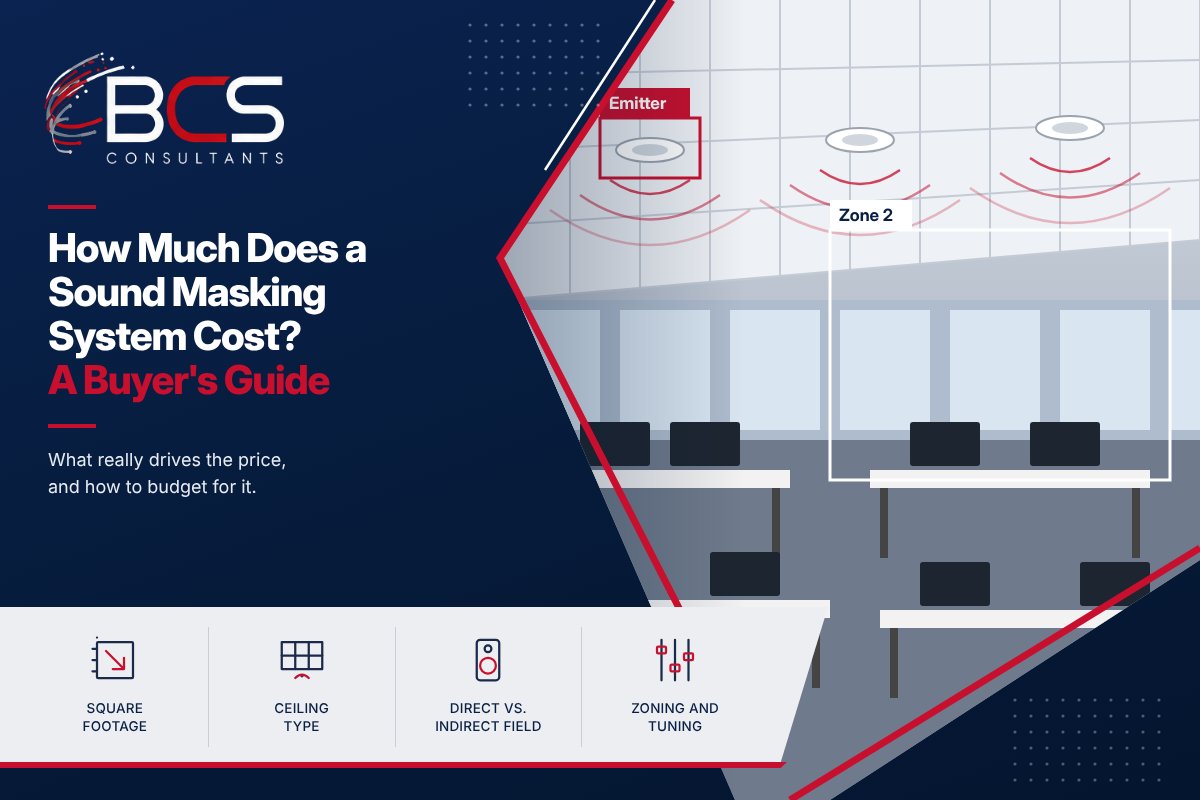
Several variables move office sound masking price up or down:
- Square footage covered. Larger areas usually lower the cost per square foot, because design, equipment and commissioning are spread across more space.
- Ceiling type. Suspended ceilings with a plenum allow either system type. Open or exposed ceilings require direct-field emitters, with mounting and cable routing that stay visible.
- System type. Direct-field and indirect-field systems use different numbers and types of emitters.
- Number of zones. More independent zones mean more control channels and more tuning time, but better results in mixed spaces.
- Private offices and conference rooms. Small rooms often need their own zones or settings.
- Building occupancy. Installing in an occupied office often means after-hours work.
- Integration. Adding paging, background music or remote management adds equipment and setup.
- Commissioning. Measuring and tuning every zone takes time, and it is what makes the system effective.
Direct field vs. indirect field cost
The direct field vs. indirect field cost comparison depends on the space, because the two main system designs price differently:
- Indirect-field systems place speakers above the ceiling tile, facing up into the plenum, so the sound reflects and spreads before it reaches the room.
- Direct-field systems use emitters that face down into the space, either through the ceiling tile or mounted in open ceilings, which gives precise control of the level in each zone.
Which one costs less depends on the space. Emitter count, mounting method, ceiling type and the number of zones decide the total, so ask bidders to propose a design and price it, rather than comparing system types in the abstract. Our article on direct-field and indirect-field sound masking equipment explains the technical differences.
Ongoing costs to include in your budget
The installed price is most of the cost, but also plan for:
- Recalibration after major layout changes, such as new walls or furniture
- Moves, adds and changes when departments shift
- Service and support, if you want remote adjustment or a maintenance agreement
- Expansion to new floors or areas later
Ask each bidder who is responsible for recalibration and what it costs.
Where sound masking pays back
Sound masking is usually chosen to solve a specific problem, and the business case follows from it:
- Open-plan offices, where nearby conversations break concentration. See our article on sound masking for open-plan offices.
- Private offices and conference rooms, where conversations carry through walls or ceilings
- Healthcare and legal settings, where speech privacy supports confidentiality
Cambridge Sound Management publishes an ROI calculator that estimates payback from headcount, salaries and square footage. Its estimates assume a 3% productivity gain, so treat the results as directional.
How to budget for a sound masking project
- Measure the area to be covered. Include work areas, offices and conference rooms. Leave out spaces that don't need masking, such as restrooms and mechanical rooms.
- Note the ceiling types in each area.
- List the rooms that need separate control, such as executive offices, HR or patient areas.
- Ask for a design-based quote, with emitter locations, zones and commissioning included.
- Compare bids on the same scope: the same coverage, the same number of zones, and commissioning and documentation included.
- Ask for the post-commissioning report, showing measured levels by zone.
Frequently asked questions
How much does sound masking cost per square foot?
Manufacturer-published figures range from about $1 to $2 per square foot (AtlasIED) to a starting point of $4.00 per square foot (Soft dB), depending on the product and what is included. These are the manufacturers' own estimates, not a guaranteed market price; a reliable price requires a design for your space.
Is direct-field or indirect-field sound masking cheaper?
It depends on the space. Ceiling type, emitter count, mounting and zoning decide the total. Open ceilings require direct-field emitters.
Does sound masking cost include installation?
It should. A complete quote includes equipment, cabling, installation, commissioning and calibration. Check that every bid includes the same items.
Are there ongoing costs after installation?
Plan for recalibration after layout changes, moves, adds and changes, and optional service agreements.
Is sound masking the same as a white noise machine?
No. A commercial system uses a tuned masking sound delivered evenly from the ceiling and calibrated to the space. A desktop white noise machine affects only the area around it.
Get a sound masking estimate for your space
The most accurate sound masking system cost comes from a design for your actual space. BCS Consultants designs and installs office sound masking systems for commercial spaces where speech privacy and concentration matter.
Compare the types of sound masking equipment BCS Consultants installs, including systems from Cambridge Sound Management, Lencore and MPS, and request a quote for your project.
