
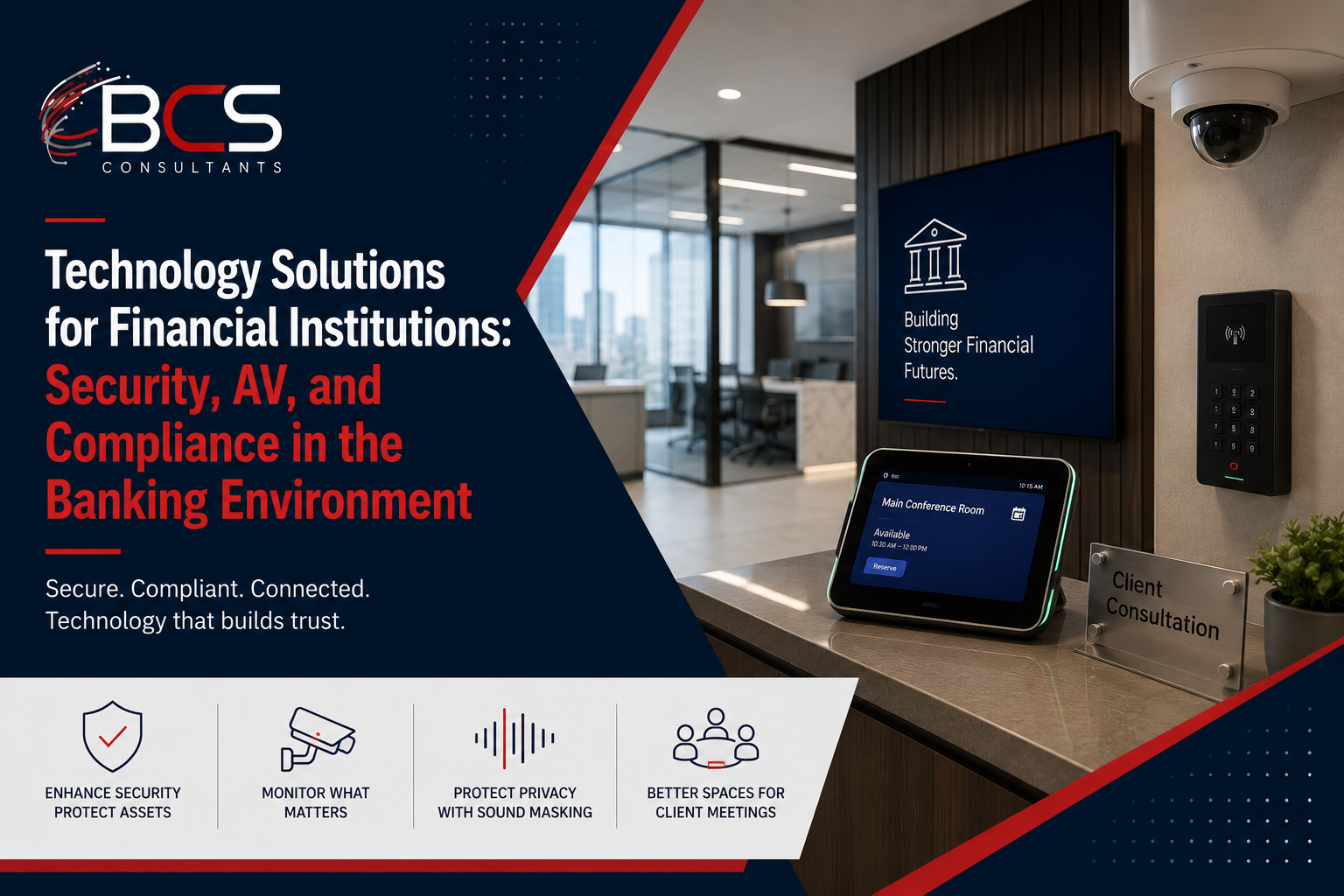
Financial institutions operate in one of the most technology-intensive commercial environments — not because finance is uniquely complicated, but because the physical spaces where financial transactions, client advisory relationships, and sensitive data management occur create a specific set of requirements that intersect security, compliance, client experience, and operational efficiency in ways that few other industries face simultaneously.
This guide covers the full technology stack that banks, credit unions, and financial advisory firms need to plan and manage — from IP surveillance in branch environments to sound masking for client privacy, to digital signage for branch communications and product promotion.
Security Systems for Financial Institution Environments
Physical security in financial institution environments is both a regulatory requirement and an operational necessity. The specific security infrastructure needs of a bank or credit union differ from a standard commercial environment in several important ways.
IP Surveillance: Coverage and Resolution Requirements
Financial institution surveillance coverage typically includes teller line cameras positioned to capture customer faces and transaction activity at each teller station, ATM cameras with the field of view and resolution required to capture license plates and facial images for investigation purposes, branch lobby and entrance coverage for general customer activity monitoring, vault and safe deposit box area coverage, back-of-house areas including cash counting rooms and document storage, and exterior perimeter coverage of the branch building and parking area.
The resolution and field of view requirements for teller and ATM cameras are typically higher than for general commercial surveillance — these cameras produce footage that may need to support forensic investigation and evidentiary use, which requires sufficient image quality for facial identification and transaction detail.
Cloud-based surveillance platforms provide financial institutions with multi-branch management from a single dashboard and the AI-powered search capabilities that make investigation efficient at scale. BCS is a certified Verkada partner and deploys cloud surveillance for financial institution clients.
Access Control: Zone Separation and Audit Trails
Financial institution access control requirements go beyond the standard commercial application. Teller line separation — preventing customer access to the teller area — is a fundamental security measure that access control supports. Vault access requires access logging that meets regulatory audit requirements. Back-of-house areas where cash handling, check processing, and sensitive document management occur require restricted access with individual credential tracking.
After-hours access — branch managers and security personnel who access the branch outside business hours — requires access control systems that log every entry and exit event with timestamp and user identity, creating the audit trail that regulators may require to be produced in a security incident or examination.
Card-based access control with individual credentials for every staff member (rather than shared codes) is the appropriate standard for financial institution environments. Cloud-based access control platforms provide instant credential revocation when an employee leaves — a critical capability in environments where staff turnover creates ongoing security management requirements.
Acoustic Privacy: Client Confidentiality Requirements
Financial institutions have acoustic privacy obligations under the Gramm-Leach-Bliley Act, which requires financial institutions to protect customers' non-public personal information. This includes protecting financial conversations from being overheard by unauthorized parties.
In branch environments where client advisory conversations occur in semi-open spaces, open-plan advisor offices, or near a branch lobby where other customers are present, sound masking provides the acoustic privacy layer that physical construction alone cannot achieve in most branch designs.
In financial advisory firms with open-plan associate areas where advisors conduct client calls, review account information at their desks, and discuss client situations with colleagues, sound masking throughout the open workspace reduces the risk of inadvertent disclosure without requiring the firm to return to a traditional private-office model.
Client-Facing AV: Advisory Offices and Conference Rooms
Financial advisory clients increasingly expect a professional AV experience when they meet with their advisors — the ability to review financial plans and portfolio analysis on a shared display, to conduct remote meetings with the same quality as in-person meetings, and to have the meeting technology be invisible rather than a source of friction.
Conference room AV for financial advisory firms and wealth management offices should include a display appropriate for sharing financial presentations and client data, a video conferencing system certified for the firm's platform (Teams, Zoom, or webex), and a one-touch meeting start experience that allows advisors to focus on the client relationship rather than technology management.
For branch environments, client-facing displays in advisor offices and waiting areas allow the institution to share product information, financial planning content, and personalized information in a format that enhances the client experience.
Digital Signage for Branch Communications and Product Promotion
Digital signage in financial institution branches serves both customer-facing and operational communication purposes. Customer-facing digital signage in branch lobbies and waiting areas can display current interest rates, product promotions, financial education content, and wait time information.
Operational digital signage in back-of-house and staff areas can communicate branch performance metrics, policy updates, compliance training reminders, and operational announcements to branch staff without requiring them to check separate communication channels.
For financial institution chains with multiple branch locations, cloud-based digital signage platforms allow content to be updated from a central marketing or communications team simultaneously across all branches — a significant operational efficiency compared to printed materials that require production, shipping, and manual placement at each location.
Frequently Asked Questions
Does BCS Consultants have experience with bank-specific security requirements?
Yes. BCS Consultants has deployed security systems for banking and financial services clients including access control, IP surveillance, and alarm systems designed to meet the specific requirements of financial institution environments, including regulatory audit trail requirements and the zone separation needs of teller and vault areas.
Can BCS Consultants manage a multi-branch financial institution technology rollout?
Yes. BCS's national rollout deployment model is well-suited to financial institution branch networks. We develop a consistent technology standard for each system type and deploy across all branches with consistent hardware specification, installation quality, and documentation.
What compliance documentation does BCS Consultants provide for financial institution installations?
BCS Consultants provides a comprehensive documentation package for every installation including system design drawings, equipment specifications, configuration records, and test reports. This documentation supports regulatory examinations and internal compliance reviews.
Ready to get started? Talk to BCS Consultants about your financial institution technology project bcsconsultants.com/contact/contact-us/
