
Sound Masking Systems for Offices: Why Open Workplaces Need Them
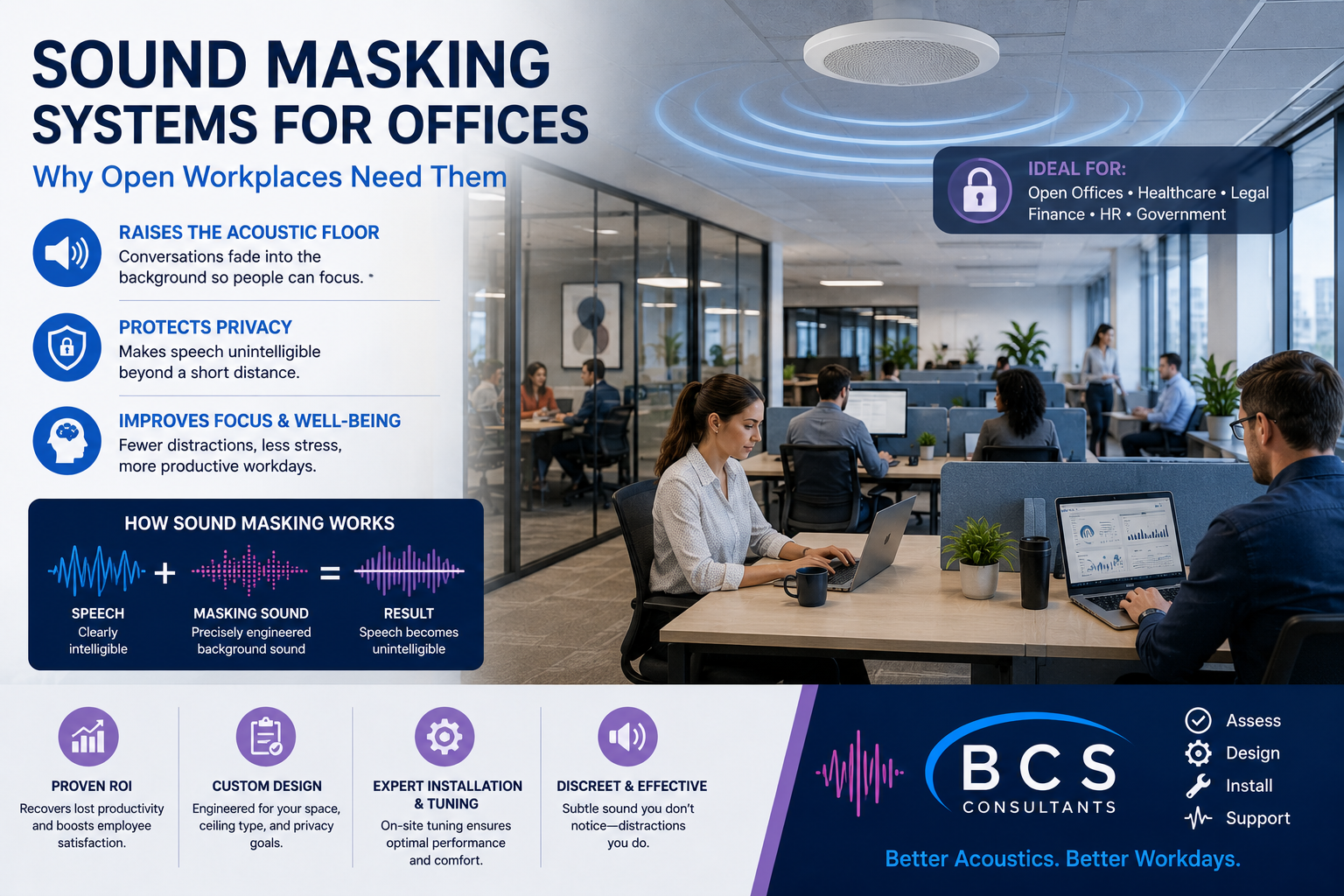
Open office layouts were supposed to make teams more collaborative. In practice, they made conversations harder to hold, focus harder to find, and confidentiality almost impossible to protect. Sound masking systems for office environments are the practical fix — quietly, intelligently raising the acoustic floor so distractions fade into the background and people can think again. This article explains how sound masking works, the science behind it, the privacy applications that matter most in regulated industries, and how BCS Consultants designs and installs sound masking for real workplaces.
Why Open Offices Hurt Concentration
Open offices spread conversations, keyboard clatter, phone calls, and footsteps across spaces that have no acoustic dampening. The result is a constant stream of intelligible speech and incidental noise — the two ingredients most likely to derail concentration. Workers report losing entire blocks of productive time to distraction, and the cognitive cost of regaining focus after each interruption compounds throughout the day.
Acoustic treatments like panels and ceiling clouds help, but they only absorb sound that already exists. They do not address the fundamental problem: human speech in the next workstation is fully intelligible from across the room. That is where sound masking changes the equation.
What Are Sound Masking Systems and How Do They Work?
Sound masking systems for office environments distribute a precisely engineered background sound through small speakers, typically installed in the ceiling. The sound is not noise in the traditional sense — it is carefully tuned to match the frequencies of human speech, raising the ambient sound level just enough to make conversations from a short distance away unintelligible.
The effect is subtle. Most people do not consciously notice the masking sound after the first few minutes — they simply find it easier to concentrate. Conversations across the room stop pulling their attention, and their own conversations feel more private.
Pink Noise vs. White Noise vs. Brown Noise
White noise contains equal energy across all frequencies. It sounds bright and harsh and is poorly suited to office environments because it draws attention rather than blending in.
Pink noise reduces energy as frequency rises, producing a softer, more natural sound. It is far more pleasant in workspaces but is still not optimized for masking speech specifically.
Brown noise rolls off the high frequencies even more, sounding deep and rumbly. Some people find it relaxing, but it is not ideal for masking the speech frequencies that cause office distraction.
Professionally engineered sound masking uses a tuned spectrum specifically designed to mask speech across the frequencies the human ear locks onto. It is more effective than any consumer noise option and far less noticeable in daily use.
Sound Masking and Workplace Privacy
Speech privacy is a regulatory requirement in many industries. Healthcare facilities operate under HIPAA rules that require reasonable safeguards for patient information — including conversations that may be overheard in hallways, intake areas, and clinical spaces. Sound masking systems for office and clinical environments are one of the most effective and most defensible tools for meeting these expectations.
Legal, financial services, and human resources environments face similar concerns. Conversations about confidential matters need to stay confidential, and the layout of modern workspaces makes that difficult without acoustic intervention. Sound masking gives those conversations a real layer of protection.
The ROI of Sound Masking for Open Offices
Industry studies consistently report that workers in open offices lose meaningful time to distraction every day, with productivity reductions that add up to a significant percentage of total work hours. Sound masking deployments have been shown to recover a substantial portion of that lost time, with employees reporting better focus, less stress, and higher satisfaction with their work environment.
Because sound masking is a relatively low-cost intervention compared to renovations or workforce changes, the productivity ROI tends to be strong — often paying back the investment within the first year or two.
How BCS Installs Sound Masking Systems
BCS Consultants designs sound masking systems for office spaces around the specifics of each environment — ceiling type, floor plan, user density, and the privacy goals that matter to the client. We work with leading systems including Biamp Cambridge and AtlasIED to spec the right hardware, then handle the installation, tuning, and validation that determine whether the system actually performs in practice.
Tuning matters enormously. A system that is not properly calibrated can be either ineffective or distracting. Our installers tune every system on-site to the building's acoustics, balancing coverage, masking effectiveness, and occupant comfort.
Restore Focus to Your Open Office
Tired of distractions in your open office? BCS Consultants designs and installs sound masking systems that restore focus and protect conversations. Get a free assessment today.
You must be logged in to post a comment.