
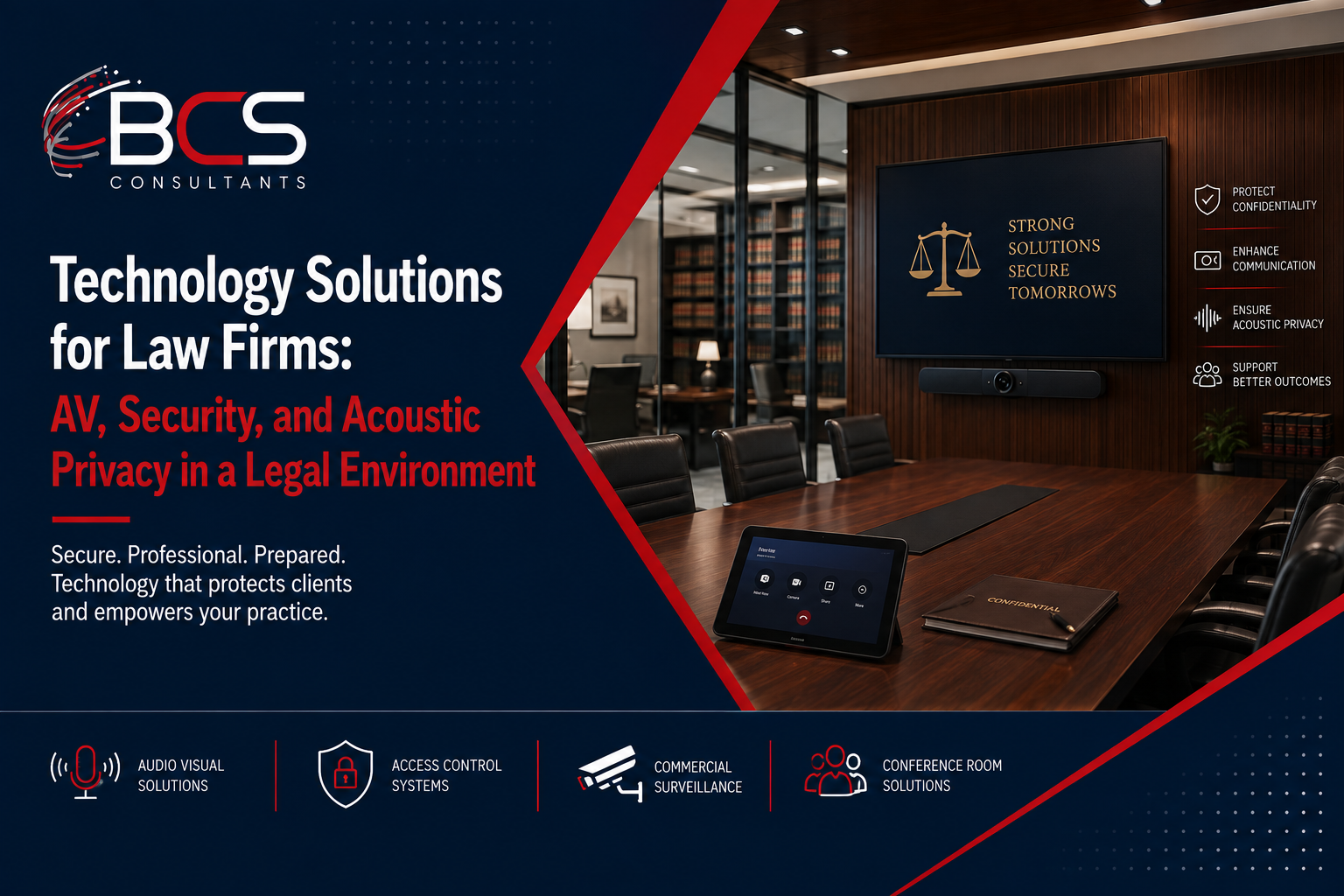
Law firms operate in a professional environment shaped by confidentiality obligations, client expectations, and the demands of contemporary legal practice — video depositions, remote client meetings, secure electronic discovery, and the management of sensitive documents across a workforce that increasingly includes distributed associates and partners working from multiple locations.
Technology in a law firm environment is not just a productivity tool. It is an operational requirement that must be implemented with the specific constraints of professional legal practice in mind — constraints that affect which systems are specified, how they are configured, and what integration exists between them.
This guide covers the complete technology stack that modern law firms need to address: from client-facing conference room AV to secure access control for sensitive floor areas to the acoustic privacy infrastructure that protects client confidentiality in open-plan work environments.
Conference Room and Deposition Room AV
Client-facing conference rooms in a law firm are among the highest-stakes AV environments in any industry. An executive at a board meeting expects excellent technology; a client who is being deposed or attending a mediation session is in an emotionally charged situation where technology that fails to perform reliably creates an impression of unprofessionalism that has real consequences.
Conference room AV for law firms should meet the same standard as for financial services firms: reliable one-touch meeting start, camera and audio quality sufficient for deposition recording and remote deposition participation, and a display configuration that allows simultaneous document review and video of remote participants.
For deposition rooms specifically, recording capability is a standard requirement — not just audio recording, but synchronized video recording of the witness that can be synchronized with the transcript for presentation at trial. This requires a camera positioned for optimal witness coverage, a recording system that produces admissible output, and a control interface simple enough for the legal team to operate reliably in a high-pressure setting.
Remote deposition participation — video links with court reporters, opposing counsel, expert witnesses, and judges — requires high-quality video conferencing with the codec certified for the platform the legal team uses. BCS Consultants designs deposition room AV that meets the technical requirements of remote participation while remaining manageable for non-technical legal professionals.
Acoustic Privacy: The Confidentiality Imperative
Attorney-client privilege is the foundation of the attorney-client relationship, and protecting confidential communications from inadvertent disclosure is a professional ethical obligation. Sound masking is the most practical acoustic solution for the specific vulnerability that open-plan law firm environments create.
In traditional law firm environments — private offices for partners and associates with a reception area — acoustic privacy was largely addressed by physical design. In the open-plan and hybrid layouts that many firms have moved to, conversations that would previously have occurred behind closed doors now happen in open work areas, glass-walled conference rooms, and at workstations where adjacent colleagues can hear.
Sound masking throughout open-plan associate areas, in corridors adjacent to conference rooms with insufficient acoustic separation, and in reception and waiting areas where clients discuss their matters with front desk staff creates a measurable, documented acoustic privacy layer that supports the firm's confidentiality obligations.
Access Control: Protecting Clients, Files, and Systems
Law firms handle documents and information that are extraordinarily sensitive — under seal, subject to legal hold, or protected by privilege — and the physical security of the spaces where that information is accessed matters.
Access control for law firm environments typically addresses: controlled access to floors housing sensitive client matters (particularly in multi-tenant buildings where other organizations share elevator lobbies), secure access to document management areas and physical file rooms, after-hours access management for attorneys and staff with legitimate access needs outside standard business hours, and visitor management for client and opposing counsel visits.
BCS Consultants designs law firm access control systems with the audit trail requirements of legal environments in mind. The access event log is a record that may need to be produced in a legal proceeding. The system must generate reliable, tamper-evident logs that document every access event at every controlled point.
IP Surveillance for Law Firm Environments
Surveillance in a law firm environment focuses primarily on common areas and access points rather than attorney work areas, where privacy considerations are paramount. Reception and lobby areas, elevator lobbies, conference room corridors, and after-hours building perimeter coverage are the typical surveillance scope.
The camera system should integrate with the access control system so that access events — including after-hours access by credentials — are associated with camera footage automatically. If a document is discovered to be missing after an after-hours entry, the access log and associated camera footage provide immediate context for the investigation.
Wireless Infrastructure for Law Firm Practice Groups
Modern legal practice depends on wireless connectivity for mobile attorneys, clients using conference rooms, and the growing number of wireless devices in a law firm environment. Network segmentation is particularly important in legal environments: client wireless access must be isolated from the firm network, attorney wireless must be isolated from client wireless, and sensitive systems — document management, practice management, billing — must be accessible only from authenticated corporate devices on the appropriate network segment.
BCS Consultants designs law firm wireless networks with the segmentation and security architecture that legal professional standards require, using enterprise wireless platforms that provide the centralized management and policy enforcement necessary for a professional services environment.
Frequently Asked Questions
Does video recording of depositions have specific technical requirements?
Yes. Deposition recording equipment must meet the standards applicable in the relevant jurisdiction for the recorded testimony to be usable in legal proceedings. BCS Consultants can advise on the technical requirements for your jurisdiction and specify recording equipment that meets those standards.
How does a law firm document its technology security measures for malpractice insurance or bar compliance purposes?
BCS Consultants provides comprehensive documentation for every installation including system design drawings, equipment specifications, configuration records, and test reports. This documentation package can be provided to insurance carriers and bar compliance reviewers as evidence of the firm's technology security measures.
Can BCS Consultants handle a law firm with multiple offices across different cities?
Yes. BCS's national rollout capability allows us to establish a consistent technology standard for a law firm and deploy it across multiple office locations, ensuring that attorney and client experience is consistent regardless of which office they are using.
Ready to get started? Talk to BCS Consultants about your law firm technology project - bcsconsultants.com/contact/contact-us/
