
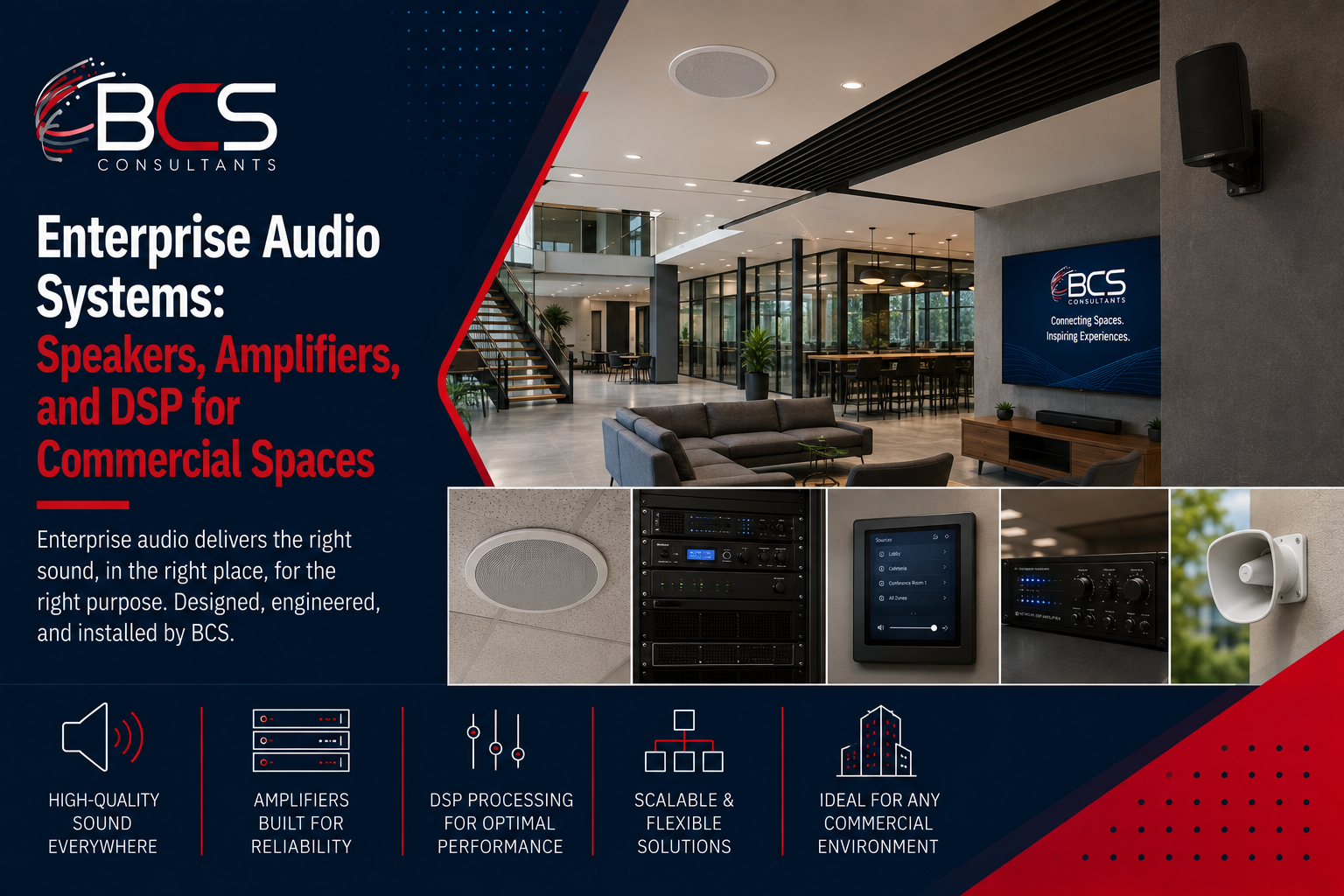
Audio is the most underspecified component of commercial AV installations — and the most immediately noticed when it is wrong. An executive meeting where the remote participants cannot hear clearly. A lobby where background music is uncomfortably loud directly under the speakers but inaudible ten feet away. A training room where the presenter's voice reinforcement echoes off hard walls and makes comprehension difficult.
These are not the result of bad hardware. They are the result of audio that was not professionally designed. This guide explains what enterprise audio systems include, how they are designed, and what professional audio equipment looks like across different commercial applications.
What Is an Enterprise Audio System?
An enterprise audio system is a professionally designed commercial audio installation that distributes sound throughout a building or space in a controlled, consistent way. Unlike a consumer audio setup — a Bluetooth speaker or a soundbar — an enterprise audio system is engineered for the specific acoustic characteristics of each space, designed with the right component types for each application, and calibrated by acoustic professionals after installation.
Enterprise audio systems serve several commercial applications: background music in lobbies and common areas, audio reinforcement in conference rooms and meeting spaces, paging and announcement systems in workplaces and facilities, sound reinforcement in training rooms and auditoriums, and acoustic masking in open-plan office environments.
The Core Components
Ceiling Speakers
Ceiling speakers are the most common distribution element in commercial audio systems. Installed flush with the ceiling surface, they provide even sound distribution throughout a space with minimal visual impact. Commercial ceiling speakers are specified by their power handling, frequency response, dispersion angle, and coverage area per speaker — all parameters that determine how many speakers are needed to achieve even coverage at the target sound pressure level for a given room.
The coverage pattern of a ceiling speaker determines how large an area a single speaker can cover at acceptable sound levels. Higher-quality commercial speakers have wider, more even dispersion patterns that allow wider speaker spacing while maintaining consistent sound levels throughout the space. Lower-quality speakers have narrower patterns that require closer spacing to achieve the same coverage.
Power Amplifiers
Power amplifiers receive the audio signal from the processor or source and deliver electrical power to drive the speakers. Commercial amplifiers for distributed audio systems are typically multi-channel designs that can independently drive multiple speaker zones at different output levels.
The amplifier must be sized correctly for the speaker load it is driving — under-powered amplifiers clip, producing distortion and potentially damaging tweeters; over-powered amplifiers with incorrect sensitivity settings waste headroom and energy. Proper amplifier sizing is part of every BCS audio system design.
Digital Signal Processors
The DSP is the brain of a professional audio system. It receives input signals from microphones, media players, codecs, and other sources; processes them (applying equalization, dynamic range compression, delay alignment, echo cancellation, and crossover filtering); and distributes them to the appropriate output channels for the connected speakers and other devices.
In conference room applications, the DSP provides acoustic echo cancellation — the signal processing that prevents the microphone from picking up the room's own loudspeaker output and creating an echo loop. Without AEC, a conference room microphone capturing the sound from the room's speakers would send that captured sound back to the far-end participants, creating a painful echo that makes the call unusable.
Biamp TesiraFORTÉ and QSC Core processors are the leading platforms for enterprise conference room and facility audio. They provide DSP capability for conference rooms of all sizes, with network-configurable routing that allows the audio system to be reconfigured for different room layouts without rewiring.
Audio for Conference Rooms
Conference room audio is the most performance-critical enterprise audio application. Participants at every position around the table must be captured clearly by the microphone system, and remote participant audio must be reproduced clearly by the room's speakers — simultaneously, without echo or feedback.
For smaller conference rooms, table microphone arrays from Shure (MXA310) and Biamp (Devio) provide zone-based pickup that captures voices across the table while rejecting ambient room noise. For larger rooms and boardrooms, ceiling microphone arrays (Shure MXA920, Biamp TesiraFORTÉ-equipped ceiling solutions) provide even pickup coverage across the entire room without any table-mounted equipment.
The speaker system in a conference room reinforces the remote participant audio so that it is heard clearly at all table positions. A small conference room may be served by a single ceiling speaker or a compact loudspeaker on the display. A larger room requires distributed ceiling speakers to ensure even coverage at the positions farthest from the display.
Audio for Lobbies and Common Areas
Background audio in lobbies, reception areas, and common spaces contributes to the sensory environment without drawing attention to itself. The design goal is even coverage at a comfortable listening level — typically ten to fifteen decibels above the ambient noise floor — throughout the entire space, without hot spots directly under speakers or dead zones between them.
Lobby audio systems typically include a distributed ceiling speaker layout, a power amplifier, a media source (streaming service, digital audio player, or audio input from a digital signage player), and a volume control zone that allows facilities staff to adjust levels without affecting other audio zones in the building.
Audio for Paging and Mass Notification
Distributed paging systems use the same speaker infrastructure as background music but add the ability to interrupt background audio with priority announcements. In commercial facilities, paging systems serve routine functions (internal announcements, customer service calls) and emergency functions (evacuation instructions, lockdown notifications, all-clear announcements).
Emergency paging requires the audio system to override all other audio sources automatically when an emergency message is triggered — including any background music that is playing. Modern paging platforms from AtlasIED and Biamp integrate paging, background music, and emergency mass notification in a single system with priority routing that ensures emergency messages always take precedence.
How BCS Designs Enterprise Audio Systems
BCS Consultants designs enterprise audio systems using acoustic modeling software that simulates sound pressure levels from proposed speaker layouts before any hardware is installed. The model accounts for the room dimensions, ceiling height, surface materials, and speaker specifications to predict coverage and identify positions where coverage may be insufficient before the installation begins.
Post-installation, BCS performs audio system commissioning: measuring actual sound pressure levels throughout the space with calibrated measurement equipment, comparing them to the design targets, and adjusting amplifier settings, speaker delays, and DSP equalization parameters until the system performs as designed.
Frequently Asked Questions
How is an enterprise audio system different from a home audio system?
Enterprise audio systems are designed for large spaces, multi-zone distribution, professional reliability, and specific applications such as conference room acoustic echo cancellation that consumer audio equipment does not address. They use commercial-grade components rated for continuous operation in a business environment.
Can the same audio system serve both background music and conference room applications?
Yes, with appropriate design. A DSP-based audio system can route different audio sources to different speaker zones — background music to the lobby, echo-cancelled conference audio to the meeting room — while maintaining separation between zones. BCS designs multi-zone audio systems for facilities where multiple audio applications need to coexist.
What is acoustic echo cancellation and why does it matter?
Acoustic echo cancellation (AEC) is signal processing that identifies the audio signal being played by the room's loudspeakers and subtracts it from the microphone signal — preventing the microphone from capturing and sending back the sound it just played. Without AEC, remote participants hear their own voice returned with a delay, making the call difficult or impossible to conduct productively.
Ready to get started? Talk to BCS Consultant about your enterprise audio project
