
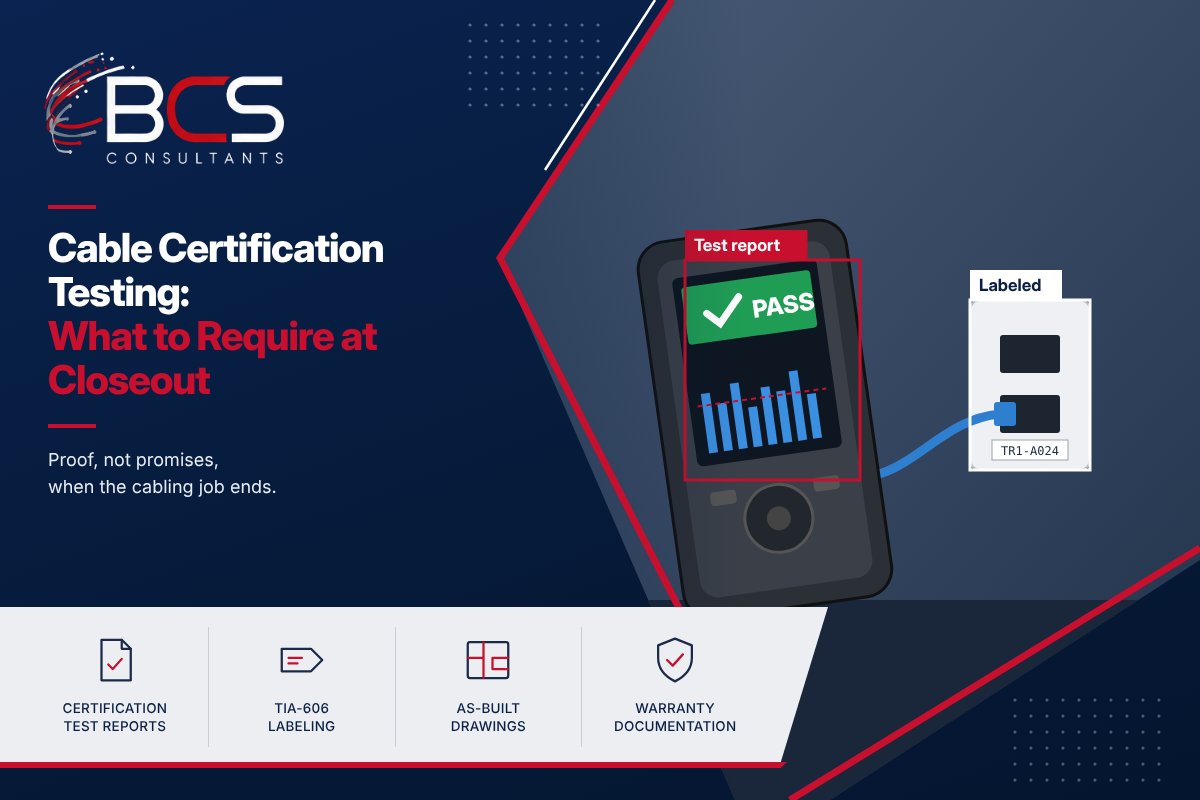
When a cabling job ends, the installer usually says everything tested fine. That statement is worth very little unless it comes with proof. Cable certification testing, clear labels and accurate as-built records are what let your IT team support the network for years, and they are what a manufacturer will ask for before honoring a warranty.
This guide explains what a complete closeout package usually contains, how to read it, and what to check before you sign off. It separates three things that are often confused: documentation that is good industry practice, requirements that apply only when your contract or specification includes them, and conditions set by a manufacturer's warranty program. It is written for IT managers, construction managers and general contractors who accept cabling work.
Verification, qualification and certification are not the same test
Installers use three kinds of test tools, and only one of them answers the question you care about at closeout:
- Verification checks that a cable is connected end to end and wired correctly. It does not prove performance.
- Qualification checks whether a link can carry a specific network application, such as Gigabit Ethernet. It does not prove the link meets its category.
- Certification measures the link against the limits of a TIA or ISO cabling standard and reports a pass or fail result. This is the test that belongs in project acceptance.
Fluke Networks explains that certification tools are the only ones that give a pass or fail result against those standards, and that a manufacturer-backed warranty requires a certification tool the manufacturer approves.
Permanent link vs. channel: which one should be tested?
For new installations, ask for permanent link testing. The permanent link is the fixed part of the cabling, from the patch panel to the work-area outlet, without patch cords. The channel adds the patch cords and equipment cords at each end.
Patch cords are often the weakest part of a channel, so a channel can pass with good cords even when the permanent link underneath it fails. Fluke Networks recommends permanent link testing for that reason. A channel result also describes only the exact patch cords used during the test. Once a cord is moved, the measurement no longer applies.
If your test reports show channel limits on a new installation, ask why.
What a cable certification report should include
A cable certification report is the tester's record of every link. Ask for the results in two formats: the tester's native file, which a future contractor can open and re-analyze, and a PDF summary. For every copper link, the report should show:
- Link identifier that matches the label on the jack and the patch panel port
- Test limit used, for example a Category 6A permanent link limit
- Overall result: pass or fail
- Margin on the key measurements, not just pass or fail
- Length of the link
- Date and time of the test
- Tester model, serial number and calibration date
- Cable type selected in the tester
For fiber links, the report should show the measured loss of each fiber against a loss budget calculated for that link.
Three things deserve a second look:
- The link count. The number of test results should match the number of installed links. Certification should cover every run, not a sample.
- Failures and retests. A failed link should appear again later with a passing result after repair. Ask what was repaired.
- Consistent test limits. One project should not mix different limits for the same cable category.
TIA-606 labeling: what good identification looks like
TIA-606 is the industry's administration standard for telecommunications infrastructure. It covers how components are identified, labeled and recorded. The standard calls for machine-generated label text, and cables are labeled at both ends so a link can be traced from either direction, according to Cabling Installation & Maintenance. Good TIA-606 labeling makes every cable traceable years after the installer leaves. These labeling guidelines are recommended practice; they become a requirement on your project when your specification adopts them.
In practice, check that:
- Every outlet, patch panel port and cable carries a unique identifier
- The identifier on the outlet matches the patch panel port and the test report
- Labels are printed, legible and durable, not handwritten
- Racks, patch panels and telecommunications rooms are labeled too
- The labeling scheme is written down, so future moves, adds and changes follow it
Labeling is where rack practices and documentation meet. Our article on server room cable management best practices covers the rack side in more detail.
Structured cabling documentation: the as-built package
As-built drawings record what was actually installed, which is rarely identical to the design. No single law defines a closeout package for private projects; what the installer must deliver is what your contract or specification requires. A complete structured cabling documentation package, as commonly recommended, includes:
- As-built floor plans showing every outlet location with its identifier, so a jack can be found without tracing cable
- Telecom room and rack elevations showing racks, patch panels, cable managers and equipment positions
- A patch panel schedule (port map) showing which panel port serves which outlet
- A backbone diagram of the fiber and copper links between rooms, floors and buildings
- Certification test reports for every link, in native and PDF formats
- The labeling scheme, so future work stays consistent
- The warranty certificate, with its coverage, term and registered owner
Ask for drawings in an editable format as well as PDF, so your team can keep them current. To see where testing and documentation fit in a project schedule, read our guide to data cabling for new office construction.
Cabling warranty: what has to be true before it is issued
A manufacturer's cabling warranty comes with conditions. Many cabling manufacturers offer extended system warranties, but they are optional programs with their own rules, not automatic or universal obligations. Programs typically require that the system is installed by a contractor certified with that manufacturer, using that manufacturer's components, and that certified test results are submitted for the installed links. Fluke Networks also notes that permanent link measurements are a requirement for cabling warranty applications.
Before work starts, ask:
- Which manufacturer's warranty applies, and what it covers
- Whether the installer is certified in that manufacturer's program
- Who submits the test results and registers the warranty
- When you will receive the warranty certificate, and in whose name
Terms vary by manufacturer and program, so get the specific conditions in writing for your project.
Closeout acceptance checklist
Use these steps before you sign off on a cabling installation:
- Count the links. Compare the number of test results with the drop count in the contract.
- Open the native test files, not just the PDF summary. Confirm the test limit and that every link passed.
- Spot-check labels. Pick ten outlets across the floor plan and trace each one to its patch panel port and test result.
- Walk the telecommunications rooms. Check cable management, bend radius, labeling, grounding and the condition of the racks.
- Check firestopping where cables pass through fire-rated walls and floors.
- Compare the as-builts with what you see on site.
- Confirm the warranty has been registered, or get a date for the certificate.
- Hold a handover meeting so your IT team knows where everything is and how it is labeled.
If your contract allows it, tie final payment or retention to delivery of the complete package. Documentation is much harder to get after the crew has moved on.
Put closeout requirements in the contract
The recommendations above become enforceable only when they are written into your contract or project specification. The easiest closeout is one defined before installation starts, so consider adding requirements like these to your scope of work:
- Certification of 100% of installed permanent links to the specified category with a calibrated tester, with native test files and PDF reports delivered
- Labeling of all components according to an owner-approved scheme based on TIA-606
- As-built floor plans, rack elevations and a patch panel schedule in editable and PDF formats
- Registration of the manufacturer's system warranty, with the certificate delivered before final payment
For the standards behind these requirements, see structured cabling standards explained.
Frequently asked questions
What is cable certification testing?
It is a test that measures each installed link against the performance limits of a cabling standard, such as a TIA category, and reports a pass or fail result. It is the only test type that proves the cabling meets the category you paid for.
Should every cable be certified, or just a sample?
Certifying every installed link is the recommended practice, and you can make it a contract requirement. A sample cannot show whether the untested links pass, and manufacturer warranty programs typically require test results for the installed links.
What is the difference between a permanent link test and a channel test?
A permanent link test covers the fixed cabling from patch panel to outlet. A channel test also includes the patch cords. New installations should be certified to permanent link limits, because a channel can pass even when the fixed cabling has a problem.
What are as-built drawings?
As-built drawings show what was actually installed, including outlet locations and identifiers, rack layouts and cable routes. They often differ from the design drawings because of changes made during installation.
Who registers the cabling warranty?
Usually the installing contractor, if it is certified in the manufacturer's program. Because warranty programs differ, confirm in the contract who registers the warranty and when you will receive the certificate.
Work with a team that documents every link
A cabling system is only as supportable as its records. BCS Consultants, whose team includes RCDD engineers and technicians, designs and installs commercial structured cabling systems for offices and other facilities. If you have inherited cabling with no labels or records, our cable repair and reorganization services can help bring it back to order.
Talk to BCS Consultants about your next cabling project and the closeout documentation you should expect.
