
Two cabling bids for the same office can be far apart, and the cheaper one is not always the better deal. Structured cabling cost is usually quoted per drop, but the per-drop number only means something when you know what is inside it. This guide explains how commercial cabling quotes are built, which site conditions move the price, and how to compare bids line by line before you sign.
It is written for facility managers, IT managers and project managers planning a build-out, an office move or an infrastructure upgrade.
What a "drop" includes in a structured cabling quote
A drop is one cable run from the telecommunications room to a work-area outlet. In a well-written quote, the per-drop price covers the complete permanent link:
- The horizontal cable, routed through ceilings, walls or raceway
- The jack and faceplate at the work area
- The termination on the patch panel in the telecommunications room
- Labeling at both ends
- Certification testing of the finished link
Industry standards cap that fixed portion of the link at 90 meters, as Fluke Networks explains in its guide to channel and permanent link testing. Runs that would exceed it need a closer telecommunications room or a different design, and that changes the price.
Some contractors quote a lower per-drop number by leaving testing, labeling or patch panels out of it and pricing them elsewhere, or not at all. That is the first thing to check when two bids look far apart.
The cost drivers that move the price per drop
Office cabling cost is mostly labor. Material differences between cable categories matter, but the building usually matters more.
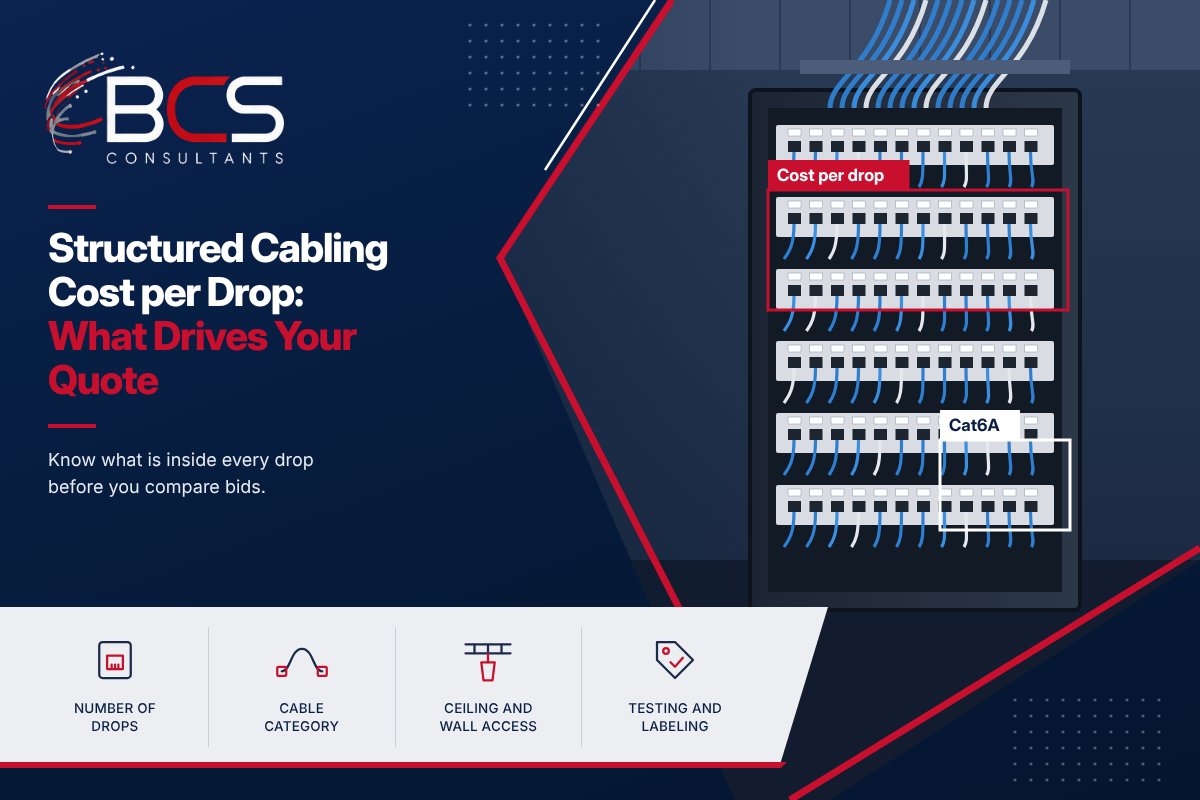
- Number of drops. Larger projects spread mobilization, setup and project management across more runs, so the cost per drop often falls as volume rises.
- Cable category. Cat6A cable is larger and stiffer than Cat6. It takes more pathway space and more care to route and terminate.
- Ceiling and wall access. Open ceilings and new construction are faster. Hard-lid ceilings, finished walls and occupied floors are slower.
- Plenum spaces. When cable runs through a ceiling space used for air handling, the electrical and building codes adopted by the local jurisdiction generally require plenum-rated cable or another approved method, such as enclosing the cable in conduit. Plenum-rated cable costs more than non-plenum cable, so confirm with your contractor which spaces on your project are treated as plenums.
- Pathways. Existing cable tray and J-hooks save time. New conduit, core drilling and firestopping add cost.
- Distance to the telecom room. Longer average runs use more cable and may require an additional telecom room.
- Work hours. After-hours, weekend or phased work in an occupied building adds labor cost.
- Project requirements. Public projects that require prevailing wages, union labor or extended manufacturer warranties change the labor and material basis.
- Removal of old cable. Removing abandoned cable adds labor, but it frees pathway space and is often required during renovations.
Cat6 installation cost vs. Cat6A
For most offices, Cat6 installation cost is the baseline. Cat6 is still common for general office drops. Cat6A is often specified for wireless access points and higher-bandwidth links because it supports 10 Gb/s over the full channel length. The price difference per drop comes less from the cable than from the extra time and pathway space Cat6A needs.
If you are weighing copper against fiber for backbone or high-bandwidth runs, see our comparison of fiber optic vs. copper cabling for business.
New construction vs. retrofit
Timing changes cost more than most buyers expect. In new construction, cabling goes in while ceilings and walls are open. In a retrofit, installers work around finished surfaces, furniture and people. Our guide to data cabling for new office construction explains when to bring the cabling contractor in so you avoid surface raceway and change orders.
Why published per-drop prices rarely match your quote
Online price ranges for cabling are averages across very different buildings, regions and scopes. They rarely state whether testing, labeling, patch panels or firestopping are included. Use them only as a rough reference, and expect a real price only after a contractor has walked the space and reviewed your floor plans.
Network cabling installation cost: line items beyond the drops
Per-drop pricing covers the horizontal links. A complete network cabling installation cost also includes items that are often quoted separately:
- Telecommunications room equipment: racks or cabinets, patch panels, cable managers, grounding and bonding
- Backbone cabling: fiber or copper between telecom rooms, floors or buildings
- Pathways: cable tray, J-hooks, conduit, sleeves and firestopping
- Wireless access point drops: often specified as Cat6A, sometimes two cables per location
- Design and documentation: drawings, a labeling scheme and as-built records
- Permits and inspections, where the jurisdiction requires them
- Patch cords: sometimes included, sometimes left to the owner
Ask each bidder to list these items separately. It is the fastest way to see whether the bids cover the same scope.
What a low bid usually leaves out
A bid that is far below the others is usually missing scope, not finding efficiency. Look for these gaps:
- No certification testing, or "testing" that only checks continuity. A continuity check does not prove the link meets its category.
- No labeling standard or no as-built documentation.
- Patch panels, racks or cable managers excluded without saying so.
- No firestopping where cables pass through fire-rated walls.
- Assumed open ceilings in a building that has hard-lid areas.
- No manufacturer warranty registration, which normally depends on certified test results.
Any of these can turn into change orders after the contract is signed, or into network problems after move-in.
How to compare office cabling cost quotes
Use the same checklist for every bid:
- Same drop count, outlet locations and cable category
- The per-drop price states what it includes: jack, faceplate, patch panel port, label and test
- Certification testing of every link, with reports delivered at closeout
- A named labeling scheme, with as-built drawings included
- Backbone, racks, pathways and firestopping listed as separate lines
- Work hours and phasing assumptions written down
- Warranty terms, and who registers the warranty
- Exclusions listed clearly
If a bidder cannot answer these questions in writing, the low price is not yet a real price.
Ways to reduce structured cabling cost without cutting quality
- Bring the cabling contractor in early. Coordinating pathways during design is cheaper than adding raceway later.
- Right-size the drop count. Plan drops around furniture plans and wireless coverage instead of a fixed number per desk.
- Reuse good pathways. Existing cable tray in good condition saves labor.
- Schedule work in open-ceiling phases when possible, before ceiling tiles and furniture go in.
- Remove abandoned cable during the same project, while ceilings are already open.
Cutting testing, labeling or documentation is not a real saving. Those items cost little compared with the time it takes to troubleshoot an undocumented network later. If your current cabling already shows problems, see 10 issues that point to an urgent cabling infrastructure upgrade.
Frequently asked questions
How is structured cabling priced?
Most commercial cabling is priced per drop, which covers one cable run from the telecom room to an outlet, including termination, labeling and testing. Racks, backbone cabling, pathways and firestopping are usually priced as separate line items.
Why does Cat6A cost more to install than Cat6?
Cat6A cable is larger and stiffer, so it takes more pathway space and more time to route and terminate. The labor difference usually matters more than the material difference.
What makes one cabling quote much cheaper than another?
Usually missing scope: no certification testing, no labeling or as-built documentation, excluded patch panels or firestopping, or optimistic assumptions about ceiling access. Ask each bidder to list inclusions and exclusions in writing.
Does structured cabling cost more in an occupied office?
Usually yes. Working around finished ceilings, furniture and employees, often after hours, takes more labor than installing during new construction.
Do I need a site survey for an accurate cabling estimate?
Yes. Ceiling type, pathways, distance to the telecom room and building rules all change labor time, and they can only be confirmed on site.
Get an accurate structured cabling estimate
The most reliable structured cabling cost is the one built from your floor plans and a walk of the space. BCS Consultants, founded in 2001 and headquartered in Irvine, California, designs and installs commercial structured cabling systems for offices and other facilities, locally and nationwide.
Contact BCS Consultants to request a site survey and an itemized cabling estimate for your project.
